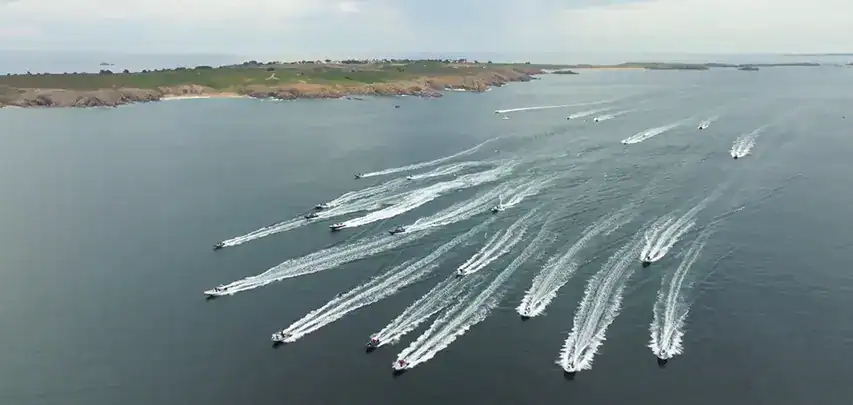
It is not my habit to post low-resolution videos. This one is 480p instead of 1080p or 2160p.
I make an exception here because pure RIB races of that size seem almost extinct today.
The video has neither subtitles nor transcript. With AI, however, I was able to create the following text.
If you want to know how I did it, I have described the process below.
The Race Comments
The fourth race by O.F.S.E. of the Greek Offshore Championship took place on 17 September 2006 in Athens. It was organized by the Hellenic RIB Club: O.F.S.E. (Hellenic Inflatable Boats Association, website).
A total of 49 boats participated, setting a new record since the competition began in 1994.
Here are the main differences between gasoline and diesel boat engines a.o. the performance.
Gasoline engines prioritize speed and acceleration. They use spark ignition to deliver quick, high-RPM performance. This is ideal for lightweight recreational boats and fast weekend cruising.
Diesel engines focus on torque and efficiency. They rely on compression ignition to generate powerful low-end thrust. This makes them especially suited for heavy-duty, commercial, or military applications. The torque is the key performance.
Gas engines are lighter and rev higher. They are perfect for planing hulls that skim water. Diesel engines are heavier. They typically stay in displacement mode.
Diesel outboards are stronger internally. They have reinforced pistons and cylinder walls to handle extreme pressure. This adds durability but also significant weight and cost that impact performance.
Torque output is much higher in diesel. Models like the Cox CXO300 produce 650Nm at low RPM. This is ideal for pushing heavy hulls through waves and rough water.
Gasoline outboards excel in recreational use. They stay light on the transom for better balance. This makes trailering easier and improves responsive handling, especially in boats under 25 feet.
Diesel’s weight creates issues on small boats. It affects trim, stability, and safety. Often, it requires upgraded trailers, lifting gear, and reinforced hull structures.
Maintenance and ownership differ greatly. Gas engines are simpler and cheaper to service. Diesel engines require specialized tools and training. They also need more expensive repairs.
Diesel engines cost significantly more. Units like the Cox CXO300 are often priced $20,000 higher than comparable gas models for the same horsepower rating (according to this video).
Fuel economy favors diesel. It burns 20–30% less fuel per hour and lasts longer under constant use. However, savings take decades for casual boaters to realize.
Gasoline won early due to accessibility. It dominated marinas, supply chains, and consumer familiarity. This happened long before diesel outboards became small enough to compete.
Diesel thrives in fleet operations. Uptime, long service intervals, and shared fuel logistics make it perfect for patrol boats. It is also ideal for offshore vessels and military craft.
Gasoline leads innovation today. Four-stroke engines are gaining cleaner emissions, digital controls, and smart integration. Diesel progresses more slowly due to niche demand.
Performance
There you have it. When it comes to performance and choosing the ‘better’ engine, it all depends on your intended use.
Electric Outboards
They’re not taking the market by storm.
Even though electric outboards offer quiet, “clean” operation they struggle with limited range, high battery costs, and slow charging.
These drawbacks, combined with current performance gaps, prevent them from dominating the boating market—especially for larger vessels.
The British Inflatable Boat Owners Association (BIBOA) is/was(?) the UK RIB club for those who like to cruise and socialise in Rigid Inflatable Boats (RIBs).
The Association was formed in 1990 following the first Round Scotland cruise/race. It is recognised by both the RYA and the UIM as the UK National Authority for Rigid Inflatable Boats (RIBs).
This video shows many fantastic looking RIBs. It really is a must see RIB video. The race was called “Highlands and Islands RIB Race” held from 10 to 16 June 1990.
I improved the video image quality and upscaled it to 4K.
Change the settings in the YouTube video to 4K to enjoy it to the fullest. First, click on settings. Then select quality. Finally, choose 2160p.
To provide the best experiences, we use technologies like cookies to store and/or access device information. Consenting to these technologies will allow us to process data such as browsing behavior or unique IDs on this site. Not consenting or withdrawing consent, may adversely affect certain features and functions.
Functional
Always active
The technical storage or access is strictly necessary for the legitimate purpose of enabling the use of a specific service explicitly requested by the subscriber or user, or for the sole purpose of carrying out the transmission of a communication over an electronic communications network.
Preferences
The technical storage or access is necessary for the legitimate purpose of storing preferences that are not requested by the subscriber or user.
Statistics
The technical storage or access that is used exclusively for statistical purposes.The technical storage or access that is used exclusively for anonymous statistical purposes. Without a subpoena, voluntary compliance on the part of your Internet Service Provider, or additional records from a third party, information stored or retrieved for this purpose alone cannot usually be used to identify you.
Marketing
The technical storage or access is required to create user profiles to send advertising, or to track the user on a website or across several websites for similar marketing purposes.