The Complete Checklist for Safe Rib Ownership and Operation
Safety equipment on a RIB is often treated as an afterthought, bought once and rarely reviewed again. Yet the right equipment, properly maintained and actually accessible, is what turns an emergency into a manageable situation.
This guide covers what’s legally required, what’s strongly recommended, and how conditions and location change the answer.
Legally Required vs Recommended Equipment
Legal minimums depend on your country, your boat’s CE category, and how far offshore you plan to go.
Coastal and inland requirements are typically lighter than offshore requirements, which assume longer response times if something goes wrong.
Treat legal minimums as a floor, not a target. Most experienced RIB owners carry more than the law demands.
Always check your national maritime authority’s current requirements, since these are periodically updated and vary by jurisdiction.
Personal Safety Equipment
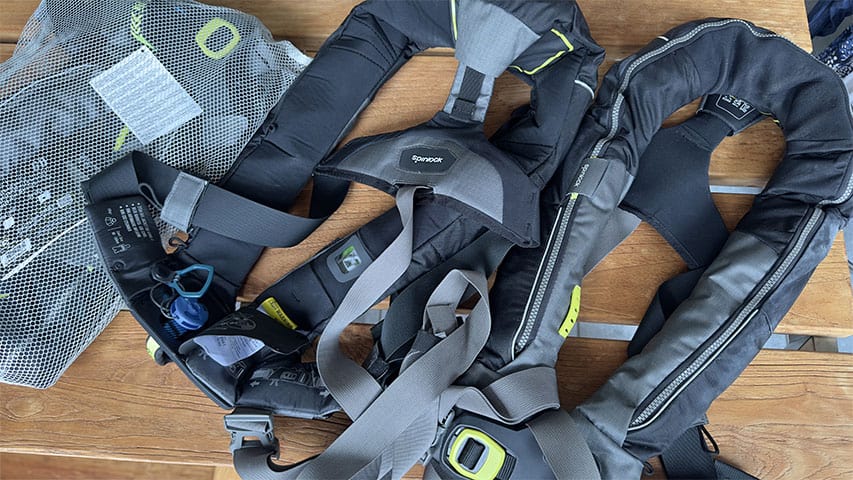
A properly fitted lifejacket for every person aboard is the single most important item on any boat.
Automatic inflation lifejackets are preferred for RIB use, since they work even if the wearer is unconscious.
A kill cord (engine cut-off lanyard) must be worn by the helmsman at all times while underway. This single piece of equipment prevents runaway boat scenarios, one of the most dangerous incidents in small-boat boating.
Consider a spare kill cord stored onboard, since a lost or damaged cord otherwise ends the trip.
Onboard Safety Equipment
A fire extinguisher rated for marine use should be mounted within easy reach of the helm position.
A manual bilge pump or bailer provides backup if the electric bilge pump fails or loses power.
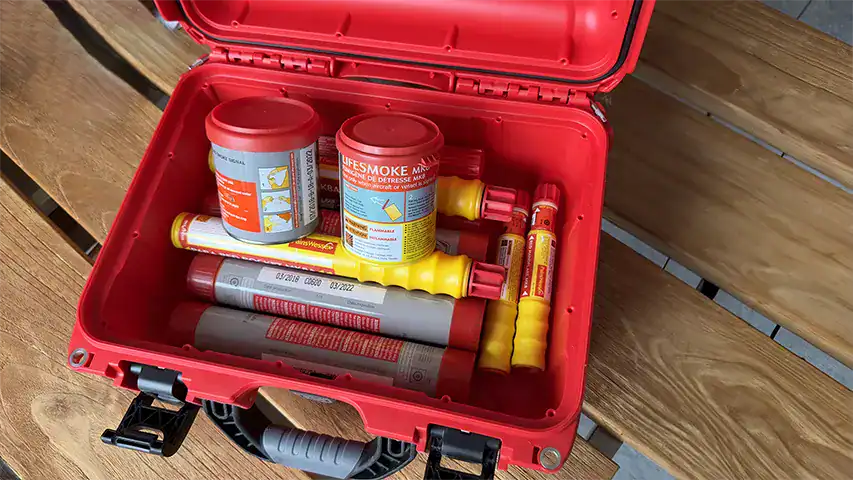
Visual distress signals (flares or an electronic equivalent) alert nearby vessels and rescue services in an emergency.
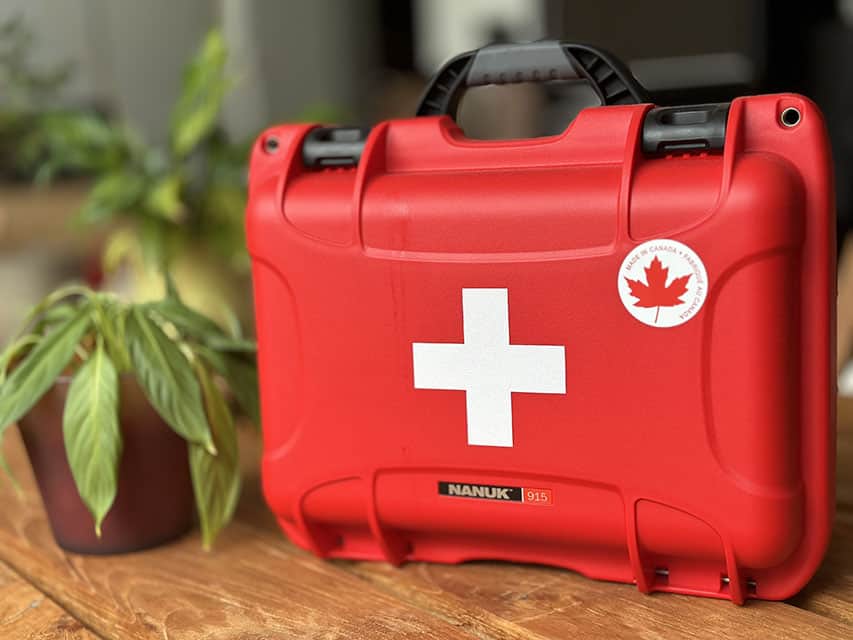
A well-stocked first aid kit, checked and restocked regularly, belongs on every RIB regardless of trip length.
An anchor with adequate rode allows you to hold position if the engine fails near a hazard.
Navigation and Communication Equipment
A VHF radio, ideally fixed-mount with DSC capability, is the primary means of calling for help at sea.
Mobile phones are not a reliable backup; coverage disappears quickly once you’re a few miles offshore.
A GPS chartplotter or a reliable backup app helps you navigate and share your exact position if needed. Be sure to have all paper charts of your navigation area on board as well.
A magnetic compass provides a low-tech backup that works even if all electronics fail simultaneously.
An EPIRB or Personal Locator Beacon is strongly recommended for any offshore or remote-water operation.
Equipment for Specific Conditions
Offshore trips warrant additional equipment: life raft, more extensive flares, and more robust communication redundancy.
Cold-water operation calls for thermal protection, since immersion in cold water incapacitates swimmers within minutes.
Night operation requires functioning navigation lights and a reliable torch or headlamp for every crew member.
Our guide Best RIB for Rough Water: What Really Matters? covers how conditions should shape your equipment choices too.
How Often to Check and Replace Safety Equipment
Flares have expiry dates and must be replaced before they lapse, typically every three to four years.
Fire extinguishers need periodic pressure checks and eventual replacement, even if never used.
Lifejackets, especially automatic-inflation types, need annual servicing to confirm the inflation mechanism still functions correctly.
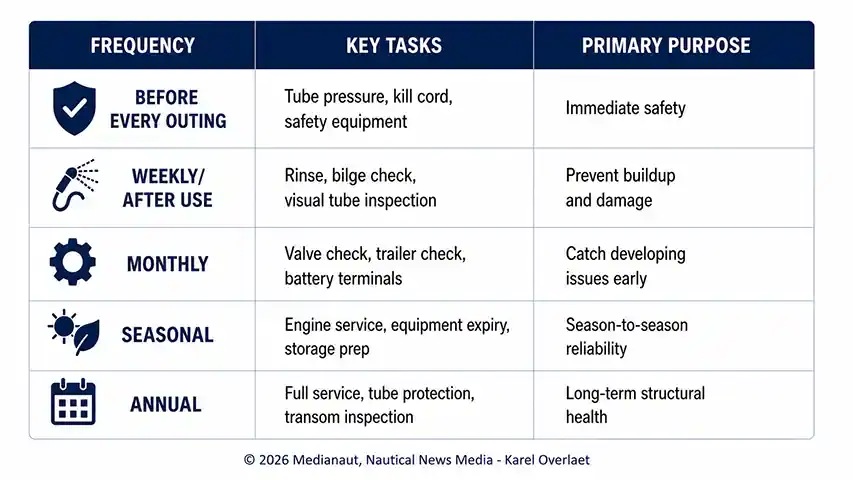
Build a simple annual safety audit into your maintenance routine, ideally at the start of each season.

Building Your Own Checklist
Start with your jurisdiction’s legal minimum, then add equipment based on where and how far you actually boat.
A boat used only on sheltered inland water needs less than one regularly running five miles offshore.
Re-evaluate your equipment list whenever your typical trip profile changes, not just when you buy the boat.
Our RIB Buying Guide covers how intended use should influence equipment planning from the moment of purchase.
Frequently Asked Questions
Is a life raft necessary on a RIB?
For coastal and inland use, generally no. For offshore passages beyond quick rescue range, a life raft is strongly recommended.
How often should I replace flares?
Most flares expire after three to four years. Check the printed date and replace before it lapses, not after.
Do I need a VHF radio if I have a mobile phone?
Yes. Mobile coverage is unreliable offshore, and VHF DSC allows rescue services to locate you precisely and quickly.
What’s the most commonly missing safety item on RIBs?
A properly worn kill cord and an in-date fire extinguisher are the two items most often overlooked or neglected.
Related reading: What Is a Rigid Inflatable Boat? · Are Rigid Inflatable Boats Safe? · Can a RIB Sink? · How to Drive a RIB in Rough Water · Best RIB for Rough Water: What Really Matters?