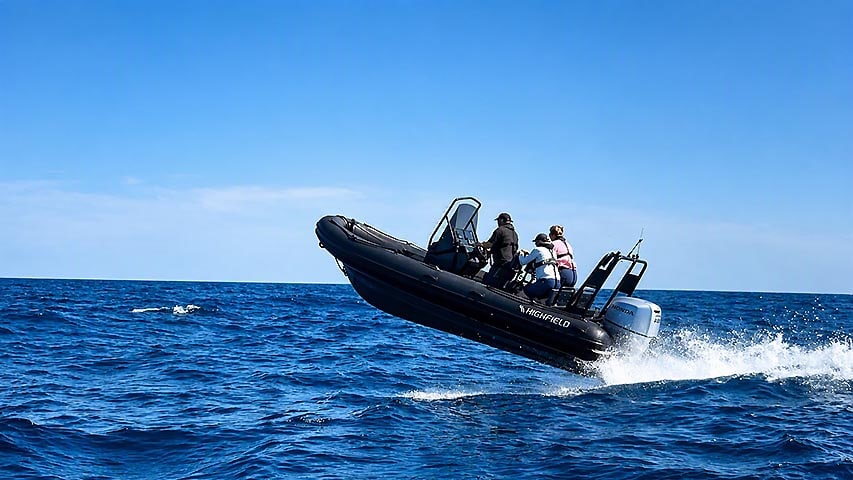
Training awareness and anticipation in challenging sea states
What happens to our ability to observe, decide, and act when conditions at sea become more demanding?
Philippe spent a day training in rough seas with a friend, focusing on how to adapt when the environment increases the pressure. The aim was not to seek excitement, but to use real-world conditions as a practical learning environment.
Throughout the day, the focus was on reading the sea state, anticipating what might happen next, maintaining situational awareness, and making sound decisions as conditions changed.
The objective was simple: gradually learn to remain alert, observe, decide, and act, while continuing to use existing skills effectively when the maritime environment becomes more challenging.
I truly value Olivier’s training, which is why you’ll find an extended collection of videos on RIBsONLY.com, focused on mastering navigatiion in agitated and rough seas.
What Does “Friends of RIBsONLY.com” Actually Mean?
Rigid Inflatable Boats have something special about them. They combine a rigid hull with inflatable tubes, creating a boat that is stable, practical and capable in a wide range of conditions.
For people who share that passion, RIBsONLY.com has been dedicated to the remarkable world of RIBs since 2008.
Along the way, we have also built relationships with companies that know this market inside out. I call them Friends of RIBsONLY.com
You will find links to these companies in the RIBsONLY.com sidebar on the right. Pay them a visit.
Who Are the Friends of RIBsONLY.com?
They are not simply RIB manufacturers or marine suppliers.
What connects them is their focus on quality, specialist knowledge on the RIB market.
Friends of RIBsONLY.com may offer:
RIBs designed for leisure, professional or performance use;
Professional tube fabrics and materials;
RIB rentals and charters for B2B;
Specialist marine seating;
Equipment, accessories and technical resources;
Practical advice based on real experience.
A Focus on Quality
RIBsONLY.com has always placed quality above quantity.
The same principle applies to Friends of RIBsONLY.com. The aim is not to create the longest possible list of marine companies here on RIBsONLY.com. It is to highlight businesses that are relevant to RIB owners and serious about what they do.
That means looking at factors such as:
Product and build quality;
Materials and engineering;
Durability and safety;
Specialist knowledge;
Reputation and reliability.
If you’re curious about all active RIB builders worldwide, check my RIBManufadturerList.com. There are more than 200!
Good Service Still Matters
A good product is only part of the story. Good service and support after sales are at least as important. Solid companies understand that.
Buying a RIB, replacing tubes or choosing new seats often involves technical questions and important decisions.
Friends of RIBsONLY.com listen first and are client centred. They help customers find a solution that suits the way they actually use their boat.
That might mean helping a first-time RIB buyer or discussing specific technical requirements with an experienced owner.
Either way, useful advice matters more than a hard sell.
Finding the Right Companies
The RIB market has grown enormously, and there is no shortage of choice.
Friends of RIBsONLY.com are companies with a clear connection to the RIB world.
They know the products, understand the customers and share an interest in keeping people safely and happily on the water.
If you are looking for a RIB, the Friends of RIBsONLY.com network is a very good place to start.
Join the RIBs ONLY Community
RIBsONLY.com is about more than boats and equipment. It is also about the people who use them.
If you have a question, want to share your experience or simply enjoy talking about RIBs, join the conversation in the RIBs ONLY 2.0 Facebook group.
Advice from experienced owners can often be just as valuable as information from manufacturers and suppliers.
And there you can share all your knowledge, your boating trips, great looking RIBs, RIB meetings and so on.
The planned route included the Eddystone Lighthouse before crossing open water toward Falmouth, combining offshore cruising with stunning coastal scenery.
Strong Winds Change the Plan
The 2026 July heat was intense, with many crews releasing air from their tubes.
The weather had other ideas. A force 4 southwesterly, gusting to force 6, created challenging and confused sea conditions (learn more about this).
The fleet quickly adapted. Instead of continuing to Falmouth, they sheltered behind the Cornish coastline and selected Fowey as the new destination.
Original video footage used with permission of Paul Liddiatt, Sales and Marketing Manager at Ribcraft, fully edited by Medianaut, Nautical News Media
Techniques and Judgment for Handling Waves and Swell Safely
To drive a RIB in rough water is a different skill from calm-water handling, and it can’t be improvised safely. Wave shape, direction, and boat trim all interact, and getting them wrong can cause loss of control quickly.
This guide covers the core techniques experienced RIB skippers use, along with the judgment calls behind them.
Always check the marine forecast for wind speed, wave height, and wave period, not just a general “sunny” outlook.
Short wave period with meaningful height creates steep, closely-spaced waves that are far harder to handle than long swell. Local knowledge matters. Tidal races, headlands, and river mouths can create dangerous conditions that generic forecasts don’t capture.
If in doubt, don’t go. Turning back early is always safer than pressing on into deteriorating conditions.
Drive is All About Trim and Throttle Control in Waves
Trimming the outboard down (bow down) generally improves control and reduces slamming in head seas.
Trimming up can help in following seas, keeping the bow from digging into the wave ahead.
Reduce speed before conditions demand it, not after the boat has already become difficult to control.
Constant micro-adjustments to throttle, easing off over crests and applying power in troughs, smooth out the ride considerably.
Avoid locking the throttle at a fixed speed; rough water requires continuous, active management rather than a set-and-forget approach.
Approaching Waves at the Right Angle
Taking waves directly on the bow, at a slight angle, is generally the safest approach in head seas. Hitting a wave square-on at speed causes hard slamming, uncomfortable and potentially damaging to hull and occupants alike.
Taking waves too far off the bow risks the boat rolling or the tubes catching the wave unpredictably. Adjust your heading slightly as each wave approaches rather than holding a rigid, fixed course throughout.
Out on training and then this happens. Watch until the end
Following seas (waves from behind) are often more dangerous than head seas, despite feeling calmer initially. The risk is broaching: the stern is pushed sideways by a wave, turning the boat unexpectedly and violently.
Reduce speed in following seas and stay alert to the boat’s tendency to slew as waves pass underneath. Avoid surfing down wave faces at speed; this significantly increases the risk of losing directional control.
Handling Beam Seas
Beam seas (waves from the side) create the most uncomfortable and potentially unstable motion of any approach.
Where possible, alter course to take waves more from ahead or behind rather than directly abeam. If beam seas are unavoidable, reduce speed and keep weight distribution balanced to minimise rolling.
When to Slow Down or Turn Back
Persistent spray over the bow, difficulty maintaining course, or repeated hard slamming are all signals to reduce speed immediately. If conditions are still deteriorating after slowing down, turning back is the appropriate decision, not a failure.
Fatigue affects judgment quickly in rough conditions; a tired skipper makes worse decisions than a rested one. Brief all crew before conditions worsen, including where to hold on and what to do if visibility drops.
Common Mistakes That Cause Loss of Control
Excessive speed for the conditions is the single most common cause of loss of control in rough water. Fixed throttle settings, rather than active management, leave the boat unprepared for sudden changes in wave height.
Poor weight distribution, with too much weight aft or to one side, worsens handling in waves significantly. Ignoring early warning signs, hoping conditions will improve, often leads to a much harder decision later.
Practice in moderate conditions before attempting genuinely rough water, ideally with an experienced skipper aboard. Start close to shelter and safe harbour, gradually extending range as your judgment and boat-handling improve.
Every RIB and every set of conditions behaves slightly differently; experience with your specific boat matters considerably.
What’s the biggest mistake new RIB skippers make in rough water? Maintaining too much speed for the conditions, often because the boat still feels controllable at that moment.
Are following seas really more dangerous than head seas? Often yes, due to broaching risk. Following seas can feel deceptively calm while carrying significant hidden risk.
Should I trim up or down in rough water? Generally down (bow down) in head seas for control, and up in following seas to avoid bow-digging.
When should I simply turn back? When speed reductions no longer restore control, when fatigue sets in, or when conditions keep worsening rather than settling.
You can watch videos where these engines were used in RIBs: check them out!
Manage Consent
To provide the best experiences, we use technologies like cookies to store and/or access device information. Consenting to these technologies will allow us to process data such as browsing behavior or unique IDs on this site. Not consenting or withdrawing consent, may adversely affect certain features and functions.
Functional
Always active
The technical storage or access is strictly necessary for the legitimate purpose of enabling the use of a specific service explicitly requested by the subscriber or user, or for the sole purpose of carrying out the transmission of a communication over an electronic communications network.
Preferences
The technical storage or access is necessary for the legitimate purpose of storing preferences that are not requested by the subscriber or user.
Statistics
The technical storage or access that is used exclusively for statistical purposes.The technical storage or access that is used exclusively for anonymous statistical purposes. Without a subpoena, voluntary compliance on the part of your Internet Service Provider, or additional records from a third party, information stored or retrieved for this purpose alone cannot usually be used to identify you.
Marketing
The technical storage or access is required to create user profiles to send advertising, or to track the user on a website or across several websites for similar marketing purposes.