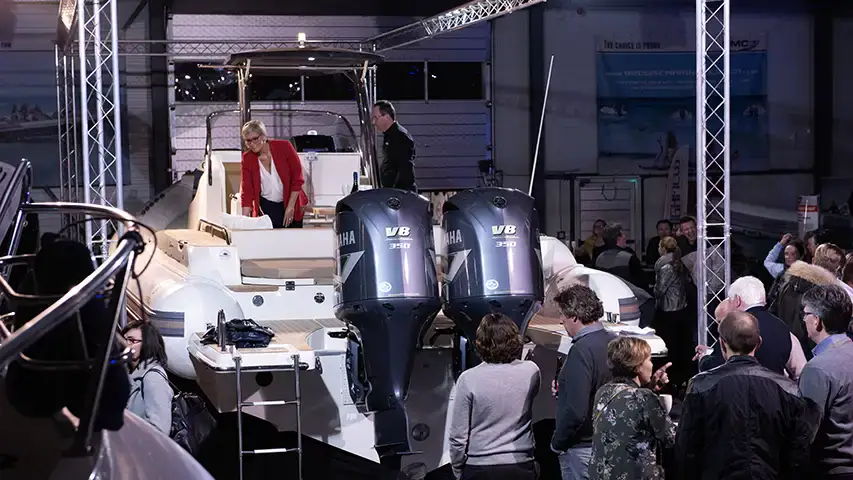
Founded in 1974 by Davide Capelli in Spinadesco, northern Italy, Cantieri Capelli initially built fibreglass riverboats for the River Po.
Its first major milestone came in 1986 with the successful launch of the Fisherman 4.7 at the Genoa International Boat Show.
The company entered the rigid inflatable boat market in 1992 with the Tempest range.
According to the company, this expansion established Cantieri Capelli as one of Italy’s leading RIB builders.
Today, the family-owned shipyard combines traditional craftsmanship with modern production methods while exporting its boats to markets around the world.
As a child, Umberto Capelli often joined his father, Davide Capelli, on the river aboard a small fishing boat his father had built by hand.
He carefully watched every movement and gradually developed a deep appreciation for boating, fishing, and life on the water.
Those early experiences eventually shaped his professional career. Looking back, he credits his father for introducing him to a passion that became his life’s work.
According to the company, the growth of Cantieri Capelli reflects its commitment to traditional craftsmanship, a skill deeply rooted in the culture of its region.
Rather than relying on mass production alone, the company continues to value artisanal expertise alongside modern manufacturing.
For him, Cantieri Capelli represents dynamism, practicality, and reliability, qualities that have helped establish the brand’s long-standing reputation in the boating industry.
The Stradivari 43 represents an ambitious interpretation of the modern Rigid Inflatable Boat (RIB), combining Italian design with premium craftsmanship.
Inspired by the flowing lines of Antonio Stradivari’s violins, the model stands apart through its distinctive styling and meticulous attention to detail.
According to the builder, the spacious walkaround layout, generous relaxation areas, and refined accommodation are designed to maximise comfort during day trips and extended weekends.
Premium finishes, teak decking, and carefully integrated design elements reinforce its luxury positioning.
On paper, the Stradivari 43 appears to target owners seeking a high-end luxury RIB that balances elegance, onboard comfort, and offshore capability.
I’ve published more videos of this Italian brand. You can watch the all here.
Discover a structured overview of 200+ active RIB brands via featured companies, global listings, and direct access through socials and email. Get to know the Global RIB Manufacturers List!
If It’s Your First RIB, This is the Buying Guide for You
Buying a Rigid Inflatable Boat (RIB) is easy to get wrong, not because RIBs are complicated, but because the market is enormous.
Hundreds of manufacturers, dozens of hull materials and tube specifications, and sizes ranging from 2.5 to over 12 metres all compete for your attention at once.
This guide cuts through that noise.
It walks through the decisions that actually matter, in the order they should be made, so you arrive at a shortlist that fits your real needs rather than a marketing brochure.
Start With Use Case, Not With Boats
The single biggest mistake buyers make is browsing models before answering what the boat is actually for. Use case determines almost every other decision that follows.
Ask yourself honestly:
Will this be mainly day trips, watersports, fishing, diving, or serious offshore use?
How many people need to be carried comfortably and safely, most of the time?
What sea conditions will the boat realistically encounter, not on your best day, but on a typical one?
Will the boat live on a trailer, a mooring, or in dry storage?
Answering these four questions first turns an overwhelming market into a manageable shortlist. Every section below builds on these answers. It is a solid buying guide.
Size affects capacity, trailering, storage, fuel consumption and rough-water capability all at once.
Undersizing leaves you outgrowing the boat within a season.
Oversizing creates ongoing costs and handling challenges that outweigh the benefits.
As a general guide:
2.5 – 4 m: Tenders and compact day boats, ideal for 2 – 4 people and light use.
4 – 6 m: The most popular leisure segment, suited to families and regular day boating.
6 – 9 m: Serious leisure and offshore-capable RIBs, typically with twin outboards.
9 m+: Commercial, rescue and superyacht-tender territory, beyond most private budgets.
This dedicated guide, What Size RIB Do I Need?, breaks this down further by passenger count, towing capability and realistic budget bands.
Choosing the Right Hull Material
Hull material affects weight, ride quality, resale value and long-term maintenance, but not in the way many first-time buyers expect.
GRP (fibreglass) remains the most common choice, offering a smooth, quiet ride and strong resale recognition across most markets.
Aluminium hulls are lighter in some configurations and highly resistant to impact damage, which explains their popularity in commercial and rescue fleets.
Neither material is objectively “better.”
The right choice depends on your priorities around noise, weight, impact resistance and typical resale market in your region.
Tubes are not a minor spec line. Material choice directly affects lifespan, appearance over time and total cost of ownership.
PVC tubes are more affordable and perform well in moderate climates, but degrade faster under intense, constant UV exposure.
Hypalon/CSM tubes cost more upfront but resist UV and chemical damage significantly better, particularly in hot, sunny regions or heavy commercial use.
If you live somewhere with strong year-round sun, or plan to keep the boat for over a decade, tube material deserves as much attention as hull material.
Engine choice shapes performance, fuel cost and resale value more than almost any other decision.
Underpowering a RIB makes it sluggish and unsafe in a following sea.
Overpowering wastes money and can strain the hull and transom unnecessarily, leading to costly repairs.
Key questions to resolve before choosing:
What is the manufacturer’s recommended horsepower range for this specific hull?
Single or twin outboards, and does your intended use justify the extra cost and complexity of twins?
New, used or refurbished engine, and what does that mean for warranty and reliability?
Our complete guide, How to Choose an Outboard for a RIB, walks through horsepower selection, single vs twin configurations and realistic engine budgets.
New vs Used: Which Should You Buy?
Both paths make sense, depending on budget and risk tolerance.
New RIBs come with full warranty coverage, the latest tube materials and no unknown history. You pay a premium for that certainty.
Used RIBs offer significant savings, sometimes 30 – 50% below new pricing for boats just a few years old, but require careful inspection to avoid inheriting expensive problems.
A realistic budget includes several ongoing and one-time costs buyers commonly underestimate.
Engine, if not already included in the boat’s asking price.
Trailer, storage or mooring fees, depending on where the boat will live.
Insurance, which varies significantly by boat value, region and intended use.
Annual servicing, antifouling and eventual tube maintenance or replacement.
Our full cost breakdown, covering both new and used RIBs across different size segments, is available in How Much Does a RIB Cost?
Matching Boat to Skill Level
Be honest about experience, not aspiration.
A smaller, more forgiving RIB let’s a new boater build genuine confidence before stepping up to something larger or more powerful.
RIBs are widely regarded as excellent first boats, thanks to their forgiving stability, but that reputation assumes appropriate sizing and proper training.
Once you’ve worked through use case, size, materials, engine and budget, building a shortlist becomes far simpler:
List 3-5 models that match your size and use-case answers.
Confirm hull and tube material specifications for each.
Check manufacturer-recommended engine range against your budget.
Arrange viewings and, where possible, sea trials for your top choices.
If considering used boats, apply the full inspection checklist before making an offer.
And that’s your personal buying guide.
Frequently Asked Questions
What’s the biggest mistake first-time RIB buyers make? Choosing a boat based on appearance or a single feature, without first defining use case, size and realistic budget.
Should beginners buy new or used? Either can work well. New removes uncertainty around history and condition; used offers better value if properly inspected.
How much should I budget beyond the boat’s price? Plan for engine, trailer or storage, insurance and annual servicing, typically adding meaningfully to the headline purchase price.
Is a bigger RIB always a better choice? No. Oversized boats create unnecessary cost, handling challenges and storage demands relative to actual use.
I’ve posted many videos of this Italian brand. Take a look.
Discover a structured overview of 200+ active RIB brands via featured companies, global listings, and direct access through socials and email. Get to know the Global RIB Manufacturers List!
To provide the best experiences, we use technologies like cookies to store and/or access device information. Consenting to these technologies will allow us to process data such as browsing behavior or unique IDs on this site. Not consenting or withdrawing consent, may adversely affect certain features and functions.
Functional
Always active
The technical storage or access is strictly necessary for the legitimate purpose of enabling the use of a specific service explicitly requested by the subscriber or user, or for the sole purpose of carrying out the transmission of a communication over an electronic communications network.
Preferences
The technical storage or access is necessary for the legitimate purpose of storing preferences that are not requested by the subscriber or user.
Statistics
The technical storage or access that is used exclusively for statistical purposes.The technical storage or access that is used exclusively for anonymous statistical purposes. Without a subpoena, voluntary compliance on the part of your Internet Service Provider, or additional records from a third party, information stored or retrieved for this purpose alone cannot usually be used to identify you.
Marketing
The technical storage or access is required to create user profiles to send advertising, or to track the user on a website or across several websites for similar marketing purposes.