Professional and Rescue RIBs Explained

A rescue RIB heading out @ RIBs ONLY - Home of the Rigid Inflatable Boat
A rescue RIB heading out – © 2025 Will Evans Snap PhotographyRIB Photo Contest Entry

How Commercial and Rescue Ribs Differ From Leisure Boats

Professional and rescue RIBs share the same basic concept as leisure boats but are built to a very different standard. Reliability, durability, and performance in extreme conditions take priority over comfort, styling, or cost efficiency.

This guide explains how these boats differ in construction, certification, and application from typical leisure RIBs.

What Defines a Professional or Rescue RIB

Professional RIBs are built for commercial, military, or rescue applications rather than leisure use. They typically meet stricter certification standards and undergo far more rigorous testing than consumer-grade equivalents.

Applications include search and rescue, coast guard, military, pilot transfer, port authority, and commercial diving support.
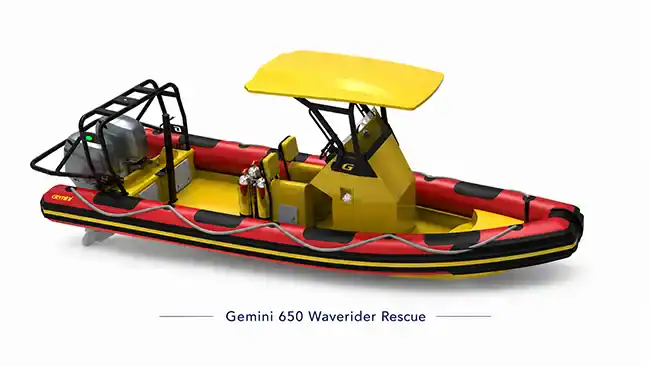
A proven favorite in both the leisure and professional markets @ RIBs ONLY - Home of the Rigid Inflatable Boat
A proven favourite in both the leisure and professional markets. Its commercial-grade construction is immediately apparent.
© Gemini Marine

Construction Differences

Professional RIB tubes are often foam-filled rather than air-filled, eliminating the risk of complete deflation from puncture. Multi-chamber tube construction is standard, ensuring the boat remains functional even if one chamber is damaged.

Hulls are typically more heavily reinforced, built to withstand years of hard commercial or operational use.

Our guide PVC vs Hypalon/CSM RIB Tubes explains why Hypalon/CSM dominates this segment, given its durability advantages.

Hull Design for Professional Use

Deep-V hulls are near-universal in this segment, since rough-water performance is often mission-critical rather than optional.

Our guide Best RIB for Rough Water: What Really Matters? explains why hull shape matters so much for these applications.

Reinforced fendering and impact-resistant materials protect the hull during frequent docking against larger vessels or piers.

Engine and Performance Requirements

Professional RIBs often run significantly more power relative to size than comparable leisure boats. Redundancy matters: twin engines are common, ensuring the boat can return safely if one engine fails.

Reliability under sustained hard use is prioritised over efficiency, given the operational demands these boats face.

Certification and Regulatory Standards

Rescue and commercial RIBs must meet stricter regulatory categories than typical leisure boats sold to private owners. Requirements vary by application and jurisdiction, covering stability, buoyancy, and equipment standards specific to commercial use.

Our guide How Does a RIB Work? explains the buoyancy and stability principles that these stricter standards build upon.

Materials and Longevity

Aluminium hulls are common in this segment, valued for their durability and resistance to impact damage.

Our guide Aluminium vs Fibreglass RIB compares these materials in more detail, relevant to both leisure and professional buyers.

Professional RIBs are typically designed and maintained for a longer operational lifespan than most leisure equivalents.

Cost and Lifecycle Differences

Professional RIBs cost significantly more than comparable-sized leisure boats, reflecting stricter build standards and certification requirements.

Maintenance schedules are typically more rigorous, with more frequent inspections mandated by operating authorities or insurers. Total lifecycle cost is often justified by the mission-critical nature of the application rather than by resale value.

difference in construction between professional and leisure ribs @ RIBs ONLY - Home of the Rigid Inflatable Boat
The true differences between pro and leisure RIBs – © 2026 Medianaut, Nautical News Media

Why This Matters for Leisure Buyers

Understanding professional RIB standards helps leisure buyers appreciate what separates a genuinely robust boat from a lighter-duty equivalent. Some manufacturers offer leisure models derived from professional designs, carrying over meaningful durability advantages.

Our RIB Buying Guide: How to Choose the Right Boat helps leisure buyers weigh these durability factors against cost.


Frequently Asked Questions

Why are professional RIB tubes foam-filled instead of air-filled?
Foam-filled tubes can’t fully deflate from puncture, ensuring the boat stays operational during rescue or commercial missions.

Can leisure buyers purchase professional-grade RIBs?
Yes, though at significantly higher cost. Some manufacturers offer civilian versions of their professional or rescue models.

Why do rescue RIBs almost always use deep-V hulls?
Rough-water performance is often mission-critical for rescue operations, making deep-V hulls the standard choice.

Are professional RIBs always aluminium-hulled?
Not always, but aluminium is common given its durability and resistance to impact damage in hard commercial use.


Related reading: What Is a Rigid Inflatable Boat? · Are Rigid Inflatable Boats Safe? · PVC vs Hypalon/CSM RIB Tubes · Best RIB for Rough Water: What Really Matters? · Aluminium vs Fibreglass RIB · RIB Photo Contest 2025


GALA Atlantis A330D – Aluminum Hull RIB Tender

The A330D’s Double Deck Technology

The GALA Atlantis A330D features a robust double-deck design for enhanced comfort and protection from water spray.

Its flat, two-tiered floor keeps the cockpit dry and ensures a smooth, enjoyable boating experience.

Built with corrosion-resistant aluminum, the hull offers durability and long service life.

This strong construction guarantees safety and comfort even in rough sailing conditions.

The Atlantis double-deck tenders stand out as top choices among lightweight and compact Rigid Inflatable Boats (RIBs).


This video was published on the GALA INFLATABLE BOATS YouTube channel.

There are more RIB videos where this came from: discover the GALA RIBs.

Proud to share that BoBat is a Friend of RIBs ONLY.

Specs

Continue Reading →

Gas vs Diesel Boat Engines: All About Performance?

My Takeaways from this Video

Here are the main differences between gasoline and diesel boat engines a.o. the performance.

  1. Gasoline engines prioritize speed and acceleration. They use spark ignition to deliver quick, high-RPM performance. This is ideal for lightweight recreational boats and fast weekend cruising.
  2. Diesel engines focus on torque and efficiency. They rely on compression ignition to generate powerful low-end thrust. This makes them especially suited for heavy-duty, commercial, or military applications. The torque is the key performance.
  3. Gas engines are lighter and rev higher. They are perfect for planing hulls that skim water. Diesel engines are heavier. They typically stay in displacement mode.
  4. Diesel outboards are stronger internally. They have reinforced pistons and cylinder walls to handle extreme pressure. This adds durability but also significant weight and cost that impact performance.
  5. Torque output is much higher in diesel. Models like the Cox CXO300 produce 650Nm at low RPM. This is ideal for pushing heavy hulls through waves and rough water.
  6. Gasoline outboards excel in recreational use. They stay light on the transom for better balance. This makes trailering easier and improves responsive handling, especially in boats under 25 feet.
  7. Diesel’s weight creates issues on small boats. It affects trim, stability, and safety. Often, it requires upgraded trailers, lifting gear, and reinforced hull structures.
  8. Maintenance and ownership differ greatly. Gas engines are simpler and cheaper to service. Diesel engines require specialized tools and training. They also need more expensive repairs.
  9. Diesel engines cost significantly more. Units like the Cox CXO300 are often priced $20,000 higher than comparable gas models for the same horsepower rating (according to this video).
  10. Fuel economy favors diesel. It burns 20–30% less fuel per hour and lasts longer under constant use. However, savings take decades for casual boaters to realize.
  11. Gasoline won early due to accessibility. It dominated marinas, supply chains, and consumer familiarity. This happened long before diesel outboards became small enough to compete.
  12. Diesel thrives in fleet operations. Uptime, long service intervals, and shared fuel logistics make it perfect for patrol boats. It is also ideal for offshore vessels and military craft.
  13. Gasoline leads innovation today. Four-stroke engines are gaining cleaner emissions, digital controls, and smart integration. Diesel progresses more slowly due to niche demand.

Performance

There you have it. When it comes to performance and choosing the ‘better’ engine, it all depends on your intended use.

Electric Outboards

They’re not taking the market by storm.

Even though electric outboards offer quiet, “clean” operation they struggle with limited range, high battery costs, and slow charging.

These drawbacks, combined with current performance gaps, prevent them from dominating the boating market—especially for larger vessels.

This video was published on the Nautical Nostalgia YouTube channel.

I wrote an article about it: Why an Electric Outboard Is Not the Better Choice Now.

GALA A360Q with Electrical Tohatsu Alaris 6

The Practical Tender GALA A360Q

The video showcases a short test ride of the GALA Atlantis A360Q RIB. The video as such shows mainly the boat’s manoeuvrability.

The GALA Atlantis A360Q is a 12-foot (3.6-meter) Rigid Inflatable Boat (RIB) featuring an aluminum hull and Aquahelm steering console, designed for lightweight agility.

It is powered by a Tohatsu Alaris 6.electrical outboard motor.

This combination is interesting for recreational and practical use like a tender.

This video was published on the GALA INFLATABLE BOATS YouTube channel.

If you’re intetested in this brand, check out these videos as well.

Specs

Continue Reading →

GALA A450L Powered by 60 hp Tohatsu

GALA A450L Where “L” Stands for Deluxe

GALA is an international project, established in 2014 and developed by GALA MARINE INTERNATIONAL Inc., a part of GRAND MARINE GROUP, ON, Ontario, Canada, in cooperation with GELEX GLOBAL GROUP in Ukraine.

GALA builds aluminum-hull Rigid Inflatable Boats and foldable inflatables at a modern facility in Ukraine, distributing them to over 30 countries.

Although I don’t know their current manufacturing location, new models continue to appear at boat shows.

In North America, buyers can contact GMI MARINE DISTRIBUTION in Canada.

Since 2019, GALA has been developing the GALAXY line of Commercial Grade Professional Aluminum hull RIBs for professional applications such as Search and Rescue,

Law enforcement, Military, and Diving. GALA’s European production is a significant strength.

They offer a range of inflatable boats from 2.1 to 8 meters.

Interested in more GALA RIBs? Check out this link.

This video was published on the GALA INFLATABLE BOATS YouTube channel.

Specs

Continue Reading →
×