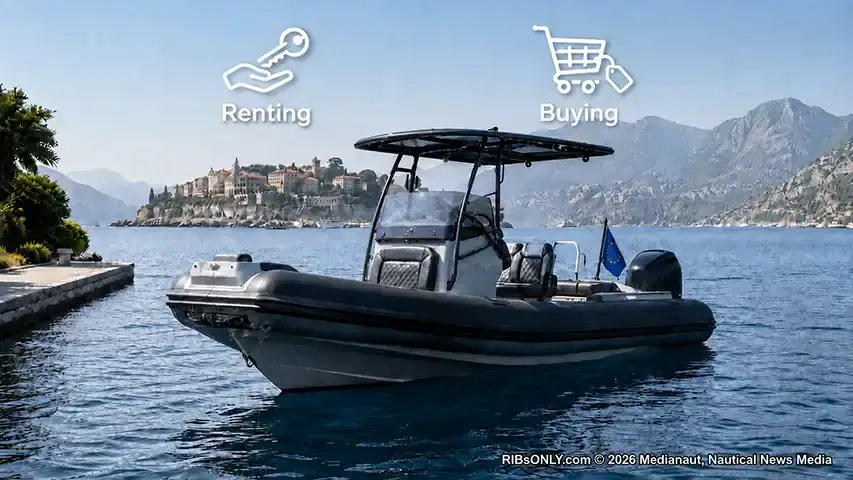
Renting vs Buying a RIB: Cost & Experience Comparison

Renting vs buying a RIB: cost & experience comparison@ RIBs ONLY - Home of the Rigid Inflatable Boat

The Real Cost of Renting

Sooner or later, almost everyone who rents a RIB more than once asks the same question: at what point does it make more financial sense to just buy one?

The answer depends heavily on how often you’d actually use it, but the numbers are more revealing than most people expect.

A typical RIB rental across European destinations ranges from € 200 – € 400 per day for a mid-sized bareboat rental, or € 400 – € 800 per day with a skipper included, depending on region and season.

Weekly rentals often bring the daily rate down by 15 – 25%. For someone using a RIB two or three times a year on holiday, renting comfortably stays the cheaper option. The total annual spend rarely exceeds € 1.500 – € 2.500.

The Real Cost of Owning

Ownership costs look very different once you account for more than the purchase price:

Cost categoryTypical annual cost
Purchase (amortised over 10 years, mid-range RIB)€ 2.000 – € 5.000/year
Mooring or storage€ 800 – € 3.000/year
Insurance€ 300 – € 800/year
Maintenance & servicing€ 500 – € 1.500/year
Winter storage/hauling€ 200 – € 600/year
Total estimated annual cost€ 3.800 – € 10.900/year
Costs may vary

This is before factoring in trailer costs, fuel, or unexpected repairs, all covered in more detail in our RIB Insurance Guide and RIB Winter Storage Guide.

Where the Break-even Point Actually Falls

Comparing these numbers directly: if your annual rental spend is below roughly €3,000–€4,000, renting remains financially the smarter choice.

Ownership only starts to pay off once you’re using a RIB frequently enough that the equivalent rental cost would exceed total ownership cost. In practice, this usually means using the boat more than 15–20 days per year, consistently, across multiple seasons.

For most casual holidaymakers renting two or three times annually, this break-even point is never reached.

For enthusiasts living near the coast who want spontaneous, weekend access without booking logistics, ownership starts to make sense far sooner.

The Factors the Cost Table Doesn’t Capture

Flexibility. Renting lets you choose a different destination, boat size, or layout every time — testing a 6-metre RIB in Croatia one summer and a 9-metre model in the Riviera the next. Ownership locks you into one boat, one home port, and one set of capabilities.

Convenience. Ownership removes the need to book in advance, work around availability, or compete for weekend slots during peak season you simply go when you want to.

Depreciation. A RIB, like most boats, depreciates typically 5 – 10% per year for the first several years. This is a real cost of ownership that renting entirely avoids; you’re never exposed to resale risk.

Maintenance responsibility. With rentals, mechanical issues are the operator’s problem. With ownership, engine servicing, hull maintenance, and off-season storage become an ongoing responsibility, covered in depth in our Own and Use articles.

Emotional and lifestyle value. For many owners, having “their” boat, customised and always accessible, carries value that a rental, however well-maintained, simply can’t replicate. This is subjective, but it’s often the deciding factor once the financial numbers are roughly comparable.

A Practical Decision Framework

Rent: if you use a RIB fewer than 10 – 15 days per year, want to try different models or destinations, or aren’t ready to commit to storage and maintenance logistics.

Consider buying: if you’re using a RIB 20+ days per year, live near a body of water where spontaneous access matters, or have already rented several times and consistently gravitate toward one type of boat.

Try before you buy: even committed future owners benefit from renting a few different models first. It’s the single best way to validate size, layout, and handling preferences before making a five-figure purchase.
See our RIB Buying Guide and Sea Trial Checklist for the next step.

The Middle Ground: Shared Ownership

For those who use a RIB more than casual renters but not enough to justify full ownership, shared or syndicate ownership is worth investigating.

Splitting purchase and running costs across two or three co-owners can bring the break-even point down significantly, though it introduces its own logistical and scheduling complexity.


Frequently Asked Questions

Is it cheaper to rent or buy a RIB?
For most people using a RIB fewer than 15 – 20 days per year, renting is cheaper. Ownership only becomes cost-effective with frequent, regular use across multiple seasons.

How much does it cost to own a RIB per year?
Total annual ownership costs, including amortised purchase price, storage, insurance, and maintenance, typically range from € 3.800 to € 10.900 depending on boat size and location.

Should I rent a RIB before buying one?
Yes! Renting different sizes and layouts is the most reliable way to identify your preferences before committing to a purchase.

What is the break-even point between renting and buying a RIB?
Roughly 15 – 20 days of use per year, though this varies significantly based on boat size, mooring costs, and local rental prices.

Is shared ownership a good alternative to renting or buying outright?
It can be, particularly for those who fall between casual renters and frequent users. It lowers individual costs but requires coordinated scheduling with co-owners.


Related Reading: What is a Rigid Inflatable Boat (RIB) · Do You Need a License to Rent a RIB? · Bareboat vs Skippered RIB Rental: Which Should You Choose? · Essential Safety Equipment for a RIB

Disclaimer: Medianaut, Nautical News Media lists third-party rental operators and platforms for informational purposes only and is not affiliated with, or responsible for, any listed provider unless explicitly stated. Pricing, availability, and licensing requirements are set solely by individual providers and may change without notice. Some links may be affiliate links. See our full rental disclaimer for details.

Bareboat vs Skippered RIB Rental: Which to Choose?

The main differences between bareboat or skippered RIB rental@ RIBs ONLY - Home of the Rigid Inflatable Boat
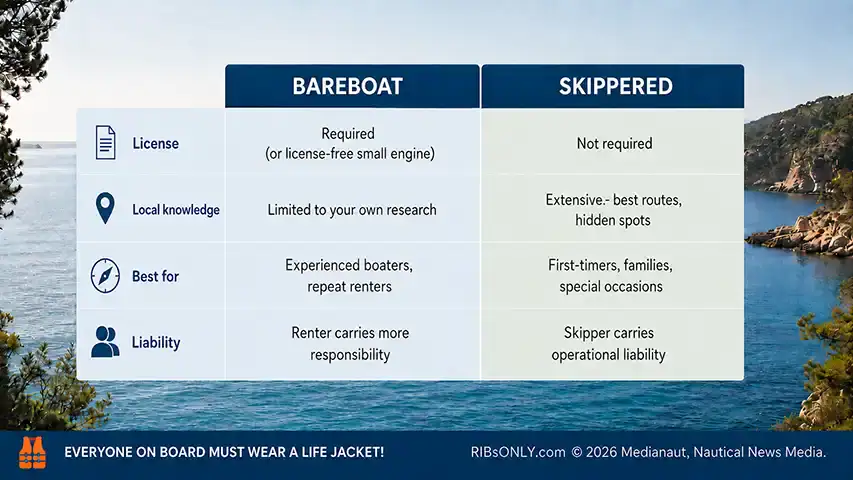
Some of the differences between RIB rental types

How to Decide?

When you book a RIB rental anywhere in Europe, one decision shapes the entire experience more than destination or boat size:
do you drive it yourself (bareboat), or does a professional skipper come with the boat?

Both options are widely available, but they suit very different types of renters, budgets, and comfort levels. Here’s how to decide.

The Core Difference

Bareboat rental means you take full control of the RIB yourself, with no crew on board.
You’re responsible for navigation, docking, fuel, and safety throughout the rental period. This requires an appropriate license (see our licensing guide) and, in most cases, a security deposit.

Skippered rental means a licensed, experienced skipper operates the boat for you.
You and your group are passengers, free to enjoy the coastline, swim stops, and scenery without any operational responsibility.

Comparison at a Glance

BareboatSkippered
License requiredYes (or license-free small engine)No
CostLower – no crew feeHigher – includes skipper’s day rate
Local knowledgeLimited to your own researchExtensive – best routes, hidden spots
Freedom to exploreFull control over route and paceRoute suggestions, but skipper decides on safety calls
Best forExperienced boaters, repeat rentersFirst-timers, families, special occasions
LiabilityRenter carries more responsibilitySkipper carries operational liability
Indicative comparison

When Bareboat Makes Sense

Bareboat rentals are the better choice if you already hold a recognised license, have prior boat-handling experience, and want the freedom to set your own pace.

Stopping wherever you like, adjusting the route on a whim, or spending longer at a particular cove.

It’s also significantly cheaper, since you’re not paying for a skipper’s day rate, which typically adds anywhere from € 150 to € 400 per day depending on the region and season.

Bareboat is also the natural choice for repeat visitors to a destination who already know the coastline, and for anyone testing whether RIB ownership might be right for them.

Driving the boat yourself is the only way to genuinely evaluate handling, comfort, and layout before a purchase decision. This is a common bridge into our Rent vs Buy comparison.

When Skippered Makes Sense

For first-time RIB renters, unfamiliar coastlines, or groups where nobody holds a valid boating license, a skippered rental removes both the legal barrier and the learning curve.

A local skipper typically knows currents, no-go zones, best swimming spots, and how to read local weather pattern. Knowledge that can take years to build independently.

Skippered rentals are also the default choice for special occasions (birthdays, proposals, corporate outings) where the priority is a relaxed, worry-free experience rather than the thrill of driving.

Families with young children frequently prefer this option for the same reason. It allows every adult on board to actually relax rather than one person needing to stay focused on navigation throughout.

The Hybrid Option Many Renters Don’t Know About

Across the Mediterranean and Croatia, some operators offer a middle-ground option.A skipper joins you for the first hour or half-day, explaining the boat, controls, and local area.

Afterwards, the skipper hands over control, allowing you to continue the rental independently.

This gives renters the confidence boost of a guided introduction combined with the freedom of bareboat driving for the rest of the trip. It’s worth asking about directly with your chosen platform, as it’s rarely advertised as a standard package.

Insurance and Liability Differences

This is often the deciding factor renters overlook. With bareboat rentals, you are typically liable for damage up to the deposit amount (commonly € 500 – € 2.500), and your travel insurance may or may not cover boat-related incidents.

Always check before departure.

With skippered rentals, liability sits primarily with the skipper and the operator’s commercial insurance, which is one of the strongest arguments in favour of skippered rentals for less experienced renters, regardless of license status.

How to Decide in Under a Minute

Ask yourself three questions:
Do I hold a valid license or am I comfortable operating an unfamiliar boat?
Do I know this coastline, or would local knowledge meaningfully improve the day?
Is my priority freedom and cost savings, or a relaxed, guided experience?

If you answered “no,” “no local knowledge,” and “relaxed experience”, book skippered. If the reverse, bareboat is the better fit.


Frequently Asked Questions

Is bareboat or skippered rental cheaper?
Bareboat is almost always cheaper, since there’s no skipper day rate added to the base rental cost. Savings typically range from € 150 to € 400 per day.

Do I need a license for a skippered RIB rental?
No. The skipper holds the required license and operates the boat, so passengers don’t need any boating qualification.

Can I switch from skippered to bareboat partway through my rental?
Some operators offer a hybrid option where a skipper gives an initial orientation before handing over control. This isn’t universally available, so confirm with the operator in advance.

Is a skippered rental safer than bareboat?
Generally yes, particularly in unfamiliar waters, since the skipper carries local knowledge and operational liability that a first-time renter wouldn’t have.

Which option is better for testing a RIB before buying one?
Bareboat, since driving the boat yourself is the only way to properly evaluate handling and layout. Read our Rent vs Buy guide for a full breakdown.


Related Reading: What is a Rigid Inflatable Boat (RIB) · Do You Need a License to Rent a RIB? · Essential Safety Equipment for a RIB


Disclaimer: Medianaut, Nautical News Media lists third-party rental operators and platforms for informational purposes only and is not affiliated with, or responsible for, any listed provider unless explicitly stated. Pricing, availability, and licensing requirements are set solely by individual providers and may change without notice. Some links may be affiliate links. See our full rental disclaimer for details.


Maritime Filming UK Highfield Patrol 760 Camera RIB

Maritime Filming UK Uses a 40-Knot RIB for Sea Filming

Maritime Filming UK uses a Highfield Patrol 760 as its dedicated camera boat for offshore filming and photography assignments.

The 7.6-metre RIB is powered by a Honda 250 hp outboard and can exceed 40 knots when following fast-moving vessels.

That performance is important during sailing races, commercial shipping shoots and other assignments where crews must remain close to the action.

Reliability and safety are equally important because filming often continues in difficult weather and time-sensitive conditions.

Fuel efficiency also influences operating costs, which can affect both client budgets and the profitability of commercial shoots.

At the helm, the skipper receives clear information about fuel levels, engine hours, RPM and economy data.

The throttle is designed to support accurate control during close-range manoeuvres and transfers alongside other vessels.

For Maritime Filming UK, the combination provides a practical platform for professional marine production work along the UK coast.


This video was published on the Honda Marine Europe YouTube channel.


Related reading: What Is a Rigid Inflatable Boat? · Are Rigid Inflatable Boats Safe? · RIB Buying Guide: How to Choose the Right Boat · How to Choose an Outboard for a RIB · What Size RIB Do I Need?


Specs

Continue Reading →

RIB Rentals Europe: Find Operators & Rental Platforms

The European continent by ChatGPT @ RIBs ONLY - Home of the Rigid Inflatable Boat
Used as illustration.

Navigate Without the Cost of Owning a RIB

Not ready to buy yet? Renting a RIB first is a practical way to test different sizes and layouts.

Renting a RIB (rigid inflatable boat) is one of the easiest ways to get on the water in Europe, fast, stable, and often available without a licence for shorter, lower-powered models.

This guide covers 20 countries and 40+ destinations across five regions, with direct links to the charter platforms that list real boats and real prices, so you can compare and book without wading through generic search results.

What is a RIB, and Why Rent One in Europe?

A RIB combines a rigid hull with inflatable tubes along the sides, making it fast, stable and forgiving, ideal for coastal exploring, island-hopping, snorkelling stops and reaching coves that larger boats can’t.

Compared to a sailboat or motor yacht charter, RIB rental is typically cheaper, faster to get moving, and in many countries (the Netherlands and parts of France, for example) available without any boating licence at all.

Europe’s coastline, from the Aegean to the Baltic, offers an unmatched range of RIB destinations within a short flight of most major cities.

Browse RIB Rental by Region

Each region below links to a dedicated page with specific destinations, each offering direct, verified links to the platforms that actually list boats there.

Mediterranean

France, Spain, Italy, Croatia, Greece, Portugal, Malta, Cyprus, Montenegro, and Slovenia: 10 countries, 18 destinations.

Northern Europe

Netherlands, Belgium, United Kingdom, Ireland and Germany: 5 countries, 12 destinations, from Dutch canals to Scottish lochs.

Scandinavia

Norway, Sweden, Denmark and Finland: 4 countries, 7 destinations, from Oslo’s fjords to the Åland archipelago.

Poland

The Baltic coast around Gdańsk and the Great Masurian Lakes, Poland’s largest inland sailing region.

Turkey

Bodrum and Fethiye/Göcek on the Turquoise Coast: affordable, uncrowded Mediterranean chartering.

Compare Europe’s RIB Rental Platforms

Rather than one dominant marketplace, RIB rental in Europe runs across several peer-to-peer and brokerage platforms, each with different regional strengths. Here’s how the seven main ones compare:

Click&Boat

Best for: broadest coverage. Over 50.000 boats across 60 countries. The only platform in this list with meaningful listings in nearly every region here, including Poland and Turkey.

SamBoat

Best for: Mediterranean premium charters. Strongest in France, Italy, Spain and Greece, with a focus on higher-end boats.

Nautal

Best for: Spain, France and Italy specifically, with strong local knowledge and multilingual support.

GetMyBoat

Best for: global reach with genuinely useful listings even in smaller destinations. The most consistent platform for out-of-the-way spots in this guide.

Borrow A Boat

Best for: RIBs specifically. A dedicated RIB hire portal rather than a general boat marketplace, strong in Greece, Croatia, Italy, Spain, France and the UK.

Tubber

Best for: scale. Access to over 17.500 boats across 600+ destinations worldwide, with or without a skipper.

Happycharter

Best for: Croatia and the wider Adriatic, with filtering by charter area and country.


Frequently Asked Questions

Do I need a boating licence to rent a RIB in Europe?
It depends on the country and the engine’s power. Many European destinations allow licence-free rental for smaller RIBs, typically under 6 kW (8 hp), while more powerful models usually require an ICC (International Certificate of Competence) or a national equivalent.
Rules vary meaningfully by country. See our full guide: Do You Need a License to Rent a RIB? Info by Country.

Should I book a RIB with or without a skipper?
Bareboat rental is cheaper and gives you full freedom, but requires a valid licence and some boat-handling confidence. A skippered rental removes the licence requirement entirely and adds local knowledge. Often the better choice for first-time renters or unfamiliar coastlines.
Read our full comparison guide: Bareboat vs Skippered RIB Rental: Which Should You Choose?

When is the best time to rent a RIB in Europe?
Peak season runs from June to August across most regions, with the warmest water and most reliable weather, but also the highest prices and busiest marinas.
May, September and early October offer a strong middle ground: quieter waters, lower rates, and still-comfortable conditions in the Mediterranean, Turkey and southern regions.
Scandinavia and Northern Europe have a shorter reliable window, typically June through early September.

How far in advance should I book?
For July and August in popular Mediterranean and Croatian destinations, book 4–8 weeks ahead. Availability for well-rated operators disappears quickly.
Shoulder-season (May, September) and less-visited regions like Poland or Scandinavia are usually bookable with 1–2 weeks’ notice, sometimes even the same week.

Is it cheaper to rent directly from an operator or through a platform?
Prices are often similar, since most operators list the same fleet across multiple platforms.
Booking through a platform typically adds buyer protection, verified reviews, and easier cancellation terms. Worth the peace of mind unless you already know and trust a specific local operator directly.

Should I rent a RIB before deciding whether to buy one?
Yes. Renting different sizes and layouts is the most reliable way to test what suits you before a purchase.
If you’re weighing occasional rental against buying your own RIB, our full cost comparison guide breaks down the real numbers: Renting vs Buying a RIB: A Cost & Experience Comparison.


Related Reading: What is a Rigid Inflatable Boat (RIB) · Do You Need a License to Rent a RIB? · Bareboat vs Skippered RIB Rental: Which Should You Choose? · Essential Safety Equipment for a RIB

Disclaimer: Medianaut lists third-party rental operators and platforms for informational purposes only and is not affiliated with, or responsible for, any listed provider unless explicitly stated. Pricing, availability, and licensing requirements are set solely by individual providers and may change without notice. Some links may be affiliate links. See our full rental disclaimer for details.


Complete Overview of Ranieri’s Cayman 41 Hard Top

The Cayman 41 Hard Top by The Sea Team

The Cayman 41 Hard Top impresses with its generous exterior space and modular design, offered by the Italian Ranieri International.

Measuring 11,90 meters in length with a 3,80-meter beam, the vessel is powered by twin Suzuki engines, ranging from 300 to 400 horsepower each.

The cockpit features a spacious U-shaped sofa spanning the boat’s full width, complemented by a fiberglass galley with induction cooktops.

A wraparound helm station offers ergonomic seating and an ultra-wide Simrad display for comprehensive navigation control.

Below deck, the cabin layout includes an open-space design with a forward double bed, a separate bathroom, and an additional aft cabin accommodating two more berths.

With four total sleeping spaces and abundant storage throughout, this 41-foot yacht delivers exceptional versatility for both relaxation and practical cruising needs.


This video was published on The Sea Team YouTube channel.

It’s worth watching more Ranieri videos on RIBsONLY.com: The Italian Ranieri International.

And The Sea Team always delivers high quality reviews. Check more of their work here.


Related reading: What Is a Rigid Inflatable Boat? · How Does a RIB Work? · What Size RIB Do I Need?


Specs

Continue Reading →
×