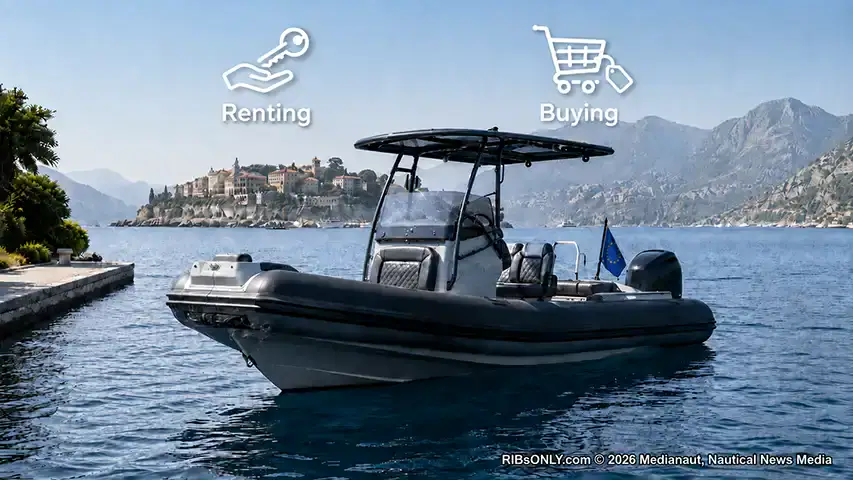
Renting vs Buying a RIB: Cost & Experience Comparison

Renting vs buying a RIB: cost & experience comparison@ RIBs ONLY - Home of the Rigid Inflatable Boat

The Real Cost of Renting

Sooner or later, almost everyone who rents a RIB more than once asks the same question: at what point does it make more financial sense to just buy one?

The answer depends heavily on how often you’d actually use it, but the numbers are more revealing than most people expect.

A typical RIB rental across European destinations ranges from € 200 – € 400 per day for a mid-sized bareboat rental, or € 400 – € 800 per day with a skipper included, depending on region and season.

Weekly rentals often bring the daily rate down by 15 – 25%. For someone using a RIB two or three times a year on holiday, renting comfortably stays the cheaper option. The total annual spend rarely exceeds € 1.500 – € 2.500.

The Real Cost of Owning

Ownership costs look very different once you account for more than the purchase price:

Cost categoryTypical annual cost
Purchase (amortised over 10 years, mid-range RIB)€ 2.000 – € 5.000/year
Mooring or storage€ 800 – € 3.000/year
Insurance€ 300 – € 800/year
Maintenance & servicing€ 500 – € 1.500/year
Winter storage/hauling€ 200 – € 600/year
Total estimated annual cost€ 3.800 – € 10.900/year
Costs may vary

This is before factoring in trailer costs, fuel, or unexpected repairs, all covered in more detail in our RIB Insurance Guide and RIB Winter Storage Guide.

Where the Break-even Point Actually Falls

Comparing these numbers directly: if your annual rental spend is below roughly €3,000–€4,000, renting remains financially the smarter choice.

Ownership only starts to pay off once you’re using a RIB frequently enough that the equivalent rental cost would exceed total ownership cost. In practice, this usually means using the boat more than 15–20 days per year, consistently, across multiple seasons.

For most casual holidaymakers renting two or three times annually, this break-even point is never reached.

For enthusiasts living near the coast who want spontaneous, weekend access without booking logistics, ownership starts to make sense far sooner.

The Factors the Cost Table Doesn’t Capture

Flexibility. Renting lets you choose a different destination, boat size, or layout every time — testing a 6-metre RIB in Croatia one summer and a 9-metre model in the Riviera the next. Ownership locks you into one boat, one home port, and one set of capabilities.

Convenience. Ownership removes the need to book in advance, work around availability, or compete for weekend slots during peak season you simply go when you want to.

Depreciation. A RIB, like most boats, depreciates typically 5 – 10% per year for the first several years. This is a real cost of ownership that renting entirely avoids; you’re never exposed to resale risk.

Maintenance responsibility. With rentals, mechanical issues are the operator’s problem. With ownership, engine servicing, hull maintenance, and off-season storage become an ongoing responsibility, covered in depth in our Own and Use articles.

Emotional and lifestyle value. For many owners, having “their” boat, customised and always accessible, carries value that a rental, however well-maintained, simply can’t replicate. This is subjective, but it’s often the deciding factor once the financial numbers are roughly comparable.

A Practical Decision Framework

Rent: if you use a RIB fewer than 10 – 15 days per year, want to try different models or destinations, or aren’t ready to commit to storage and maintenance logistics.

Consider buying: if you’re using a RIB 20+ days per year, live near a body of water where spontaneous access matters, or have already rented several times and consistently gravitate toward one type of boat.

Try before you buy: even committed future owners benefit from renting a few different models first. It’s the single best way to validate size, layout, and handling preferences before making a five-figure purchase.
See our RIB Buying Guide and Sea Trial Checklist for the next step.

The Middle Ground: Shared Ownership

For those who use a RIB more than casual renters but not enough to justify full ownership, shared or syndicate ownership is worth investigating.

Splitting purchase and running costs across two or three co-owners can bring the break-even point down significantly, though it introduces its own logistical and scheduling complexity.


Frequently Asked Questions

Is it cheaper to rent or buy a RIB?
For most people using a RIB fewer than 15 – 20 days per year, renting is cheaper. Ownership only becomes cost-effective with frequent, regular use across multiple seasons.

How much does it cost to own a RIB per year?
Total annual ownership costs, including amortised purchase price, storage, insurance, and maintenance, typically range from € 3.800 to € 10.900 depending on boat size and location.

Should I rent a RIB before buying one?
Yes! Renting different sizes and layouts is the most reliable way to identify your preferences before committing to a purchase.

What is the break-even point between renting and buying a RIB?
Roughly 15 – 20 days of use per year, though this varies significantly based on boat size, mooring costs, and local rental prices.

Is shared ownership a good alternative to renting or buying outright?
It can be, particularly for those who fall between casual renters and frequent users. It lowers individual costs but requires coordinated scheduling with co-owners.


Related Reading: What is a Rigid Inflatable Boat (RIB) · Do You Need a License to Rent a RIB? · Bareboat vs Skippered RIB Rental: Which Should You Choose? · Essential Safety Equipment for a RIB

Disclaimer: Medianaut, Nautical News Media lists third-party rental operators and platforms for informational purposes only and is not affiliated with, or responsible for, any listed provider unless explicitly stated. Pricing, availability, and licensing requirements are set solely by individual providers and may change without notice. Some links may be affiliate links. See our full rental disclaimer for details.
Bareboat vs Skippered RIB Rental: Which to Choose?

The main differences between bareboat or skippered RIB rental@ RIBs ONLY - Home of the Rigid Inflatable Boat
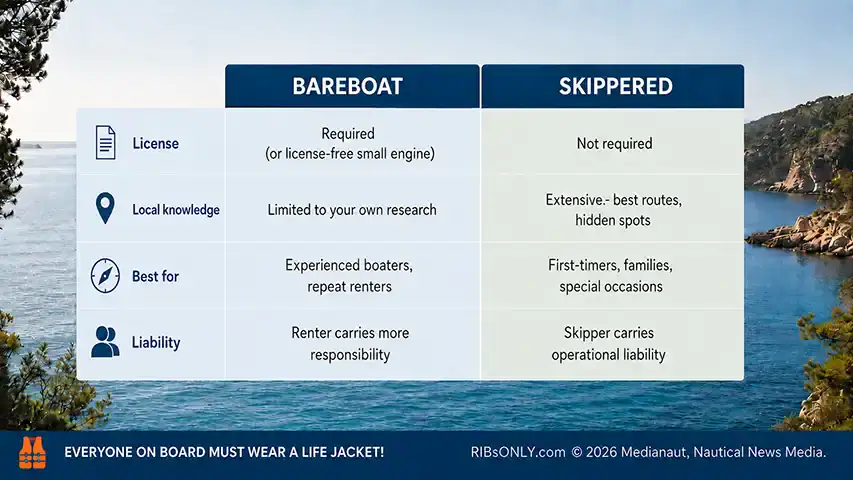
Some of the differences between RIB rental types

How to Decide?

When you book a RIB rental anywhere in Europe, one decision shapes the entire experience more than destination or boat size:
do you drive it yourself (bareboat), or does a professional skipper come with the boat?

Both options are widely available, but they suit very different types of renters, budgets, and comfort levels. Here’s how to decide.

The Core Difference

Bareboat rental means you take full control of the RIB yourself, with no crew on board.
You’re responsible for navigation, docking, fuel, and safety throughout the rental period. This requires an appropriate license (see our licensing guide) and, in most cases, a security deposit.

Skippered rental means a licensed, experienced skipper operates the boat for you.
You and your group are passengers, free to enjoy the coastline, swim stops, and scenery without any operational responsibility.

Comparison at a Glance

BareboatSkippered
License requiredYes (or license-free small engine)No
CostLower – no crew feeHigher – includes skipper’s day rate
Local knowledgeLimited to your own researchExtensive – best routes, hidden spots
Freedom to exploreFull control over route and paceRoute suggestions, but skipper decides on safety calls
Best forExperienced boaters, repeat rentersFirst-timers, families, special occasions
LiabilityRenter carries more responsibilitySkipper carries operational liability
Indicative comparison

When Bareboat Makes Sense

Bareboat rentals are the better choice if you already hold a recognised license, have prior boat-handling experience, and want the freedom to set your own pace.

Stopping wherever you like, adjusting the route on a whim, or spending longer at a particular cove.

It’s also significantly cheaper, since you’re not paying for a skipper’s day rate, which typically adds anywhere from € 150 to € 400 per day depending on the region and season.

Bareboat is also the natural choice for repeat visitors to a destination who already know the coastline, and for anyone testing whether RIB ownership might be right for them.

Driving the boat yourself is the only way to genuinely evaluate handling, comfort, and layout before a purchase decision. This is a common bridge into our Rent vs Buy comparison.

When Skippered Makes Sense

For first-time RIB renters, unfamiliar coastlines, or groups where nobody holds a valid boating license, a skippered rental removes both the legal barrier and the learning curve.

A local skipper typically knows currents, no-go zones, best swimming spots, and how to read local weather pattern. Knowledge that can take years to build independently.

Skippered rentals are also the default choice for special occasions (birthdays, proposals, corporate outings) where the priority is a relaxed, worry-free experience rather than the thrill of driving.

Families with young children frequently prefer this option for the same reason. It allows every adult on board to actually relax rather than one person needing to stay focused on navigation throughout.

The Hybrid Option Many Renters Don’t Know About

Across the Mediterranean and Croatia, some operators offer a middle-ground option.A skipper joins you for the first hour or half-day, explaining the boat, controls, and local area.

Afterwards, the skipper hands over control, allowing you to continue the rental independently.

This gives renters the confidence boost of a guided introduction combined with the freedom of bareboat driving for the rest of the trip. It’s worth asking about directly with your chosen platform, as it’s rarely advertised as a standard package.

Insurance and Liability Differences

This is often the deciding factor renters overlook. With bareboat rentals, you are typically liable for damage up to the deposit amount (commonly € 500 – € 2.500), and your travel insurance may or may not cover boat-related incidents.

Always check before departure.

With skippered rentals, liability sits primarily with the skipper and the operator’s commercial insurance, which is one of the strongest arguments in favour of skippered rentals for less experienced renters, regardless of license status.

How to Decide in Under a Minute

Ask yourself three questions:
Do I hold a valid license or am I comfortable operating an unfamiliar boat?
Do I know this coastline, or would local knowledge meaningfully improve the day?
Is my priority freedom and cost savings, or a relaxed, guided experience?

If you answered “no,” “no local knowledge,” and “relaxed experience”, book skippered. If the reverse, bareboat is the better fit.


Frequently Asked Questions

Is bareboat or skippered rental cheaper?
Bareboat is almost always cheaper, since there’s no skipper day rate added to the base rental cost. Savings typically range from € 150 to € 400 per day.

Do I need a license for a skippered RIB rental?
No. The skipper holds the required license and operates the boat, so passengers don’t need any boating qualification.

Can I switch from skippered to bareboat partway through my rental?
Some operators offer a hybrid option where a skipper gives an initial orientation before handing over control. This isn’t universally available, so confirm with the operator in advance.

Is a skippered rental safer than bareboat?
Generally yes, particularly in unfamiliar waters, since the skipper carries local knowledge and operational liability that a first-time renter wouldn’t have.

Which option is better for testing a RIB before buying one?
Bareboat, since driving the boat yourself is the only way to properly evaluate handling and layout. Read our Rent vs Buy guide for a full breakdown.


Related Reading: What is a Rigid Inflatable Boat (RIB) · Do You Need a License to Rent a RIB? · Essential Safety Equipment for a RIB


Disclaimer: Medianaut, Nautical News Media lists third-party rental operators and platforms for informational purposes only and is not affiliated with, or responsible for, any listed provider unless explicitly stated. Pricing, availability, and licensing requirements are set solely by individual providers and may change without notice. Some links may be affiliate links. See our full rental disclaimer for details.


Do You Need a License to Rent a RIB? Info by Country

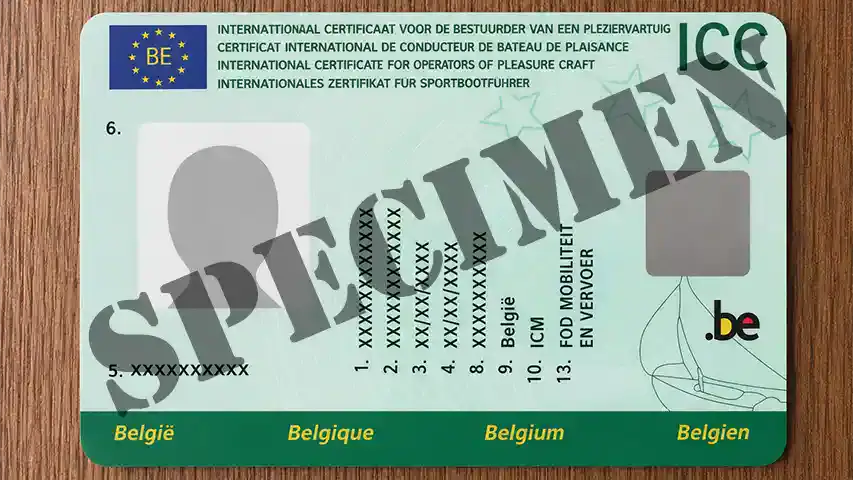
Specimen of the International Certificate of Competence (ICC) @ RIBs ONLY - Home of the Rigid Inflatable Boat
An International Certificate of Competence – RIBsONLY.com © 2026 Medianaut, Nautical News Media

All About Licences

If you’re planning to rent a RIB in Europe, the first question that decides everything else, bareboat or skippered, which platform, which destination, is whether you’re legally allowed to drive it yourself.

The short answer:

In most of Europe, you can rent and drive a RIB without a license if the engine is under a certain power threshold, usually around 6 kW (roughly 8 hp), and you stay within a limited distance from shore.

Above that threshold, most countries require either a recognised boating qualification (such as the International Certificate of Competence, ICC) or a mandatory skipper on board.

But “most of Europe” hides a lot of local variation, and getting this wrong can mean arriving at your destination with a booking you’re not legally allowed to use. Here’s what actually applies, country by country.

The general European pattern

Across the EU, national authorities regulate recreational boating individually, there is no single unified license. However, a common pattern has emerged:

  • Small RIBs with low-powered engines (typically under 6 kW / 8 hp) can usually be rented and driven without any license, often called a “license-free” or “no license needed” rental.
  • RIBs with engines above that threshold generally require proof of competence — most commonly the ICC, a nationally recognised powerboat license, or a rental company-issued short briefing combined with a liability waiver (rules vary by operator and country).
  • Distance-from-shore limits often apply to license-free rentals, typically 1 to 5 nautical miles, enforced by the rental operator rather than the coast guard directly.

Country-by-country Overview*

France — Requires a “permis bateau côtier” or ICC for RIBs above 6 kW. Below that threshold, no licence is needed, but many operators still require a short on-water briefing. Popular in the French Riviera rental market.

Italy — Similar structure: licence required above roughly 40 hp for RIBs travelling more than 6 nautical miles offshore or moving faster than certain speeds; smaller, slower rentals near the coast are typically licence-free.

Spain — Requires a “Título de Patrón” or ICC for most motorised rentals above minimal power; Spanish operators are generally strict about checking documentation before departure, especially in the Balearics.

Croatia — No licence required for boats under 5 kW; above that, an ICC or equivalent is required. Croatian authorities are known for enforcing this more consistently than some neighbouring countries.

Greece — Licence-free rentals are common for small RIBs near coastal resorts; larger or faster RIBs require a Greek boating licence or ICC, and enforcement varies significantly by region.

Portugal — Requires a “Carta de Navegador de Recreio” or ICC for engines above roughly 6 kW; the Algarve rental market is well used to processing ICC documentation for international visitors.

Netherlands & Northern Europe — The “Klein Vaarbewijs” is required for boats capable of exceeding 20 km/h or longer than 15 metres; most smaller RIB rentals fall under this threshold and require no licence.

Turkey — Regulations are stricter than in much of the EU; an ICC or Turkish equivalent is generally required for any motorised rental, and operators are diligent about checking this before handover.

*by Claude so double check

What is the ICC, and do you actually need one?

The International Certificate of Competence is the most widely recognised qualification for renting powered boats across Europe, particularly useful if you’re travelling between countries or renting from international platforms.

It is not an EU-wide legal requirement everywhere, but it functions as the de facto standard that most rental operators accept without further questions.

If you plan to rent RIBs more than once across different European destinations, obtaining an ICC is by far the most efficient way to avoid repeated paperwork or last-minute checks.

No license? Here’s what still works

If you don’t hold a licence and don’t want to obtain one before your trip, a skippered rental removes the issue entirely, a licensed skipper operates the boat while you enjoy the experience.

This is by far the most common workaround for first-time RIB renters, and many operators default to offering a skipper for exactly this reason.

For a full comparison of both options, see our guide to Bareboat vs Skippered RIB Rental.

Age requirements

Most countries set a minimum age of 18 for unaccompanied bareboat rentals, though some operators accept 16-year-olds with a valid junior licence or parental consent for smaller, lower-powered RIBs.

Age limits are almost always enforced more strictly than power thresholds, since they carry direct liability implications for the rental company.


Frequently Asked Questions

Do I need a licence to rent a RIB in Europe?
It depends on the engine power and the country. Most RIBs under roughly 6 kW (8 hp) can be rented without a licence across the EU. Anything above that generally requires an ICC or national equivalent, or a skipper on board.

What is the easiest licence to get for renting a RIB?
The International Certificate of Competence (ICC) is the most widely accepted licence across European rental markets and is the most practical option if you plan to rent in multiple countries.

Can I rent a RIB without any licence at all?
Yes, either by booking a rental under the licence-free power threshold, or by booking a skippered rental where a licensed professional operates the boat.

Which European countries have the strictest RIB rental licence rules?
Turkey and Croatia are generally the strictest in practice, with more consistent enforcement than some Mediterranean destinations.

Is the ICC valid in every European country?
It is widely recognised, but not universally mandated by law in every jurisdiction. Almost all commercial rental operators accept it regardless of the local legal requirement.


Related Reading: What is a Rigid Inflatable Boat (RIB) · Bareboat vs Skippered RIB Rental: Which Should You Choose? · Essential Safety Equipment for a RIB

Disclaimer: Medianaut, Nautical News Media lists third-party rental operators and platforms for informational purposes only and is not affiliated with, or responsible for, any listed provider unless explicitly stated. Pricing, availability, and licensing requirements are set solely by individual providers and may change without notice. Some links may be affiliate links. See our full rental disclaimer for details.


RIB Rental Turkey: Bodrum, Fethiye & Turquoise Coast

RIB rental Turkey@ RIBs ONLY - Home of the Rigid Inflatable Boat
Used as illustration

Rib Rental Turkey Opens Up the Turquoise Coast

One of the Mediterranean’s most affordable and least crowded charter regions, famous for its “Blue Cruise” bays, ancient ruins visible only from the water, and traditional wooden gulets.

Each destination below offers direct access to verified charter platforms so you can compare prices and availability before you book.

🇹🇷 Turkey

RIB rental Turkey centres on the Aegean and Turquoise coasts, where two very different sailing hubs.
Glamorous Bodrum and laid-back Fethiye/Göcek offer some of the best value chartering in the Mediterranean.

Bodrum

The “Saint-Tropez of Turkey”, Castle of St Peter, Gulf of Gökova, vibrant nightlife.

Fethiye & Göcek

Twelve Islands, Cleopatra’s Bay, Oludeniz Beach, calm sheltered sailing.

Europe-wide Charter Platforms

These platforms operate across multiple European destinations and offer comprehensive RIB rental services with verified operators:

Click&Boat

Europe’s largest boat rental platform with over 50.000 boats across 60 countries. Comprehensive RIB selection with verified owners and instant booking.

SamBoat

Mediterranean specialist with strong presence in France, Italy, Spain and Greece. Focus on premium and luxury charter experiences.

Nautal

Leading platform for Spain, France and Italy with excellent local knowledge and customer service available in multiple languages.

GetMyBoat

Global platform with strong European coverage, offering both RIB rentals and skippered charters across major Mediterranean destinations.

Borrow A Boat

Dedicated RIB hire portal with a large fleet across Greece, Croatia, Italy, Spain and France, from small day-boats to luxury Maxi-RIBs, bareboat or skippered.

Tubber

Charter broker with access to over 17.500 boats in 600+ destinations worldwide, offering RIB hire across Europe with or without a skipper.

Happycharter

International charter portal with an extensive RIB listing, filterable by charter area and country, particularly strong in Croatia and the wider Adriatic.


Related Reading: What is a Rigid Inflatable Boat (RIB) · Do You Need a License to Rent a RIB? · Bareboat vs Skippered RIB Rental: Which Should You Choose? · Essential Safety Equipment for a RIB

Disclaimer: Medianaut, Nautical News Media lists third-party rental operators and platforms for informational purposes only and is not affiliated with, or responsible for, any listed provider unless explicitly stated. Pricing, availability, and licensing requirements are set solely by individual providers and may change without notice. Some links may be affiliate links. See our full rental disclaimer for details.


RIB Rental Poland: Baltic Coast & Masurian Lakes

RIB rental Poland: Baltic Coast & Masurian Lakes@ RIBs ONLY - Home of the Rigid Inflatable Boat
Used as illustration

Lots of Inland Possibilities

RIB rental Poland offers two very different waters in one country: the Baltic coast around Gdańsk, and the “Land of a Thousand Lakes” in Masuria.

It has one of Europe’s largest inland sailing playgrounds.

Each destination below offers direct access to verified charter platforms so you can compare prices and availability before you book.

🇵🇱 Poland

RIB rental Poland covers two contrasting regions: the historic Tricity (Gdańsk, Sopot, Gdynia) on the Baltic Sea, and the Great Masurian Lakes further inland, Poland’s largest and most popular sailing region.

Gdańsk (Baltic Coast)

Tricity area with Gdańsk, Sopot and Gdynia, Gulf of Gdańsk, Hel Peninsula.

Mazury (Masurian Lakes)

Great Masurian Lakes, Mikołajki’s sailing hub, over 2.000 lakes to explore.

Europe-wide Charter Platforms

These platforms operate across multiple European destinations and offer comprehensive RIB rental services with verified operators:

Click&Boat

Europe’s largest boat rental platform with over 50.000 boats across 60 countries. Comprehensive RIB selection with verified owners and instant booking.

SamBoat

Mediterranean specialist with strong presence in France, Italy, Spain and Greece. Focus on premium and luxury charter experiences.

Nautal

Leading platform for Spain, France and Italy with excellent local knowledge and customer service available in multiple languages.

GetMyBoat

Global platform with strong European coverage, offering both RIB rentals and skippered charters across major Mediterranean destinations.

Borrow A Boat

Dedicated RIB hire portal with a large fleet across Greece, Croatia, Italy, Spain and France, from small day-boats to luxury Maxi-RIBs, bareboat or skippered.

Tubber

Charter broker with access to over 17.500 boats in 600+ destinations worldwide, offering RIB hire across Europe with or without a skipper.

Happycharter

International charter portal with an extensive RIB listing, filterable by charter area and country, particularly strong in Croatia and the wider Adriatic.


Related Reading: What is a Rigid Inflatable Boat (RIB) · Do You Need a License to Rent a RIB? · Bareboat vs Skippered RIB Rental: Which Should You Choose? · Essential Safety Equipment for a RIB

Disclaimer: Medianaut, Nautical News Media lists third-party rental operators and platforms for informational purposes only and is not affiliated with, or responsible for, any listed provider unless explicitly stated. Pricing, availability, and licensing requirements are set solely by individual providers and may change without notice. Some links may be affiliate links. See our full rental disclaimer for details.


×