Choose the Outboard carefully
The engine is the single most expensive component on most RIBs, and the decision with the biggest long-term impact on safety, performance and running costs.
Get it wrong, and even a beautifully built hull disappoints on the water.
This guide walks through horsepower selection, single versus twin configurations, and the practical trade-offs that matter once you’re comparing real options rather than spec sheets.
Start With the Manufacturer’s Recommended Range
Every RIB hull has a manufacturer-specified horsepower range, tested for that specific hull shape, weight and transom strength. This range isn’t a marketing suggestion.
It reflects genuine engineering limits.
Fitting an engine below the recommended minimum leaves the boat underpowered, sluggish to plane, and potentially unsafe in a following sea.
Fitting one above the maximum risks transom stress, handling problems and, in many jurisdictions, invalidates insurance or certification entirely.
Always confirm this range directly from the manufacturer’s documentation or CE plate, never from a general size-to-power assumption.
How Horsepower Affects Real-World Performance
Within the recommended range, more horsepower generally means faster planing, better acceleration and more confident handling when fully loaded. It also means higher fuel consumption and greater purchase cost.
Buyers often default to the maximum recommended horsepower, assuming more is simply better. In practice, the right choice depends on typical loading and use:
- Light, occasional use with few passengers. Mid-range horsepower within the recommended band usually suffices, keeping costs and fuel consumption reasonable.
- Regular full-capacity use, watersports towing, or offshore trips. Higher horsepower within the range provides safer margins when the boat is genuinely loaded.
Single vs Twin Outboards
This decision affects cost, redundancy, fuel consumption and handling in ways worth understanding before you commit.
Single outboard advantages include lower purchase price, simpler maintenance and typically better fuel economy for the same total horsepower. The clear disadvantage is a complete loss of propulsion if that engine fails.
Twin outboards provide genuine redundancy. If one engine fails, the other gets you home. Twins also allow differential thrust for tighter low-speed manoeuvring, valued by many owners docking in tight marinas.
The trade-off is cost. Twin configurations typically cost considerably more upfront, add weight, and increase maintenance and fuel expenses compared with a single engine of equivalent combined horsepower.
We break it down in our article Single vs Twin Outboards on a RIB.
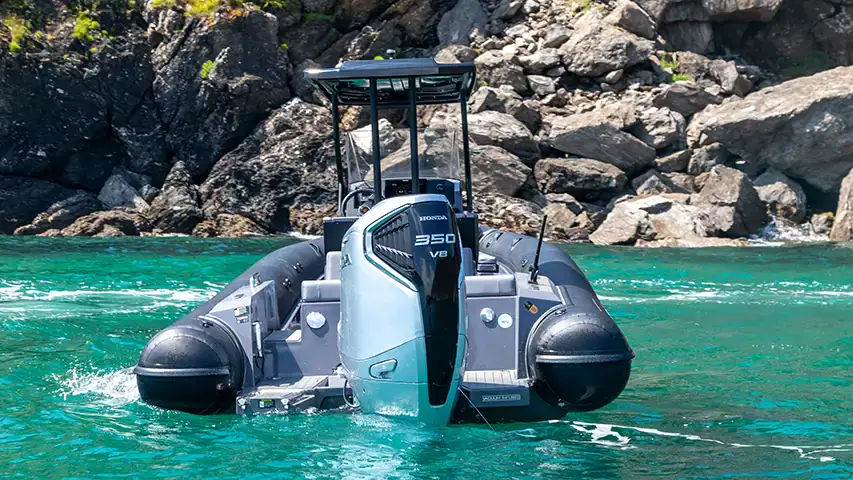

Redundancy matters most for offshore use, remote cruising, or commercial and charter operations where reliability is non-negotiable. For coastal day boating close to help, a well-maintained single engine is often entirely sufficient.
Two-Stroke vs Four-Stroke: A Quick Note
Modern outboards are overwhelmingly four-stroke, offering better fuel economy, lower emissions and quieter operation than older two-stroke designs.
Two-stroke outboards still exist in the used market and offer a lighter weight advantage, but expect higher fuel consumption and stricter emissions restrictions in many regions.
For most buyers today, particularly when purchasing new, four-stroke is the practical default.
New, Used or Refurbished: Weighing the Options
New outboards carry full manufacturer warranty and the latest fuel-efficiency and reliability improvements, at the highest purchase cost.
Used outboards can offer significant savings, but engine hours and documented service history matter enormously. An outboard with high hours but meticulous servicing often outperforms a low-hours engine that sat neglected.
Refurbished outboards, professionally reconditioned by a dealer or specialist, can bridge the gap, offering some warranty assurance at a lower price than new.
Whichever route you choose, our Buying a Used RIB: Complete Inspection Guide covers exactly how to assess a used outboard’s real condition before committing.
Weight, Transom Strength and Correct Installation
Every RIB’s transom is engineered for a specific weight range.
Fitting an engine heavier than the transom was designed for, even within the horsepower range, can cause long-term structural stress.
Correct mounting height and trim angle also affect performance significantly, sometimes more than horsepower itself.
A poorly mounted engine, even a powerful one, delivers disappointing performance and increases fuel consumption.
Professional installation, or at minimum professional verification of an existing installation, protects both performance and safety.
Matching Engine Choice to Boat Size
Engine requirements scale directly with hull size and weight. As a rough guide, based on typical manufacturer recommendations:
| RIB Length | Typical Horsepower Range |
|---|---|
| 2,5 – 3,5 m | 15 – 40 hp |
| 3,5 – 5 m | 40 – 90 hp |
| 5 – 6,5 m | 90 – 150 hp |
| 6,5 – 9 m | 150 – 300 hp, often twin installation |
| 9 m+ | Twin or triple, 300 hp+ |
For a complete sizing decision that considers passengers, use case and towing alongside engine requirements, see our guide What Size RIB Do I Need?.
Frequently Asked Questions
Can I fit a more powerful engine than the manufacturer recommends?
No. Exceeding the recommended maximum risks transom damage, handling problems and can invalidate insurance or certification.
Is a twin-engine setup worth the extra cost for leisure use?
It depends on use case. Offshore or remote boating benefits significantly from the redundancy; coastal day boating close to assistance often doesn’t require it.
How do I know if a used outboard is in good condition?
Check documented service history, inspect the lower unit for water intrusion, and always arrange a sea trial before purchase.
Does engine weight affect a RIB’s handling?
Yes, significantly. Correct weight and mounting height affect planing behaviour, fuel efficiency and overall handling more than most buyers expect.
Related reading: What Is a Rigid Inflatable Boat? · RIB Buying Guide · What Size RIB Do I Need? · Buying a Used RIB: Complete Inspection Guide · Single vs Twin Outboards on a RIB