What RIB Insurance Covers, What It Costs, and How to Choose a Policy
Insurance is one of the least exciting parts of RIB ownership, but it’s also one of the most important. Policies vary considerably in coverage, exclusions, and cost, making comparison genuinely worthwhile before committing.
This guide explains what RIB insurance typically covers, what affects premiums, and how to choose sensibly.
Why RIB Insurance Matters
RIBs carry real financial exposure: hull damage, engine failure, theft, and liability for injury or damage to others. Some marinas, clubs, and events require proof of insurance, particularly third-party liability cover, before granting access.
Even where not legally mandatory, insurance protects against costs that could otherwise be financially significant.
Make Sure You Have at Least These Documents at Hand
First of all you have to present a proof of ownership. It is the original purchase invoice, bill of sale, or a formal vessel value attestation.
Vessel Details: Clear photographs of the hull, tubes, outboard/inboard engine, and safety equipment, plus any prior insurer statements of history.
Registration Papers: Official flag registration deed.
Types of Coverage Available

© 2026 Medianaut, Nautical News Media
Third-party liability covers damage or injury you cause to others, typically the minimum level many marinas require. Hull and machinery cover extends protection to your own boat and engine against damage, fire, and certain other risks.
Theft cover protects against the boat, trailer, or outboard being stolen, a genuine risk for trailerable RIBs. Personal accident cover extends protection to you and passengers in the event of injury while aboard.
What Typically Isn’t Covered
Wear and tear, gradual deterioration, and lack of maintenance are standard exclusions across most policies.
Our guide PVC vs Hypalon/CSM RIB Tubes explains how tube degradation over time falls outside typical insurance coverage.
Racing, unauthorised chartering, or use outside your policy’s stated navigation limits often void coverage entirely.
Always read exclusions carefully; assumptions about coverage are a common source of disputed claims.
Factors That Affect Premiums
Boat value, engine power, and hull material all influence premium calculations, with higher-value boats costing more to insure.
Navigation area matters significantly; offshore cover typically costs more than coastal-only or inland-only policies.
Your boating experience and claims history affect pricing too, similar to how driving history affects car insurance.
Storage method (marina, driveway, secured facility) can influence theft-related premium components.
Agreed Value vs Market Value Policies
Agreed value policies pay a pre-agreed sum in the event of total loss, regardless of market fluctuations.
Market value policies pay the boat’s assessed value at time of loss, which can be less predictable.
Agreed value offers more certainty but may carry a higher premium than an equivalent market value policy.
How to Choose a Policy
Compare navigation limits carefully against where you actually boat, not just where you boat most of the time.
Check excess (deductible) amounts, since a low premium with a high excess may cost more overall after a claim.
Confirm whether trailer and outboard are covered separately or bundled within the main hull policy.
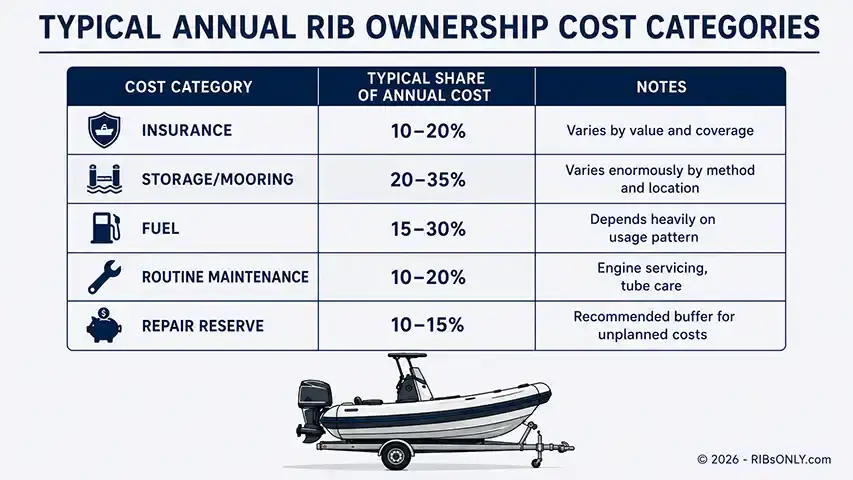
Our guide RIB Ownership Costs places insurance within the broader picture of annual ownership expenses.
Reducing Your Premium
Security measures like trackers, hitch locks, and secured storage can reduce theft-related premium components meaningfully.
Completing recognised boating safety courses sometimes qualifies for discounts with certain insurers.
Bundling policies, such as boat and trailer together, can occasionally reduce overall cost compared with separate policies.
Choosing Insurance That Fits Your Boating Pattern
Match navigation limits and coverage type to your actual boating pattern, not a generic minimum policy.
Review your policy annually, since boat value, usage pattern, and storage method can all change over time.
Our RIB Buying Guide: How to Choose the Right Boat touches on insurance as part of the full ownership cost picture.
Frequently Asked Questions
Is RIB insurance legally required?
Not universally, but many marinas and clubs require at least third-party liability cover for access.
What’s the difference between agreed value and market value policies?
Agreed value pays a pre-set sum on total loss; market value pays the boat’s assessed value at that time.
Does insurance cover normal wear and tear on tubes?
No. Gradual deterioration and lack of maintenance are standard exclusions across nearly all policies.
Can I reduce my premium without reducing coverage?
Yes, often through security measures, safety courses, or bundling policies with the same insurer.
Related reading: What Is a Rigid Inflatable Boat? · PVC vs Hypalon/CSM RIB Tubes · RIB Ownership Costs · How Much Does a RIB Cost? · RIB Buying Guide: How to Choose the Right Boat