Your Trailer Carries Your Investment
A RIB trailer is as safety-critical as the boat itself, yet it receives far less attention from most owners. Most trailering incidents trace back to setup and towing habits, not to the road or the trailer’s build quality.
This guide covers choosing the right RIB trailer, safe towing practice, and the launching and retrieval steps that prevent the most common mistakes.
Matching the RIB Trailer to the Boat
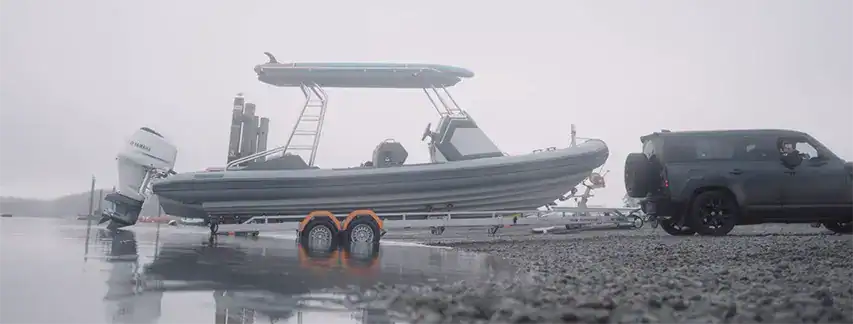
A correctly matched RIB trailer supports the hull properly across its full length, not just at a few contact points. Mismatched trailers, even if technically rated for the weight, can cause hull stress over time from incorrect support.
Check that roller or bunk positions suit your specific hull shape, particularly for deep-V hulls where incorrect support can create pressure points along the keel line.
Confirming Your Tow Vehicle is Suitable
Before towing anything, confirm your vehicle’s rated towing capacity against the combined weight of boat, trailer, fuel and equipment, not the boat’s weight alone.
Check local regulations regarding towing licence requirements, trailer braking systems and maximum combined weight, as these vary considerably by country and trailer class.

Trailer Maintenance Checklist
A well-maintained RIB trailer prevents the vast majority of roadside problems.
- Check tyre pressure and condition, including the spare, before every significant trip.
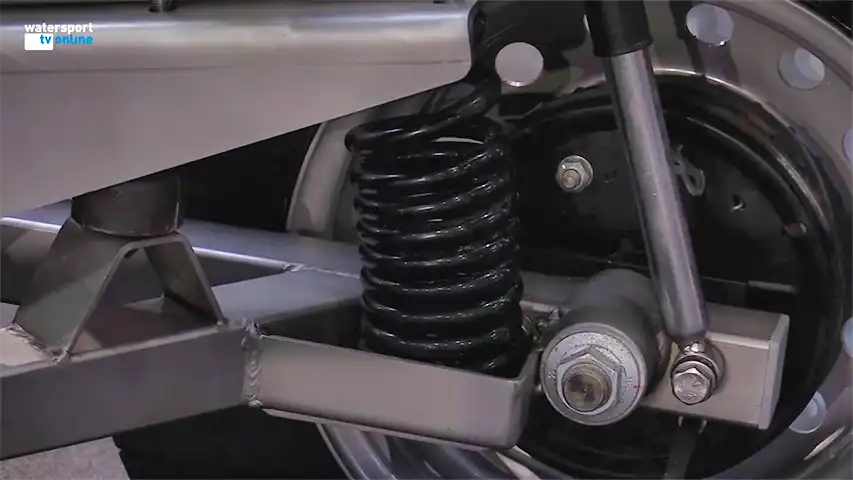
- Grease wheel bearings on a regular schedule, more frequently for trailers regularly submerged during launching.
- Test all lights, indicators and brake lights before departure.
- Inspect the winch, strap or chain securing the boat for wear or damage.
- Check safety chains and coupling mechanism for correct, secure attachment.
Loading the Boat Correctly
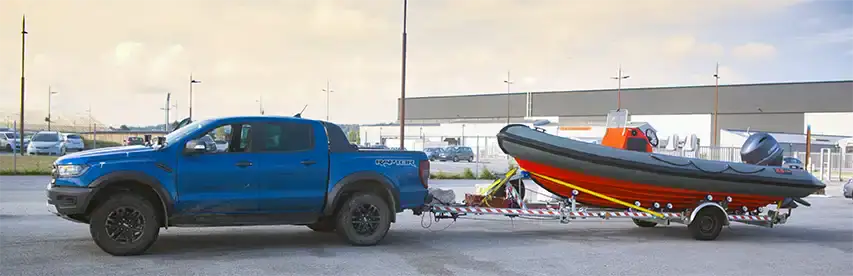
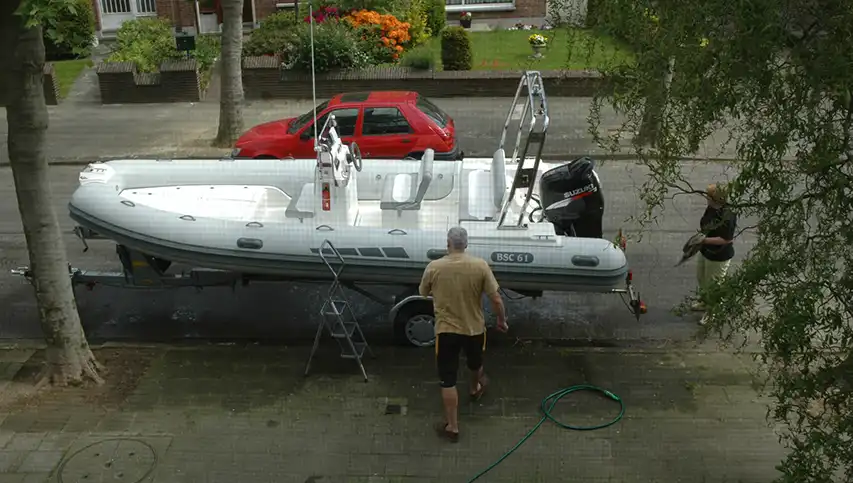
Position the boat so weight distributes appropriately over the trailer axle, avoiding excessive tongue weight or, conversely, a rear-heavy setup that reduces steering control.
Secure the boat with both the winch strap at the bow and additional transom tie-down straps for road travel. The winch strap alone isn’t designed to hold the boat in place during transport.
Safe Towing Practice
Driving with a loaded RIB trailer requires adjusted habits compared with normal driving.
- Allow significantly more distance for braking than usual.
- Take corners and roundabouts more slowly than feels necessary.
- Check mirrors regularly for trailer sway, and ease off the accelerator rather than braking sharply if sway develops.
- Plan routes avoiding unnecessarily tight manoeuvring where possible.
Launching Without Damage
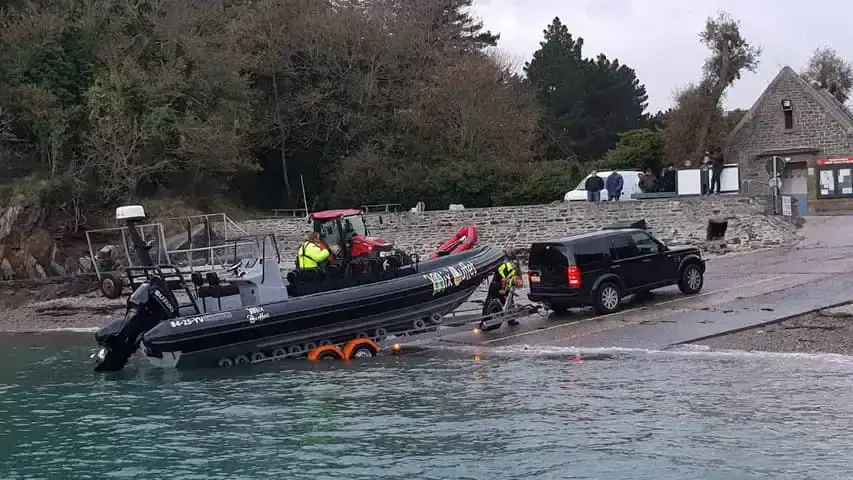
Before backing down the slipway, remove tie-down straps except the winch strap, and disconnect any trailer lights if your setup requires it to avoid electrical damage from submersion.
Back down slowly and evenly, watching for the trailer wheels reaching a safe depth without submerging the vehicle’s exhaust or electrical components.
Release the boat under control, using the winch to ease it off rather than releasing it to float free suddenly, particularly on trailers with steep ramp angles.
Retrieval Without Stress
Line up the trailer centrally in the water before attempting to drive the boat on, rather than trying to correct alignment once the boat is already approaching.
Use the winch to draw the boat fully onto the trailer and seated correctly against the bow stop before pulling the trailer out of the water, avoiding a boat that shifts or turns during the final pull-out.
A Quick Pre-Trip Trailer Checklist
- Confirm combined weight is within your tow vehicle’s rated capacity.
- Check tyres, bearings and lights on the trailer.
- Load the boat with correct weight distribution.
- Secure both winch strap and transom tie-downs for road travel.
- Drive with adjusted following distance and cornering speed.
For buyers evaluating a used boat that includes a trailer, our Buying a Used RIB: Complete Inspection Guide covers what to check on the trailer itself before purchase.
Frequently Asked Questions
How often should I service my RIB trailer’s wheel bearings?
Roughly once a season for regular use, more often if the trailer is frequently submerged in saltwater during launching.
Is it safe to tow with only the winch strap securing the boat?
No. Always add separate transom tie-down straps for road travel; the winch strap alone isn’t designed for that load during transport.
Do I need a specific licence to tow a RIB trailer?
This depends on combined weight and your local regulations, which vary considerably by country. Always check current requirements for your specific setup.
Related reading: What Is a Rigid Inflatable Boat? · What Size RIB Do I Need? · Buying a Used RIB: Complete Inspection Guide