Family RIB Buying Guide

The number of passengers on the RIB  will determine the size
2025 RIB photo contest by RIBsONLY.com – © Michael.Nechajev

What Matters Most When Choosing a Rib for Family Boating

Buying a RIB for family use involves a different set of priorities than buying for performance or fishing. Safety, stability, seating comfort, and ease of handling typically outweigh raw speed or aggressive hull design.

This guide covers the specific factors that matter most when choosing a RIB that will carry a family safely and comfortably.

Priorities for Family Boating

Family RIBs need to balance capacity, stability, and manageable handling for a range of skill levels aboard. Unlike performance-focused buyers, most families prioritise a smooth, predictable ride over outright speed or sharp handling.

Ease of use matters too, since more than one family member may need to operate the boat confidently.

Size and Seating Capacity

These RIBs typically range from 5 to 7 metres, offering enough capacity for six to ten people comfortably. Check the manufacturer’s rated maximum capacity, but also consider realistic comfortable capacity for longer outings.

Our guide What Size RIB Do I Need? covers sizing principles that apply directly to family-use decisions.

Bow seating with proper handholds and backrests matters more for families than it does for performance-focused buyers.

Choosing a family RIB to enjoy the time on the water @ RIBs ONLY - Home of the Rigid Inflatable Boat
This large family RIB has a great deck layout – © Highfield Boats

Stability and Safety Features

A wider beam and higher tube volume generally improve stability at rest, useful for swimming stops and boarding. Look for boarding ladders, swim platforms, and secure handholds throughout the boat, not just at the helm.

Our guide Essential Safety Equipment for a RIB covers the equipment every family RIB should carry as standard. And Are Rigid Inflatable Boats Safe? explains the inherent stability advantages RIBs offer over comparable hard-hull boats.

Comfort Features for Longer Days

Sun shade or a bimini top makes a significant difference on longer summer outings with children aboard. Cushioned, well-padded seating throughout improves comfort considerably compared with basic bench seating on entry-level models.

Adequate stowage for gear, coolers, and safety equipment keeps the boat organised and safer to move around.

Engine Power for Family Use

Family RIBs generally don’t need maximum available horsepower; moderate power with good low-speed manners is more valuable. Prioritise smooth throttle response and easy low-speed handling over top speed for family-oriented boating.

Twin engines add redundancy and confidence for families boating further from shore, though at higher cost.

Budget Considerations

Family RIBs sit in a wide price range depending on size, brand, and engine configuration. Our guide How Much Does a RIB Cost? breaks down the cost factors relevant to typical family-oriented purchases.

Factor in ongoing costs too: fuel, storage, insurance, and safety equipment add up over a season of use.

RIB length and number of persons tabel @ RIBs ONLY - Home of the Rigid Inflatable Boat

RIB length and number of persons tabel – © 2026 Medianaut, Nautical News Media

Choosing the Right Family RIB

Prioritise stability, safety features, and comfortable seating over raw performance for most family boating scenarios. Test the boat with your typical passenger load, not empty, since handling changes meaningfully with weight aboard.

Our RIB Buying Guide: How to Choose the Right Boat covers the full decision process alongside these family-specific priorities.


Frequently Asked Questions

What size RIB is best for a family of four?
A 5 to 5,5 metre RIB comfortably serves a family of four, with room for gear and safety equipment.

Do family RIBs need twin engines?
Not necessarily. A single well-matched engine is often sufficient; twins add redundancy at higher cost.

What safety features matter most for family use?
A secure boarding ladder, sturdy handholds, proper lifejackets for all ages, and a stable swim platform.

Is a bigger RIB always better for families?
Not always. Bigger boats cost more to run and store; match size to realistic typical passenger numbers. But that’s a personal choice.


Related reading: What Is a Rigid Inflatable Boat? · What Size RIB Do I Need? · Essential Safety Equipment for a RIB · Are Rigid Inflatable Boats Safe? · How Much Does a RIB Cost?

Tender RIB Buying Guide

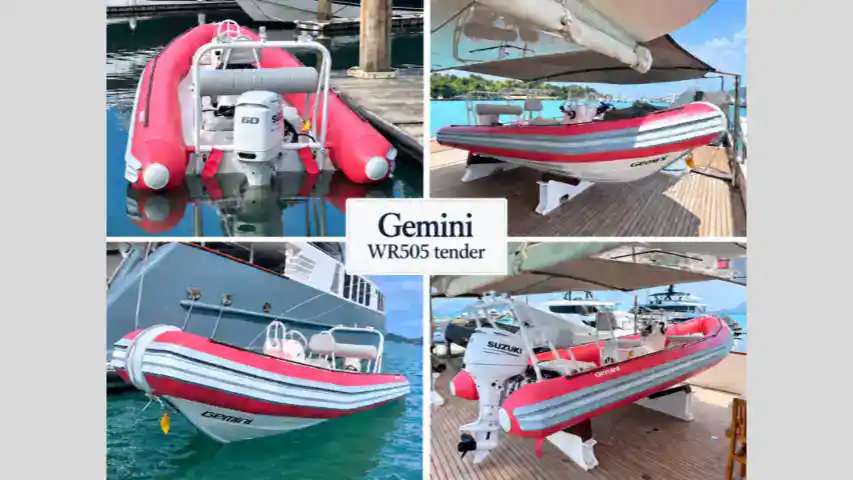
A special tender RIB used for a yacht @ RIBs ONLY - Home of the Rigid Inflatable Boat

Who picked the colour? – © Gemini Marine

Choosing the Right Tender RIB to Serve a Larger Yacht

A tender RIB serves a different purpose than a standalone leisure boat, and that changes almost every buying decision.

Size, weight, storage method, and folding capability matter more here than they do for most other RIB purchases.

This guide covers what to prioritise when choosing a RIB specifically to serve as a yacht or cruiser tender.

What Makes a Good Tender RIB

A tender’s primary job is safe, practical transport between the mothership and shore, nothing more.

This means compactness, low weight, and easy handling typically matter more than outright performance or comfort.

Durability still matters, since tenders are used frequently and often handled roughly during loading and unloading.

Size and Weight Constraints

Tender size is dictated by the mothership’s davit, garage, or deck storage capacity, not by personal preference.

Check maximum length, beam, and weight limits for your specific storage system before considering any particular model.

Davit-launched tenders typically range from 2.5 to 4 metres, with weight limits often between 150 and 400 kilograms.

Garage-stored tenders may need to fold or deflate partially, depending on available garage dimensions.

Our guide What Size RIB Do I Need? covers sizing principles that apply here too, adapted for storage constraints.

Rigid vs Folding Tenders

Rigid tenders offer better performance and durability but take up fixed space regardless of storage method.

Folding or roll-up tenders trade some rigidity and performance for significantly reduced storage footprint when not in use.

For davit or garage storage with generous space, rigid tenders are generally the stronger long-term choice.

For tight storage or occasional use, a folding design may be the more practical compromise.

Tube Material for Tenders

Tenders spend more time exposed to sun, salt, and abrasion from loading than many leisure RIBs.

Hypalon/CSM is often favoured for tenders in sunny climates, given its superior UV resistance over long service life.

Our guide PVC vs Hypalon/CSM RIB Tubes explains this trade-off in full, including cost and climate considerations.

Engine and Performance for Tenders

Most tenders run smaller outboards, typically between 15 and 60 horsepower, prioritising weight and simplicity over speed.

Lighter four-stroke outboards are common, balancing reasonable performance against the weight limits of davit systems.

Our guide How to Choose an Outboard for a RIB covers outboard selection principles that apply to tenders as well.

Storage and Handling Features

Look for reinforced lifting points rated for your davit system’s specific hardware and weight capacity.

Non-marking fenders or rub strips protect both the tender and the mothership’s hull during loading.

Consider how easily the tender can be washed down and drained after saltwater use, given frequent handling.

Cost Considerations

Tender pricing varies enormously by size, material, and engine, typically ranging from a few thousand to tens of thousands.

Our guide How Much Does a RIB Cost? breaks down the factors driving price across all RIB categories, tenders included.

Factor in davit or garage compatibility costs, since retrofitting storage systems can add significantly to the total.

Mothership lengthTypical tender lengthStorage method
Under 12 m2,5 – 3,2 mDeck chocks or small davit
12 – 18 m3,0 – 3,8 mDavit or garage
18 – 25 m3,5 – 4,5 mGarage or davit
25 m and above4,0 m and aboveGarage or dedicated tender deck

Tender RIB sizing by mothership length, purely indicative – © 2026 Medianaut, Nautical News Media

Which Tender Should You Choose?

Choose a rigid tender if your storage system has generous space and performance matters for guest use. Choose a folding tender if storage space is limited or the tender is used only occasionally.

Prioritise weight limits and davit compatibility above all else; a perfect tender that doesn’t fit is no tender at all.

To help you create a reference, watch these videos of many tender brands like Highfield, Northstar, Zodiac, Gemini, Interactor, AB Inflatables … to name a few.

Our RIB Buying Guide: How to Choose the Right Boat covers the broader decision framework alongside tender-specific factors.


Frequently Asked Questions

How heavy can a tender be for davit storage?
This depends entirely on your davit’s rated capacity, typically between 150 and 400 kilograms including engine and fuel.

Is Hypalon worth the extra cost for a tender?
Often yes, given frequent sun exposure and handling. The longer lifespan usually justifies the premium for tender use.

Can a folding tender perform as well as a rigid one?
Generally no. Folding tenders trade some rigidity and speed for significantly reduced storage footprint.

What engine size is typical for a yacht tender?
Most tenders use 15 to 60 horsepower outboards, balancing weight limits against reasonable performance.


Related reading: What Is a Rigid Inflatable Boat? · What Size RIB Do I Need? · PVC vs Hypalon/CSM RIB Tubes · How to Choose an Outboard for a RIB · How Much Does a RIB Cost? · videos of tender brands


Aluminium vs Fibreglass RIB

Aluminium vs Fibreglass RIB @ RIBs ONLY - Home of the Rigid Inflatable Boat
Left: After the fibreglass is laid up, the hull is vacuum-sealed for resin infusion.
Right: The aluminium hull is assembled by welding the individual sections together.
© Gemini Marine – © Highfield Boats

Learn All About Both Materials

Hull material shapes a RIB’s ride, weight, durability and even its resale market, often more than buyers expect before comparing the two side by side.

Aluminium and fibreglass (also known as GRP) each have genuine strengths, and neither is objectively superior across every use case.

This guide compares both materials honestly, covering the trade-offs that matter once you’re standing on the dock deciding between two real boats.

Construction: How Each Hull is Built

GRP (fibreglass) hulls are built by laying layers of glass fibre and resin into a mould, sometimes with a foam or balsa core for added stiffness and buoyancy. This process allows complex, smoothly curved hull shapes and consistent quality across production runs.

Aluminium hulls are typically welded from marine-grade aluminium plate and extrusions, a process closer to traditional metal boatbuilding. This construction method favours simpler, often more angular hull shapes, though modern techniques increasingly allow more refined forms.

Ride Quality and Noise

This is one of the most noticeable differences owners report after switching between the two materials.

Fibreglass hulls (GRP) flex slightly under load, which helps absorb some vibration and impact energy. Combined with the resin matrix’s natural damping properties, this generally produces a quieter, smoother-feeling ride, particularly at speed in a chop.

Aluminium hulls are stiffer and transmit more vibration and slap noise through the structure, especially in choppy conditions. Many owners describe aluminium RIBs as noticeably louder underway, though hull design and construction quality significantly affect how pronounced this difference feels in practice.

Weight and Performance

Aluminium can offer a genuine weight advantage in certain configurations, particularly for larger hulls, since it achieves structural strength with thinner material than fibreglass (GRP) requires for equivalent rigidity.

This weight advantage can translate into better power-to-weight ratios, marginally improved fuel efficiency, or the ability to run a smaller engine for equivalent performance.

The practical difference varies considerably by specific hull design and size, and isn’t universal across every model comparison.

Durability and Impact Resistance

Aluminium’s standout advantage is impact resistance.

It dents rather than cracks under significant impact, and dents can often be repaired without the structural concerns that accompany GRP damage (fibreglass).

This resilience explains aluminium’s popularity in commercial, rescue and working environments where hull impacts are routine.

Fibreglass (GRP) performs excellently under normal use but is more vulnerable to cracking or delamination under significant impact, particularly if a core material is compromised by water intrusion following damage.

Well-built GRP hulls are robust, but repairs after serious impact are typically more involved and costly than aluminium dent repair.

Corrosion and Long-term Maintenance

GRP (fibreglass) doesn’t corrode in the way metal does, though gelcoat can fade, chalk or develop osmosis blisters over many years without proper care.

Aluminium requires attention to galvanic corrosion, particularly around fittings, fasteners and areas where dissimilar metals meet. Saltwater use demands proper anode maintenance and attentive care around any electrical connections. Well-maintained aluminium hulls resist corrosion effectively, but neglect carries real consequences over time.

Repair Complexity

Minor aluminium dents are often straightforward for a competent welder to address, and welding repairs, while requiring specific skills, are widely available in most boating regions.

GRP (fibreglass) repairs require gelcoat matching, resin work and, for structural damage, careful attention to core material condition.

Cosmetic GRP repairs are generally accessible; structural repairs benefit strongly from professional expertise.

Resale Value and Market Preference

Resale patterns vary considerably by region and market segment.

In many leisure markets, GRP remains the more commonly traded material, benefiting from broader buyer familiarity and typically stronger aesthetic resale appeal.

Aluminium holds strong resale value in commercial, rescue and working-boat markets, where its durability credentials directly translate into buyer confidence.

Checking local market trends for your specific region and intended resale timeline is worthwhile before treating either material as the automatically “safer” resale choice.

Cost Comparison

Pricing varies significantly by manufacturer, size and specification, making broad generalisations risky.

That said, aluminium construction, particularly for smaller hulls, can carry a cost premium related to labour-intensive welding processes, while GRP benefits from more standardised mould-based production at scale for popular models.

Larger aluminium hulls sometimes narrow or reverse this gap, given the material efficiency advantages at bigger sizes.

Always compare specific, equivalent models rather than assuming one material is universally cheaper.

Which Should You Choose?

Choose fibreglass (GRP) if ride comfort, noise levels and broad leisure-market resale familiarity matter most to your priorities.

Choose aluminium if impact resistance, repairability after damage, and proven performance in demanding or commercial-adjacent use matter more than ride refinement.

Many rescue services, commercial operators and serious offshore users choose aluminium specifically for its durability under repeated hard use.

Many leisure buyers choose GRP (fibreglass) specifically for the smoother, quieter experience it typically delivers.

Our complete RIB Buying Guide places this decision alongside sizing, tube material and engine choice for a full picture of what matters most to you.


Frequently Asked Questions

Is aluminium always heavier than fibreglass (GRP)?
Not necessarily. Aluminium can achieve strength with thinner material, sometimes producing lighter hulls than GRP at equivalent sizes, though this varies by specific design.

Which material is better for saltwater use?
Both perform well in saltwater with proper maintenance. Aluminium requires attentive corrosion management; GRP requires attentive gelcoat and core care.

Do aluminium RIBs really sound louder underway?
Generally yes, due to the material’s stiffness transmitting more vibration, though hull design and construction quality significantly affect how noticeable this is.

Is one material objectively safer than the other?
No. Both materials, properly built and maintained, deliver excellent safety records across leisure, commercial and rescue applications worldwide.


Related reading: What Is a Rigid Inflatable Boat? · How Does a RIB Work? · RIB Buying Guide · Best RIB for Rough Water


A Phenomenal Two Day Pasty Run

OCRDA bank holiday weekender @ RIBs ONLY - Home of the Rigid Inflatable Boat
Three of the fourteen participating RIBs – all photos by Aaron Squirrell and Tornado Tom

Fourteen RIBs and Two Jet Skis at the Pasty Run

The 14th Annual Pasty Run and Hunt took place during the weekend of 23rd and 24th May 2026 across Devon and Cornwall waters.

The event has grown significantly over recent years and is now probably the South Coast’s largest RIB gathering, outside Easdale in Scotland.

The event originally began after the Nacho Run, organised through Ribnet, where Hampshire crews enjoyed nachos while Cornish crews preferred pasties instead.

Over the years, RIBs of every size and style gathered together, cruising Cornish waters while searching enthusiastically for the famous elusive pasty.

For the first time, the 2026 event included an overnight stop, travelling east into Devon instead of remaining within Cornwall throughout entirely.

Fourteen RIBs and two jet skis travelled from Plymouth Breakwater Fort to Torquay, stopping overnight through Salcombe and Dartmouth during the social cruise.

The RIBs

The cruise was led by a Highfield Patrol 600, while an impressive Highfield Sport 700 followed behind, bringing up the rear.

Between the Highfields were RIBs of many shapes and sizes, including a 4m Tornado, Atlantic 21, and solid 7.4m Delta prominently.

Other boats included a Ribcraft, Ribtec, several Brigs, an Osprey, a Valiant, Avon Super Sport, and an X-Pro among the fleet.

Two Sea-Doos joined the adventure, although a third jet ski, a Yamaha, unfortunately failed to reach the starting location before departure.

Continue reading below the photo gallery.

Continue Reading →

HamiltonJet Waterjet Impressive Built Technology

HamiltonJet Started in 1950

I thought it might be interesting to show how a waterjet propulsion is built. There are RIB brands that offer that option like Highfield, Williams, Zodiac Nautic, and others.

I found this video and although it’s from 2015, it’s still very impressive. Of course you still need an engine. Mostly it’s inboards.

But Honda, Yamaha and Mercury offer also outboards jet systems. But that’s another story.

What are the advantages of et propulsion for a boat?

  • High speed and acceleration
    Jet propulsion systems deliver strong thrust and rapid acceleration, making a RIB (Rigid Inflatable Boat) extremely fast and responsive, even in demanding sea conditions.
  • Improved safety
    Because there is no exposed propeller, jet propulsion reduces the risk of injury to swimmers, divers, and marine life. It is also safer when operating in shallow water.
  • Excellent maneuverability
    Jet-driven RIBs offer precise handling and tight turning capability. They can quickly change direction, stop efficiently, and operate effectively in confined or challenging environm

Here’s some background info of the company.

Marine propulsion took a decisive turn in the 1950s when Sir William Hamilton developed the first commercial waterjet.

More than 70 years later, the New Zealand based company, remains among the industry’s foremost names in waterjets and vessel control technology.

Now they offer 6 series. You’ll find them on their website: hamiltonjet.com.


This video was published on the HamiltonJet YouTube channel.

You can see here more videos of jet propelled RIBs.


×