How Does a RIB Work?

A RIB in planing behaviour @ RIBs ONLY - Home of the Rigid Inflatable Boat
A RIB on plane – © 2026 – Northstar

This is How!

A RIB works by combining two separate systems into one boat: a rigid, planing hull below, and a flexible, buoyant tube structure above.

Neither part alone would perform nearly as well as the two working together.

This article explains exactly how that combination functions, from the physics of planing to the practical role each tube chamber plays underway.

The Hull: How It Achieves Speed

At rest, or at low speed, the hull sits deep in the water like any displacement boat.

As speed increases, water pressure beneath the hull increases too. Past a certain speed, that pressure becomes strong enough to lift most of the hull clear of the water.

This is called planing. Once planing, the boat rides on a much smaller wetted surface area.

Drag drops sharply, and speed increases dramatically for the same engine power.

This is the same basic principle that lets any hard-hull motorboat plane, and a RIB’s rigid hull is essential to making it happen efficiently.

The deadrise angle, essentially how sharp the V-shape is, determines how the hull handles waves. A sharper deadrise cuts through chop more smoothly but sacrifices some stability at rest.

Our guide Best RIB for Rough Water: What Really Matters? explains this trade-off for real buying decisions.

The Tubes: How They Add Stability Underway

While the hull provides speed, the tubes provide the stability that keeps a narrow, fast hull from rolling.

At cruising speed in calm water, the tubes barely touch the surface.

Their role becomes active the moment the boat heels, whether from a turn, a wave, or shifting weight on board.

As the boat leans to one side, that side’s tube compresses into the water.

Compressed air inside the tube resists further compression, pushing back against the heel and helping right the boat.

This happens automatically, continuously and without any input from the skipper.

Why Multiple Air Chambers Matter
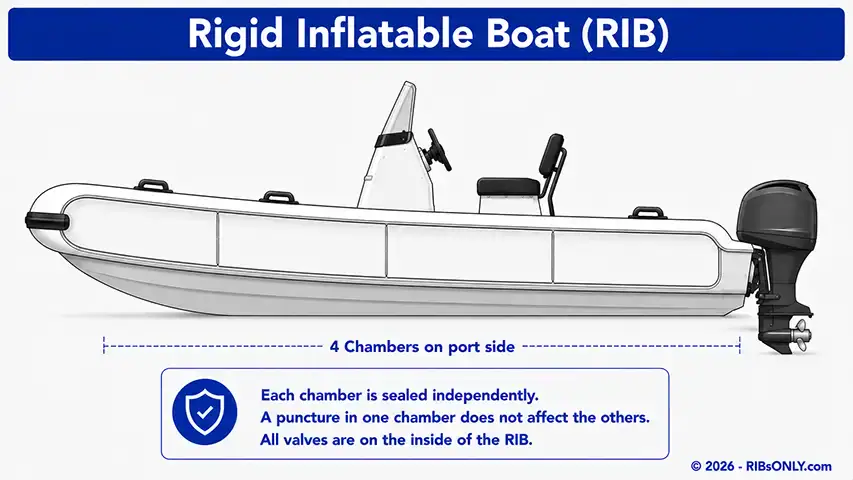
Cutaway diagram of RIB tube air chambers and valve system @ RIBs ONLY - Home of the Rigid Inflatable Boat
RIB cutaway showing the tube’s chambers – © 2026 Medianaut, Nautical News Media – Karel Overlaet

Most RIB tubes are divided into between three and seven separate, sealed air chambers, rather than one continuous tube.

This matters enormously for safety.

If one chamber is punctured or damaged, only that section loses pressure. The remaining chambers continue providing buoyancy and stability, keeping the boat safely afloat and manoeuvrable.

We explain the real-world safety implications of this design in full in Are Rigid Inflatable Boats Safe? and Can a RIB Sink?.

Tube Pressure: Why It’s Carefully Managed

RIB tubes are inflated to a specific pressure range, typically measured in PSI or millibar, set by the manufacturer for that particular boat.

Correct pressure matters for two reasons. Underinflated tubes flex too much, reducing stability and increasing drag. Overinflated tubes become rigid and brittle, increasing the risk of seam damage under impact.

Pressure also changes with temperature.

Tubes inflated in cool morning air can become noticeably firmer once the sun heats them through the day, which is why experienced owners check pressure regularly rather than only at haul-out.

How Hull Material Affects Overall Behaviour

The hull’s material, GRP or aluminium, doesn’t change the basic planing principle, but it does affect weight, flex and noise underway.

GRP hulls tend to flex slightly and absorb some vibration, producing a quieter ride.

Aluminium hulls are stiffer and often lighter for a given size, but can transmit more noise and vibration through the structure.

Our full comparison, Aluminium vs Fibreglass RIB, covers how this affects real-world ownership beyond the physics.

Putting It All Together

A RIB works because its two systems solve two different problems simultaneously.

The rigid hull delivers speed through efficient planing.

Tubes provide overall stability @ RIBs ONLY - Home of the Rigid Inflatable Boat
Tubes provide overall stability  – © Iceman Images – Anthony Hadaway

The inflatable tubes deliver stability, reserve buoyancy and impact absorption the hull alone cannot provide.

Neither system is redundant.

Remove the rigid hull, and you lose planing performance entirely, leaving a fully inflatable boat instead.

Remove the tubes, and you lose the stability and safety margin that makes RIBs so trusted in demanding conditions.

Our complete overview of this design, including its history and applications, is covered in What Is a Rigid Inflatable Boat?.


Frequently Asked Questions

Why do RIBs feel more stable than similar-sized hard-hull boats?
The tubes add buoyancy exactly where a hard-hull boat is weakest, at the sides, without adding significant hull width or weight.

Does tube pressure need checking every time before use?
Not strictly every time, but regular checks are important, since temperature and minor leaks both affect pressure over time.

Can a RIB plane with only one working tube chamber?
Usually yes. Planing depends primarily on the hull, so tube damage affects stability and buoyancy more than outright planing ability.


Related reading: What Is a Rigid Inflatable Boat? · Why Do RIBs Have Inflatable Tubes? · Aluminium vs Fibreglass RIB · RIB Buying Guide · Buying a Used Rigid Inflatable Boat? Free Download!


RIB vs RHIB: Meaning and Differences

RHIB fleet @ RIBs ONLY - Home of the Rigid Inflatable Boat
An impressive RHIB fleet – © 2026 – Tom Bettle

What’s the Difference?

RIB and RHIB refer to the same basic design: a rigid hull, wrapped in inflatable tubes. In terms of construction, there is no real difference between them.

So why do both terms exist and what’s the difference?

The answer lies in context, vocabulary and, often, vessel size rather than engineering.

What RHIB Stands For

RHIB stands for Rigid-Hulled Inflatable Boat.

It’s essentially a more formal, fully spelled-out version of the same concept behind the acronym RIB, which we cover in detail in What Does RIB Stand For?.

Where Each Term Is Used

RIB dominates leisure boating. Manufacturers, dealers and private owners overwhelmingly use this shorter term when describing recreational vessels.

RHIB dominates military, coastguard and commercial contexts. Navies, special forces and search-and-rescue organisations almost always use this fuller term in official documentation.

This pattern isn’t a strict rule, but it holds true across the vast majority of manufacturer catalogues, government procurement documents and industry publications.

Are There Any Real Design Differences?

Not in the core structure, but there are meaningful trends worth knowing.

Size. RHIBs used by military and coastguard services tend to run larger, often 7 metres and up, built to carry more crew and heavier equipment.

Robustness. RHIBs frequently feature reinforced hulls, higher-spec tube fabrics and redundant systems, built to survive extreme, repeated operational stress.

Equipment. Military and commercial RHIBs often carry specialised electronics, weapon mounts or towing systems that leisure RIBs never need.

Certification. RHIBs built for government or commercial service typically meet stricter certification standards than leisure RIBs of similar size.

None of these differences comes from the acronym itself. They come from the demands of the sector using the boat.

A lifeboat RHIB @ RIBs ONLY - Home of the Rigid Inflatable Boat
A lifeboat RHIB with visible hull design and special tubes – © Andy Squirrell

Training session using a RHIB @ RIBs ONLY - Home of the Rigid Inflatable Boat
Training using a RHIB – © Andy Squirrell

A Simple Way to Remember It

If you’re buying a boat for leisure, you’ll almost always call it, and find it listed as, a RIB.

If you’re researching military, coastguard or commercial vessels, you’ll almost always encounter the term RHIB instead.

Either way, the underlying design principle is identical: a rigid hull for performance, wrapped in inflatable tubes for stability and buoyancy.

The difference lies in what the boat is being built for.

Our complete explanation of that design lives in What Is a Rigid Inflatable Boat?.


Frequently Asked Questions

Is a RHIB always bigger than a RIB?
Not always, but larger vessels are more commonly labelled RHIB, especially in military and commercial fleets.

Can I call my leisure boat a RHIB instead of a RIB?
Technically, yes. The terms describe the same design. In practice, most leisure boaters use “RIB” simply because it’s the industry norm.

Do RHIBs cost more than RIBs of the same size?
Often yes, due to reinforced construction, certification requirements and specialised equipment common in military and commercial builds.


Related reading: What Is a Rigid Inflatable Boat? · What Does RIB Stand For? · Are Rigid Inflatable Boats Safe? · RIB Buying Guide · Buying a Used Rigid Inflatable Boat? Free Download!


Buying a Used Rigid Inflatable Boat? Free Download!

Looking for a used RIB - Your  Buyers Checklist @ RIBs ONLY - Home of the Rigid Inflatable Boat
Download the guide by clicking the image above – © 2026 Medianaut, Nautical News Media

Buying a Used RIB: The Complete Inspection Guide

A used Rigid Inflatable Boat can be the smartest purchase in boating, or the most expensive mistake you make this year.

The difference almost always comes down to inspection.

A hard-hull boat hides its problems in the gelcoat and the bilge.

A RIB hides half its problems inside inflatable tubes you cannot see through.

Most buyers don’t know what to look for, and most sellers know that too.

This article explains what actually matters when you inspect a used RIB, and why.

For the exact checks, the specific questions to ask, and the walk-away thresholds, we’ve put everything into one practical resource.

📘 Get the Full Checklist Free

Looking for a Used RIB? Your Ultimate RIB Buyer’s Checklist is a free, 23-page guide published by Medianaut, Nautical News Media for RIBsONLY.com.

It was written by eleven contributors from across the RIB industry:

Adam Younger, Andy Squirrell, Arjen Maan, Fraser Mackie, Mike Tilley, Petter Martens, René Haar, Robin Kilroy, Roy Andersen, Tim De Rick and Tom Bettle.

It contains the full point-by-point inspection sequence, the exact questions to ask a seller, and clear thresholds for when to walk away.

Download the free checklist PDF now.

No inbox spam, just the guide. Print it, bring it to the viewing.

Why a Used RIB Needs a Different Approach

A hard-hull boat ages mostly in one material, at a fairly predictable rate. A RIB ages in two materials, at two very different speeds.

The hull, whether GRP or aluminium, degrades slowly. The tubes degrade faster, and far less predictably.

UV exposure, storage conditions and repair history all shape how a specific set of tubes has aged, regardless of the boat’s registered year.

This means the calendar age of a used RIB tells you far less than it would for an equivalent hard-hull boat.

Two identical models from the same year can be in completely different condition, depending purely on how they were kept.

The eleven contributors behind our checklist have inspected, surveyed, sold and operated RIBs professionally for decades between them.

Their combined experience is what separates a confident purchase from a costly guess.

Before You Even View the Boat

A short round of questions, asked before you travel, saves wasted trips and reveals sellers who avoid detail.

Ask for the hull identification number, the full service history, and a clear answer on when the tubes were last inspected or repaired. Ask directly why the boat is being sold, and whether it has ever been swamped or involved in a collision.

Vague or evasive answers to any of these are a warning sign before you’ve even left the driveway. Our checklist includes the exact wording we recommend using, and how to read between the lines of a seller’s response.

You’ll also want to confirm the boat’s CE category matches your intended use. Our separate guide, CE Categories for RIBs Explained, covers what each rating actually permits on the water.

The Tubes: Where Most Used RIBs Are Won or Lost

This is the single most important part of any used-RIB inspection, and the part buyers most often get wrong.

Tube condition depends on material. PVC and Hypalon/CSM age at genuinely different rates, and knowing which one you’re looking at changes what a fair asking price should be.

Our detailed comparison, PVC vs Hypalon/CSM RIB Tubes, explains the realistic lifespan of each.

Beyond material, there are specific visual, tactile and pressure-based checks that reveal a tube’s true condition, well before it visibly fails.

Chalking, seam behaviour, chamber firmness and patch history all tell a different part of the story, and each needs a different test.

Getting this section wrong is the single most common way used-RIB buyers overpay, or inherit an expensive repair within months of purchase.

📘 This Is the Part You Can’t Afford to Guess

The full checklist walks through every tube check step by step, including the overnight pressure test most buyers never think to run, and the exact seam and chamber inspection sequence surveyors use.

Download the free checklist PDF now.

Hull, Transom and Engine: Three More Areas That Matter

Beyond the tubes, three structural areas deserve close attention before you make an offer.

The hull behaves differently depending on material. GRP and aluminium each have their own failure signs, covered in full in Aluminium vs Fibreglass RIB.

The transom absorbs every ounce of engine thrust the boat produces. It is one of the few areas where a visual check alone is not enough, and where a specific mechanical test genuinely matters.

The engine tells its real condition through service history far more than through hours on the clock.

Our guide How to Choose an Outboard for a RIB explains what realistic hours and documentation should mean for your budget.

Each of these areas has clear pass/fail signals, which we lay out in full, checklist-style, in the downloadable guide.

The Sea Trial: Never Skip It

No dockside inspection, however thorough, replaces watching the boat perform under load.

Engine behaviour, hull handling and tube response all show themselves differently in motion than at rest.

A seller who resists a proper sea trial is telling you something important, whether they intend to or not.

Our checklist includes the specific things to listen and feel for during a test run, at idle, cruising speed and wide-open throttle.

When to Walk Away

Some findings aren’t negotiation points. They’re reasons to look elsewhere entirely.

The full checklist sets out clear thresholds for tubes, hull and transom, so you don’t have to guess where that line sits under pressure at a viewing.

Negotiating with Confidence

Every issue you find has a cost attached, and that cost belongs in the negotiation.

A precise, quote-backed number is far harder for a seller to dismiss than a vague objection.

Our guide includes guidance on turning inspection findings into fair, defensible price adjustments.

When in Doubt, Call a Surveyor

This guide, and the checklist behind it, will catch the vast majority of issues a buyer needs to know about.

Some findings, particularly hull delamination or structural transom damage, genuinely need a qualified marine surveyor’s professional judgement.

Their fee is small compared with the cost of an undisclosed structural problem.


Don’t Walk Into a Viewing Unprepared

Everything in this article points to one conclusion: a used RIB rewards buyers who know exactly what to check, and punishes those who don’t.

Looking for a Used RIB? Your Ultimate RIB Buyer’s Checklist puts the full inspection sequence, the right questions, and clear walk-away thresholds in your hands, for free.

23 pages. Eleven contributors. Written for exactly the moment you’re standing next to a boat, deciding whether to buy it.

📘 Download the Free Ultimate RIB Buyer’s Checklist.


Frequently Asked Questions

How old is too old for a used RIB?
Age alone is not the deciding factor. A well-maintained 15-year-old RIB with recent tubes can be a better buy than a neglected 5-year-old boat.

Can RIB tubes be replaced instead of repaired?
Yes. Full tube replacement is common and, on an otherwise sound hull, often the right long-term investment.

Should I buy a used RIB without a sea trial?
No. A sea trial reveals engine, steering and hull-behaviour issues that a dockside inspection simply cannot show.

Is a private sale riskier than buying from a dealer?
Not necessarily, but private sales usually come with less warranty protection, which makes thorough inspection even more important.


Related reading: What Is a Rigid Inflatable Boat? · RIB Buying Guide · How Much Does a RIB Cost? · Are Rigid Inflatable Boats Safe?


This essential 23-page expert guide is published by Medianaut, Nautical News Media.


A Phenomenal Two Day Pasty Run

OCRDA bank holiday weekender @ RIBs ONLY - Home of the Rigid Inflatable Boat
Three of the fourteen participating RIBs – all photos by Aaron Squirrell and Tornado Tom

Fourteen RIBs and Two Jet Skis at the Pasty Run

The 14th Annual Pasty Run and Hunt took place during the weekend of 23rd and 24th May 2026 across Devon and Cornwall waters.

The event has grown significantly over recent years and is now probably the South Coast’s largest RIB gathering, outside Easdale in Scotland.

The event originally began after the Nacho Run, organised through Ribnet, where Hampshire crews enjoyed nachos while Cornish crews preferred pasties instead.

Over the years, RIBs of every size and style gathered together, cruising Cornish waters while searching enthusiastically for the famous elusive pasty.

For the first time, the 2026 event included an overnight stop, travelling east into Devon instead of remaining within Cornwall throughout entirely.

Fourteen RIBs and two jet skis travelled from Plymouth Breakwater Fort to Torquay, stopping overnight through Salcombe and Dartmouth during the social cruise.

The RIBs

The cruise was led by a Highfield Patrol 600, while an impressive Highfield Sport 700 followed behind, bringing up the rear.

Between the Highfields were RIBs of many shapes and sizes, including a 4m Tornado, Atlantic 21, and solid 7.4m Delta prominently.

Other boats included a Ribcraft, Ribtec, several Brigs, an Osprey, a Valiant, Avon Super Sport, and an X-Pro among the fleet.

Two Sea-Doos joined the adventure, although a third jet ski, a Yamaha, unfortunately failed to reach the starting location before departure.

Continue reading below the photo gallery.

Continue Reading →

Boot 2026: Three Countries, One Boat Show

Boot 2026: Three Countries, One Boat Show @ RIBs ONLY - Home of the Rigid Inflatable Boat

How We Got to Boot 2026

Another post focused on boats already. This story concentrates more on the journey than the displays.

This is true unless you study the photographs.

Boot Düsseldorf is the iconic marine show where manufacturers launch boats, dive equipment, sailing yachts, ribs, superyachts, and marine toys.

It had been on our list for years, and this time the diary finally aligned, so we went.

Travel and Stopover

Flying Exeter to Amsterdam with KLM cost more than easy Jet from Bristol but was far more convenient and comfortable.

KLM offered great flight times, generous baggage allowance, and complimentary drinks and cheese sandwiches.

Parking at the Grange Hotel meant a front-door drop-off, avoiding a long walk from remote car parks.

An overnight stay in Amsterdam ensured a relaxed evening and an early, stress-free start.

The hotel was clean, affordable, kettle-free, and fifteen minutes from the station.

Tourist tax was payable by card at reception, despite rooms being prepaid.

Coffin-style accommodation tempted us briefly but was fully booked.

Boot Düsseldorf Experience

The intercity train quickly took us to Düsseldorf, followed by a short tram ride to the Boot 2026 exhibition station.

Our first stop was the Highfield stand to see the newly launched ADV9.

The ADV9 builds on the ADV7 and is Highfield’s first cabin boat.

Continue Reading →
×