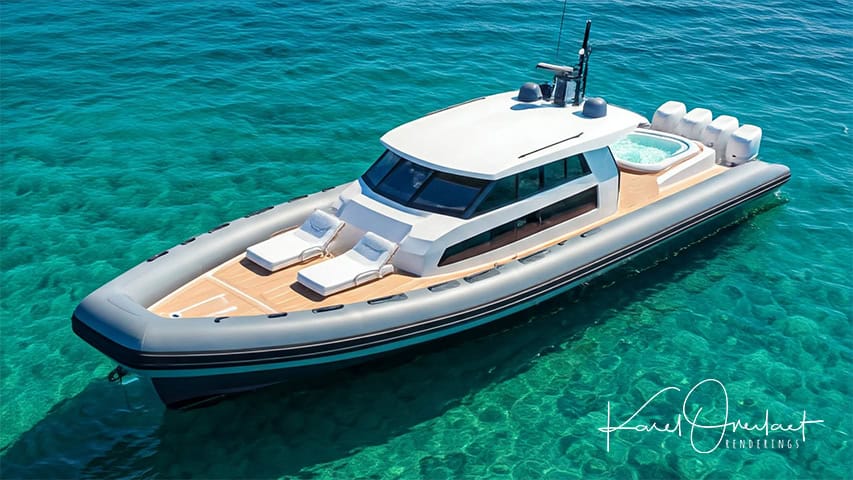
Built by the Italian yard Cantieri Opera, the Opera 60 was produced in a limited series between 2008 and 2010.
Only 38 examples were completed, including two high-power demonstrator models.
Production has long since ended, leaving the brokerage market as the only source for buyers.
Many surviving boats have spent years in commercial tourism or luxury charter service and have undergone extensive refits, according to published reports.
Size is the single decision that shapes almost everything else about owning a RIB.
Get it right, and the boat fits your life for years.
Get it wrong, and you’ll either outgrow it within a season or struggle with a boat too demanding for your actual needs.
This guide walks through sizing the practical way: by passengers, use case, towing capability and storage reality, rather than by what looks impressive at a boat show.
Why Size Matters More Than It First Appears
A RIB’s length affects far more than how many people fit on board.
It determines rough-water capability, fuel consumption, trailer weight, storage requirements and even which marinas or slipways you can realistically use.
Buyers who focus purely on passenger count often overlook these knock-on effects, then discover them the hard way after purchase.
Size by Passenger Count and Typical Use
Length
Typical Capacity
Best Suited For
2,5 – 3,5 m
2 – 4 people
Compact tender, yacht dinghy, occasional light use
3,5 -5 m
4 – 6 people
Day trips, watersports towing, family outings
5 – 6,5 m
6 – 8 people
Regular family boating, moderate offshore capability
6,5 – 9 m
8 – 12 people
Serious leisure, offshore cruising, dive charter use
These figures reflect typical CE-rated capacity for the segment, not absolute maximums. Always confirm the specific certification plate for any individual boat.
Occasional calm-water use. A compact 3 – 4 metre RIB covers short trips, swimming stops and light fishing without the cost and complexity of a larger boat.
Regular family day boating. The 4 – 6 metre range remains the most popular leisure segment for good reason. It balances capacity, cost and manageable trailering.
Serious offshore or rough-water use. Boats from 6 metres upward generally offer the length, weight and hull volume needed to handle open water confidently. Our guide Best RIB for Rough Water: What Really Matters? explains exactly why length matters so much in challenging conditions.
Diving, fishing or charter work. Deck space and load capacity often matter more than outright length here. A 6 -7 metre RIB with a wide beam can outperform a longer, narrower model for these purposes.
Towing and Storage: The Practical Reality Check
Size decisions don’t happen in isolation. Your vehicle, driveway and storage situation all impose real limits worth checking before you fall in love with a specific model.
Confirm your tow vehicle’s rated towing capacity against the boat, trailer and fuel weight combined, not just the boat alone.
Measure your driveway, garage or storage unit against the trailered length and height, including any bimini or console.
Check local slipway and marina restrictions if you plan to launch regularly rather than store the boat in the water.
Consider whether you can physically manoeuvre a larger trailer alone, or whether you’ll always need a second person.
Many buyers who choose a boat one size larger than needed find towing and storage become the daily friction point, not the boat’s on-water performance.
Longer hulls generally handle waves more comfortably, for a simple physical reason: a longer waterline crosses more of a wave’s wavelength at once, reducing pitching motion.
This doesn’t mean bigger is automatically better for every buyer.
A well-designed 5-metre RIB with the right deadrise angle can outperform a poorly designed 7-metre boat in genuine rough conditions.
Hull design matters alongside raw length, which is why our Best RIB for Rough Water guide covers both factors together.
How Size Affects Engine Choice and Running Costs
Larger RIBs need proportionally more horsepower to achieve similar performance, which directly affects fuel consumption and engine cost.
A 4-metre RIB might run comfortably on a single 40hp outboard, while a 7-metre model may require twin 150 hp engines to match that performance-to-weight ratio.
List your typical passenger count, not your absolute maximum for one busy weekend.
Identify your primary use case: calm water, family day boating, or serious offshore use.
Confirm your tow vehicle’s capacity against realistic combined weight.
Measure your actual storage space, including height and turning clearance.
Cross-check your shortlist against the engine power and running costs it will require.
Once size is settled, our complete RIB Buying Guide covers every remaining decision, from hull material through to final budget.
Frequently Asked Questions
Is it better to buy slightly bigger than I need, just in case? Not necessarily. Oversizing adds real, ongoing costs in towing, storage and fuel that often outweigh occasional extra capacity.
What size RIB is best for a first-time owner? Most first-time owners do well in the 4 – 6,5 metre range, balancing manageable towing and handling with genuine day-boating capability.
Does a bigger RIB always handle rough water better? Generally yes, but hull design matters just as much as length. A well-designed smaller RIB can outperform a poorly designed larger one.
How much does size affect resale value? Popular size segments, particularly 4 – 6 metres, tend to hold value well due to strong ongoing demand from a wide buyer pool.
Are you seeking the ultimate blend of speed, luxury, and sophistication on the water?
Or perhaps you’re just indulging your curiosity or dreaming about it, ‘What if I win the lottery?’
Either way, let me inspire you with this lineup of elite maxi RIBs. All are 50 ft or 15 m and more.
They are engineered for stylish relaxation enthusiasts and or adventurers alike.
Some of these impressive RIBs enter the category of “crossover boats”. A boat between a RIB and a yacht.
It’s no surprise that these maxi RIBs are often used as charter boats.
Certain brands and models go unnoticed. These include Novamarine, Sacs and others. This happens because they do not have the ‘inflatable’ designation in their maxi RIB model. Alternatively, they just fall short of 50 ft.
Let’s go!
Overview to Video Links Below
L’Amphitrite – The christening December 10, 1960, in the port of Monaco with Princess Grace Kelly in attendance for Jacques-Yves Cousteau. It was 19,50 m long and 8,5 m wide. This giant Zodiac RIB was powered by no less than 8 outboard motors. It was equipped with a pressurized cabin for five people at the front. However, speed was not comparable to today’s performances, as the Amphitrite only reached about 13 knots (FR).
Anvera 200-S Racing – Anvera is an Italian brand known for its innovative design. This Anvera 200-S Racing is a 19,97 m carbon-fiber RIB. This “hyperboat” is capable of speeds over 70 knots (IT).
Anvera 58 – It has two 12-meter airfoil struts that outline the deckhouse, bridge and cockpit cover: a majestic but sinuous boat. With the terraces opened, it has a beam of 5,80 m (IT).
Anvera 55S – The 55S model is a sleek RIB made from lightweight carbon fiber. Its aerodynamic design supports high speeds. The luxurious deck space and cabin accommodations make it ideal for long trips or day cruises,(IT).
Capelli Stradivari 52 – Designed with refined lines and premium materials, this 15,5 meter Capelli delivers both high performance and exceptional onboard comfort for demanding owners and guests (IT).
Chaser Yachts: 500R – A maxi RIB of 16,50 m long and a massive beam of 4,56 m (NL).
Heaven 50 Akuma – This Italian brand has three maxi RIBs in their offer ranging from 50 to 80 ft. The Akuma is a special version by Kardis (IT).
Heaven – H55 – It is 17,30 m long and 4 m wide. It has a very special and unique design of the outside of the cabin. ‘De gustibus et coloribus non disputandum est’ … ‘There is no arguing about tastes and colors (IT).
Heaven 80 – It is the world’s first Rigid Inflatable Boat to reach an extraordinary length. The boat measures nearly 24 meters. Below deck, the interiors rival those of luxury yachts. They offer an opulent escape. This redefines what an inflatable boat can be (IT).
Nuova Jolly Prince 50 – This 10 ton and 15,50 m long RIB offers a very deep V, has 2 double beds and is at this moment the flagship of the Italian shipyard (IT).
Ranieri International Cayman 50 hard top – At the rear of this 10 ton RIB, the sun deck conceals a practical garage for a dinghy, while the bracket conceals a convenient electric gangway (IT).
Opera 60 – The Italian RIB (Rigid Inflatable Boat) manufacturer Opera seems to have gone quiet in recent years. There is limited to no information available about its current operations (IT).
Oromarine 52C – At more than 15 metres, this luxury RIB blends Italian design, high-speed performance and comfort. Two cabins, 1,450 litres of fuel and up to 1,600 hp perfectly suit extended cruising.
Pirelli 50 Mansory Edition – A premium version of the Pirelli 50, enhanced by Mansory for luxury and performance. It’s an Italian brand. Known for high speeds and custom luxury details. It combines powerful engines (up to 3 x 600 hp) with custom finishes. This makes it ideal for both sport and leisure. By TecnoRib (IT).
Redbay Stormforce 1450 – The 1450 is a 15,5 m 3 cabin go anywhere RIB, built for the leisure market (UK).
Salpa Soleil 52 – This boat is a very luxurious Rigid Inflatable Boat. It features an elegant design and spacious decks above and below. This boat offers lots of comfort and cool style for weekenders,(IT).
Seawater Phantom 500 – This RIB has a massive fuel tank of 1.440 l and can have 30 people on board (IT).
SPX 55 – This 17,36 m RIB has cabins with 6+1 berths and 3 bathrooms (IT).
Scanner Envy 1500 – The Envy 1500 is 15,20 meters in length and a maximum beam of 4,40 meter (IT).
Technohull Alpha 50 – The Greek built Technohull’s flagship is designed for high speed and stability. It features advanced hull technology. The boat is equipped with multiple high-powered engines. It’s renowned for smooth handling at high speeds, making it a favorite among thrill-seeking boaters (GR).
To provide the best experiences, we use technologies like cookies to store and/or access device information. Consenting to these technologies will allow us to process data such as browsing behavior or unique IDs on this site. Not consenting or withdrawing consent, may adversely affect certain features and functions.
Functional
Always active
The technical storage or access is strictly necessary for the legitimate purpose of enabling the use of a specific service explicitly requested by the subscriber or user, or for the sole purpose of carrying out the transmission of a communication over an electronic communications network.
Preferences
The technical storage or access is necessary for the legitimate purpose of storing preferences that are not requested by the subscriber or user.
Statistics
The technical storage or access that is used exclusively for statistical purposes.The technical storage or access that is used exclusively for anonymous statistical purposes. Without a subpoena, voluntary compliance on the part of your Internet Service Provider, or additional records from a third party, information stored or retrieved for this purpose alone cannot usually be used to identify you.
Marketing
The technical storage or access is required to create user profiles to send advertising, or to track the user on a website or across several websites for similar marketing purposes.