
Rigid Inflatable Boats Explained: The Complete Guide
A Rigid Inflatable Boat, almost always shortened to RIB, is a motorboat built around two very different structures.
A solid hull sits beneath the waterline. Inflatable tubes wrap around the sides above it.
That combination is not a gimmick. It is the reason RIBs dominate rescue fleets, naval operations, diving centres and increasingly, private leisure boating worldwide.
This guide answers the question completely, in plain language, with the technical depth a buyer, owner or enthusiast actually needs.
It draws on RIBsONLY’s own dedicated coverage of the sector since 2008, including hands-on reviews, manufacturer contacts and reader questions collected over more than 15 years.
Quick Answer: What is a RIB?
A Rigid Inflatable Boat (RIB) is a lightweight, high-performance motorboat with a solid hull and inflatable tubes around the sides. The rigid hull delivers speed and handling. The buoyant tubes add stability, reserve buoyancy and protection alongside.
That single sentence explains the concept. The rest of this guide explains why it works so well, and where its limits lie.
What Does RIB Mean? What About RHIB?
RIB stands for Rigid Inflatable Boat, sometimes written Rigid-Hulled Inflatable Boat. Both terms describe the same basic design.
A separate, fully detailed breakdown of the terminology lives in our dedicated article, What Does RIB Stand For?
You will also see the acronym RHIB, mainly in military, coast guard and commercial contexts.
RHIB and RIB describe the same core concept in almost every practical sense. The difference is mostly one of vocabulary, sector and vessel size rather than construction.
Larger RHIBs used by navies and coast guards often carry heavier engines, armour options and specialised electronics.
Smaller leisure RIBs prioritise comfort, fuel economy and ease of trailering instead.
We cover this distinction in full in RIB vs RHIB: Meaning and Differences.
The Key Components of a RIB
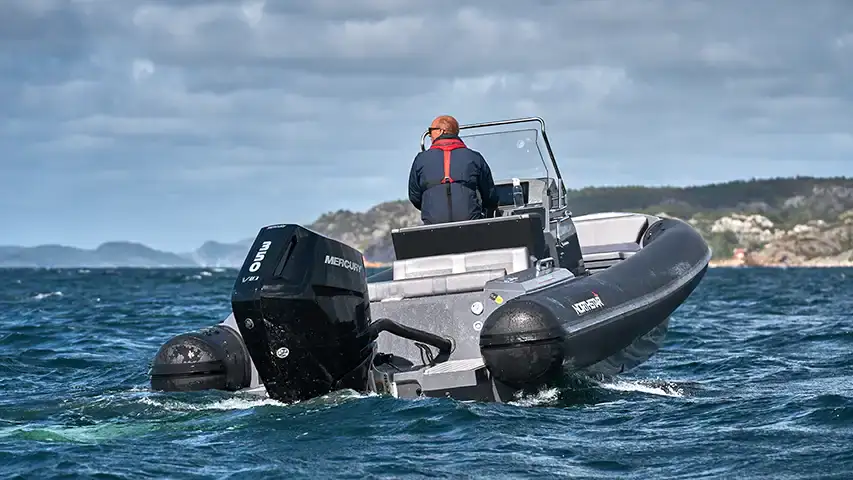
Every RIB, regardless of size or brand, shares a common anatomy. Understanding these parts makes every later section of this guide easier to follow.
- The hull. A rigid structure, usually deep-V shaped, built from GRP (fibreglass), aluminium or occasionally other composites.
- The tubes. Inflatable collars, called sponsons, fitted around the hull’s perimeter and filled with air under controlled pressure.
- The transom. The reinforced rear structure that carries the outboard or inboard engine mounting.
- The console. The steering position, which ranges from a simple centre console to a fully enclosed helm.
- Seating and deck layout. Ranging from simple bench seats to jockey seats designed for rough-water impact absorption.
- Chambers within the tubes. Most RIB tubes are divided into 3 to 7 separate air chambers for redundancy.
That last point matters more than most buyers realise, and we return to it in the safety section below.
How the Hull and Tubes Work Together
The rigid hull cuts through waves and provides directional stability at speed. Alone, however, a narrow rigid hull without side buoyancy would be tender and prone to rolling.
The inflatable tubes solve that problem. They sit above the waterline at rest and only touch the water more actively when the boat heels or meets a wave.
At that moment, the tubes provide additional buoyancy exactly where it is needed. This self-correcting effect is what gives RIBs their famous stability in a turn and their forgiving behaviour in a chop.
The tubes also absorb impact energy when coming alongside another vessel, a jetty or a person in the water.
That cushioning role explains why RIBs are the default choice for rescue and diving operations, where repeated close-quarters contact is routine.
Our companion article, How Does a RIB Work?, goes deeper into hull hydrodynamics, planing behaviour and tube pressure management for readers who want the full technical picture.
Why RIBs Have Inflatable Tubes At All
It is a fair question. Why not simply build a narrow, fast fibreglass boat without tubes?
The short answer: buoyancy, stability and forgiveness. Tubes add flotation exactly where a hard-chine boat is weakest, at the sides.
They let designers build a narrower, faster hull without sacrificing stability. They also turn hard collisions into soft ones, protecting both the boat and the people near it.
We explore this design logic, including the historical alternatives that were tried and abandoned, in Why Do RIBs Have Inflatable Tubes?
Advantages and Limitations of a RIB
No boat type is perfect for every use case. A fair, balanced view helps buyers set realistic expectations.
Advantages
- Excellent stability at rest and underway, even in a beam sea.
- High speed-to-weight ratio compared with equivalent hard-hull boats.
- Forgiving, cushioned contact with docks, other vessels and swimmers.
- Strong reserve buoyancy, since tubes remain inflated even if the boat takes on water.
- Lightweight construction, which suits trailering and smaller outboards.
Limitations
- Tubes require periodic maintenance, inspection and eventual replacement.
- UV exposure and abrasion gradually degrade tube material over years, not months.
- Interior space is reduced compared with a hard-hull boat of the same length.
- Puncture risk exists, though modern multi-chamber tubes limit real-world consequences.
We address that last point directly, with realistic scenarios rather than scare stories, in Can a RIB Sink? and Are Rigid Inflatable Boats Safe?
RIB vs Inflatable Boat: What is the Difference?
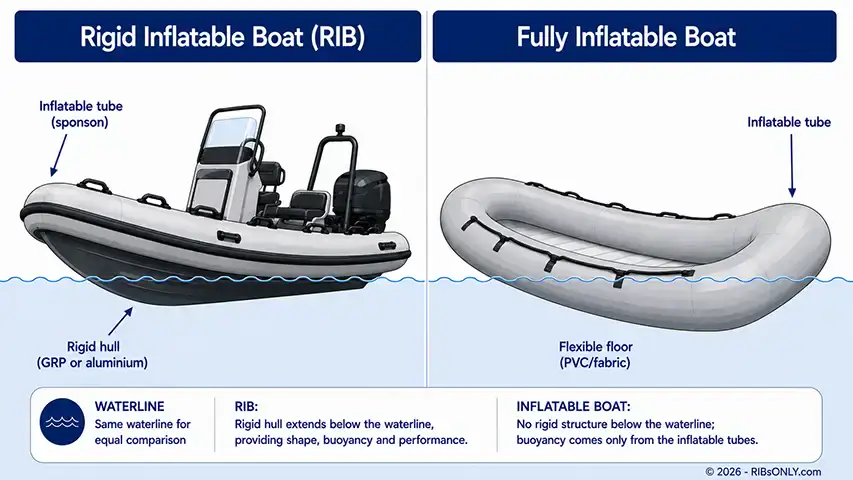
Many buyers confuse RIBs with fully inflatable boats. The confusion is understandable, since both use inflatable tubes for buoyancy.
The construction underneath, however, is fundamentally different.
A fully inflatable boat has a flexible floor and hull, often made from PVC or a similar coated fabric over an inflatable or slatted structure. It packs down small, deploys quickly and suits light, low-speed use.
A RIB replaces that flexible floor with a rigid, load-bearing hull. This single change transforms performance.
A RIB can plane at speed, hold a straight course in a chop and carry a far larger outboard than an equivalent inflatable boat.
Our detailed comparison, RIB vs Inflatable Boat: What Is the Difference?, walks through use cases where each type genuinely makes more sense.
RIB vs Hard-hull Boats
Compared with a conventional hard-hull motorboat of similar length, a RIB typically weighs less, planes faster and handles chop with less pounding.
The trade-off is usable interior volume, since the tubes occupy space a hard-hull boat could use for cabin, storage or wider decks.
RIBs also tend to feel more stable at rest for activities like diving, fishing or swimming stops, precisely because the tubes act as outriggers.
This is one reason dive centres, rescue services and charter operators favour RIBs so consistently over hard-hull alternatives of comparable size.
RIB Hull and Tube Materials Explained
Material choice affects weight, cost, durability and even resale value. Two separate decisions are involved: the hull material and the tube material.
Hull materials
- GRP (fibreglass). The most common choice. Offers a smooth, quiet ride, good resale recognition and flexible hull shaping.
- Aluminium. Lighter in some configurations, highly resistant to impact damage, popular in commercial and rescue fleets.
We compare these two directly, with real ownership trade-offs, in Aluminium vs Fibreglass RIB.
Tube materials
- PVC. More affordable, performs well in moderate climates, but degrades faster under intense, constant UV exposure.
- Hypalon/CSM. More expensive, more UV and chemical resistant, generally favoured for boats used in hot, sunny climates or heavy commercial use.
The full technical comparison, including realistic lifespan expectations for each material, is covered in PVC vs Hypalon/CSM RIB Tubes.
Typical Sizes, Power and Speed

© Malc Attrill
A race rib leaving a trail – © Malc Attrill – entrant in the 2024 RIB photo contest
RIBs range enormously in size, from compact 2,5-metre tenders that fold into a car boot to 12-metre-plus offshore and commercial vessels.
As a rough guide for leisure buyers:
- 2.5 – 4 m: Tenders and small day boats, single small outboard, 2 – 4 people.
- 4 – 6 m: The most popular leisure segment, single or twin outboard, family day boating.
- 6 – 9 m: Performance and offshore leisure RIBs, twin outboards common, serious rough-water capability.
- 9 m+: Commercial, rescue, military and superyacht-tender territory.
Speed depends heavily on hull design, weight and power, but well-matched leisure RIBs commonly cruise in the 25 – 35 knots range, with performance models exceeding 50 knots and more.
Choosing the right combination of size and power is not intuitive, which is why we dedicate full guides to it: What Size RIB Do I Need? and How to Choose an Outboard for a RIB.
Safety and Behaviour in Rough Water
RIBs earned their reputation in the harshest environment there is: open-water search and rescue. That heritage still shapes how RIBs behave today. Multi-chamber tube construction means a single puncture rarely causes a dangerous loss of buoyancy.
The rigid hull, combined with a deep-V or variable deadrise shape, sheds spray and maintains directional control in a genuine chop.
Well-designed seating absorbs impact energy that would otherwise transfer directly into a skipper’s spine.
None of this makes a RIB immune to bad decisions, overloading or poor maintenance.
Real safety depends on equipment, training and honest boat selection as much as on design.
We unpack every relevant factor, backed by real incident patterns rather than assumptions, in our dedicated safety article Are Rigid Inflatable Boats Safe? and address the specific, frequently searched question Can a RIB Sink? directly.
For buyers specifically targeting challenging conditions, our guide Best RIB for Rough Water: What Really Matters? breaks down deadrise angle, tube diameter, weight distribution and hull length in practical terms.
Applications: Leisure, Rescue, Military, Tender, Diving
The RIB’s versatility explains its spread across such different sectors.
- Leisure boating. Day trips, watersports towing, family boating and coastal cruising.
- Search and rescue. Lifeboat services worldwide rely on RIBs for their speed, stability and crew safety in extreme conditions.
- Military and coastguard. RHIBs handle boarding operations, patrol duties and special forces insertion.
- Superyacht tenders. Compact, fast RIBs ferry guests and equipment between yacht and shore.
- Diving and commercial charter. Low freeboard, stable platforms and strong load capacity suit dive operations closely.
Each sector places different demands on the same basic design, which explains the huge variation in RIB specification and price across the market.
Costs, Maintenance and Lifespan
Purchase price is only the starting point. Tubes typically need replacement every 10 to 15 years depending on material, climate and use, though careful owners regularly exceed this.
Engines, storage, insurance and antifouling all add to the real cost of ownership over time.
We break down realistic new and used pricing, by size and segment, in How Much Does a RIB Cost?.
For anyone actively shopping, our companion resources RIB Buying Guide: How to Choose the Right Boat and Buying a Used RIB: Complete Inspection Guide cover the full purchase process, including the specific checks that protect a buyer from an expensive mistake.
How to Choose the Right RIB
Choosing a RIB comes down to answering a small number of honest questions before looking at any specific model:
- What will the boat mainly be used for: day trips, watersports, diving, fishing or serious offshore use?
- How many people need to be carried comfortably and safely?
- What size and weight can realistically be towed, stored and launched?
- What sea conditions will the boat actually encounter, most of the time?
- What is the true total budget, including engine, trailer, storage and insurance?
Answering these questions first turns a confusing market into a short, manageable shortlist.
Our full RIB Buying Guide walks through this process step by step, with specific guidance for choosing the right size and selecting the right outboard.
A Short History of the Rigid Inflatable Boat
The RIB concept emerged in the 1960s at Atlantic College in South Wales.
Instructors and students experimented with fitting a rigid hull beneath inflatable tubes to build a faster, more seaworthy lifeboat.
That early work directly influenced the RNLI‘s Atlantic 21 lifeboat class. It proved the design’s rescue credentials in some of the world’s roughest coastal waters.
From that rescue origin, the design spread steadily into military, commercial and eventually leisure boating, as manufacturers refined hull shapes, tube materials and engine options.
Today’s RIB market spans everything from compact tenders to serious offshore performance craft.
But the core engineering logic has changed remarkably little since those first Atlantic College prototypes.
Frequently Asked Questions
What does RIB actually stand for?
RIB stands for Rigid Inflatable Boat, a motorboat combining a solid hull with inflatable side tubes.
Is a RIB the same as a RHIB?
Yes, in almost all practical respects. RHIB is more common in military and commercial contexts, RIB in leisure boating.
Can a RIB’s tubes be punctured?
Yes, but multi-chamber construction means a single puncture rarely causes the boat to lose usable buoyancy.
Are RIBs safe in rough water?
RIBs were originally developed for rescue work in rough water and generally handle chop better than comparable hard-hull boats, though outcome still depends on skipper skill, equipment and boat size.
How long do RIB tubes last?
Typically 10 to 15 years, depending on tube material, UV exposure and maintenance, with Hypalon/CSM generally outlasting PVC.
Are RIBs suitable for beginners?
Yes, smaller RIBs are widely used as first boats thanks to their forgiving stability, though proper training remains essential regardless of boat type.
Sources and Editor-in-Chief
Karel Overlaet, editor in chief of RIBsONLY.com, founded and owns Medianaut, Nautical News Media (est. 2003).
The RIBsONLY.com editorial team has provided dedicated coverage of the Rigid Inflatable Boat industry since 2008, drawing on more than 15 years of specialist expertise.
This includes manufacturer contact, owner interviews and hands-on model reviews published throughout our archive.