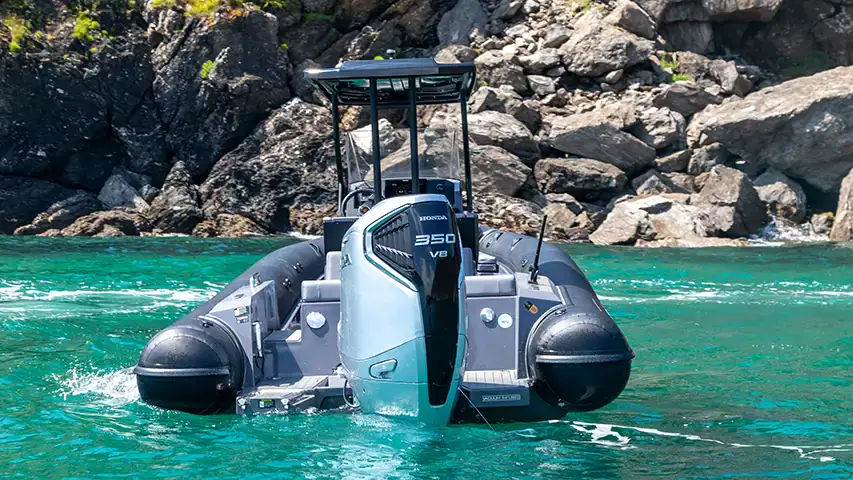
The Northstar G12 Designed for Serious Offshore Operations
The Northstar G12 is built for demanding operations where speed, reliability, and carrying capacity matter.
At 11.65 metres long, it is the largest and most powerful model in Northstar’s G Series, built in Turkey.
Its stepped hull is designed to deliver efficient high-speed performance while maintaining control in challenging sea conditions
With a maximum engine rating of 1,050 hp, the G12 can accommodate up to 17 people.
The hull and deck use vacuum-infused GRP construction, while the Hypalon tubes feature eight separate air chambers.
Operators can configure the G12 for military missions, maritime security, patrol duties, search and rescue, or professional workboat operations.
Available options include twin or triple outboard installations, suspension seats, advanced navigation electronics, thermal cameras, radar, and ballistic protection.
The result is a versatile professional RIB that can be adapted to different operational requirements without compromising its focus on performance and functionality.
Understanding Deadrise, Hull Shapes, and How They Affect Ride and Handling
Hull shape is one of the least visible specifications on a RIB, hidden entirely beneath the waterline. Yet it shapes nearly everything about how the boat feels: ride comfort, stability, fuel use, and top speed.
This guide explains the main hull shapes used on RIBs, what deadrise means, and how to match hull shape to intended use.
What Deadrise Means and Why It Matters
Deadrise is the angle of the hull bottom relative to horizontal, measured in degrees at the transom.
A higher deadrise angle means a sharper V-shape, which cuts through waves more than it rides over them.
A lower deadrise angle means a flatter bottom, which rides higher and planes faster but pounds more in chop.
Most production RIBs fall somewhere between 18 and 24 degrees of deadrise at the transom. Deadrise typically varies along the length of the hull, sharper at the bow and flatter toward the stern.
Deep-V Hulls
Deep-V hulls carry a transom deadrise of roughly 20 degrees or more, sometimes reaching 24 degrees. They excel in rough water, cutting through chop and swell with less pounding than flatter alternatives.
The trade-off is reduced initial stability at rest and typically higher fuel consumption at a given speed.
Shallow-V hulls use a lower deadrise angle, generally between 12 and 18 degrees at the transom. They offer better low-speed stability and often reach plane faster with a given amount of power.
The trade-off is a harsher ride in genuinely rough conditions compared with a deeper-V equivalent. This shape suits calmer inland or coastal use where ultimate rough-water performance matters less than efficiency and stability.
Cathedral and Tri-Hull Designs
Cathedral hulls use multiple sponsons or a stepped bottom to combine stability with reasonable rough-water ability. They’re less common on modern performance RIBs but still appear on some tenders and utility designs.
Stability at rest is a strong point, useful for diving, fishing, or work-boat applications requiring a stable platform. Rough-water performance and top-end speed generally fall short of a well-designed deep-V equivalent.
Variable Deadrise Hulls
Many modern RIBs use variable deadrise, sharper forward and flatter aft, rather than a single constant angle. This design aims to combine a soft entry through waves with efficient, stable planing at speed.
Warped-V or compound-V are terms sometimes used for this type of variable-deadrise hull design. Most performance-oriented RIBs today use some form of variable deadrise rather than a truly constant-deadrise hull.
How Hull Shape Affects Performance
Deadrise angle, hull length, weight distribution, and tube design all interact to determine actual on-water performance. A deep-V hull with poor weight distribution can still perform worse than a well-designed shallow-V equivalent.
Hull shape alone doesn’t determine performance; it sets the baseline that other design choices build upon.
Choose a deep-V hull if you regularly boat offshore or in areas prone to chop and swell.
Choose a shallow-V or cathedral design if stability at rest and calm-water efficiency matter more than rough-water comfort.
Most buyers are best served by a modern variable-deadrise hull, which balances these priorities reasonably well.
Our RIB Buying Guide covers how hull shape fits into the broader decision alongside size, engine, and materials.
Frequently Asked Questions
Is a deeper deadrise always better? Not necessarily. It improves rough-water ride but reduces stability at rest and typically increases fuel consumption.
What deadrise do most leisure RIBs use? Most fall between 18 and 24 degrees at the transom, often using variable deadrise along the hull length.
Does hull shape affect fuel consumption? Yes. Deeper-V hulls generally need more power to plane and cruise at a given speed than flatter hulls.
Can hull shape be changed after purchase? No. Hull shape is fixed at manufacture, making it one of the most important factors to get right when buying.
What Matters Most When Choosing a Rib for Family Boating
Buying a RIB for family use involves a different set of priorities than buying for performance or fishing. Safety, stability, seating comfort, and ease of handling typically outweigh raw speed or aggressive hull design.
This guide covers the specific factors that matter most when choosing a RIB that will carry a family safely and comfortably.
Priorities for Family Boating
Family RIBs need to balance capacity, stability, and manageable handling for a range of skill levels aboard. Unlike performance-focused buyers, most families prioritise a smooth, predictable ride over outright speed or sharp handling.
Ease of use matters too, since more than one family member may need to operate the boat confidently.
Size and Seating Capacity
These RIBs typically range from 5 to 7 metres, offering enough capacity for six to ten people comfortably. Check the manufacturer’s rated maximum capacity, but also consider realistic comfortable capacity for longer outings.
Our guide What Size RIB Do I Need? covers sizing principles that apply directly to family-use decisions.
Bow seating with proper handholds and backrests matters more for families than it does for performance-focused buyers.
A wider beam and higher tube volume generally improve stability at rest, useful for swimming stops and boarding. Look for boarding ladders, swim platforms, and secure handholds throughout the boat, not just at the helm.
Sun shade or a bimini top makes a significant difference on longer summer outings with children aboard. Cushioned, well-padded seating throughout improves comfort considerably compared with basic bench seating on entry-level models.
Adequate stowage for gear, coolers, and safety equipment keeps the boat organised and safer to move around.
Engine Power for Family Use
Family RIBs generally don’t need maximum available horsepower; moderate power with good low-speed manners is more valuable. Prioritise smooth throttle response and easy low-speed handling over top speed for family-oriented boating.
Twin engines add redundancy and confidence for families boating further from shore, though at higher cost.
Budget Considerations
Family RIBs sit in a wide price range depending on size, brand, and engine configuration. Our guide How Much Does a RIB Cost? breaks down the cost factors relevant to typical family-oriented purchases.
Factor in ongoing costs too: fuel, storage, insurance, and safety equipment add up over a season of use.
Prioritise stability, safety features, and comfortable seating over raw performance for most family boating scenarios. Test the boat with your typical passenger load, not empty, since handling changes meaningfully with weight aboard.
What size RIB is best for a family of four? A 5 to 5,5 metre RIB comfortably serves a family of four, with room for gear and safety equipment.
Do family RIBs need twin engines? Not necessarily. A single well-matched engine is often sufficient; twins add redundancy at higher cost.
What safety features matter most for family use? A secure boarding ladder, sturdy handholds, proper lifejackets for all ages, and a stable swim platform.
Is a bigger RIB always better for families? Not always. Bigger boats cost more to run and store; match size to realistic typical passenger numbers. But that’s a personal choice.
“Rough water capability” gets thrown around loosely in boat marketing, often reduced to little more than “bigger is better.”
The reality is more specific, and more useful once you understand what actually determines how a RIB behaves when conditions turn.
This guide breaks down the real factors, deadrise angle, tube diameter, weight distribution and hull length.
That way you can evaluate any RIB’s genuine rough water capability rather than relying on marketing language alone.
Deadrise Angle: The Most Important Hull Factor
Deadrise angle describes how sharply a hull’s bottom rises from the keel to the sides, measured in degrees.
This single specification affects rough-water behaviour more than almost any other hull characteristic.
Higher deadrise (typically 20 – 24 degrees at the transom) cuts through waves more smoothly, reducing pounding and improving comfort in a chop.
The trade-off is slightly reduced stability at rest and marginally higher fuel consumption at a given speed.
Lower deadrise (typically 12 – 18 degrees) offers more stability at rest and better fuel efficiency, but transmits more pounding impact in genuine rough conditions.
Many serious offshore RIBs use a variable deadrise design, sharper toward the bow for wave-cutting, flatter toward the stern for stability and efficient planing.
This represents the practical compromise most rough water-focused manufacturers settle on.
Hull Length: Why Longer Generally Handles Better
A longer waterline crosses a greater portion of a wave’s wavelength simultaneously, which reduces the boat’s tendency to pitch violently as it moves through consecutive waves.
This is genuine physics, not just a size-selling argument.
It’s also why our sizing guide, What Size RIB Do I Need?, recommends longer boats specifically for buyers planning serious offshore use.
That said, length alone doesn’t guarantee good rough water behaviour.
A long hull with poor deadrise or weight distribution can still handle worse than a shorter, better-designed alternative.
Tube Diameter and Rough-Water Stability
Larger diameter tubes provide greater reserve buoyancy and a higher freeboard.
Both are valuable in genuinely rough conditions where waves regularly wash over the deck of a lower-freeboard boat.
Offshore-focused RIBs typically feature noticeably larger tube diameters relative to their length compared with calm-water leisure models.
This isn’t purely cosmetic; it directly affects how much water the boat can take on before performance and safety are compromised.
How weight is distributed aboard a RIB significantly affects rough-water handling, sometimes more than the hull’s inherent design.
Excess weight concentrated at the stern, whether from heavy twin outboards or poorly placed equipment, can cause the bow to ride high.
It’s reducing wave-cutting effectiveness and increasing the risk of the hull slamming down hard between waves.
Properly distributed weight, including thoughtful fuel tank placement and balanced passenger seating, helps the hull maintain its designed running trim even as conditions worsen.
Freeboard: Often Overlooked, Genuinely Important
Freeboard, the height of the hull and tubes above the waterline, determines how much wave height a boat can encounter before water regularly comes aboard.
Rough water focused RIBs typically feature higher freeboard than calm-water leisure models of similar length.
This single specification, easy to overlook on a spec sheet, has a direct and significant effect on how a boat feels and performs once conditions deteriorate.
Self-Bailing Cockpit Design
A self-bailing cockpit, where the deck sits above the waterline and drains automatically through dedicated outlets, matters enormously in genuine rough water. In those conditions some water coming aboard becomes almost inevitable.
Boats without effective self-bailing design can accumulate water on deck faster than it drains, adding dangerous weight exactly when stability matters most.
We cover this design feature’s broader safety role in Can a RIB Sink?
Engine Configuration and Rough Water Confidence
Twin outboards provide genuine redundancy that matters significantly more in rough, remote or offshore conditions than in calm coastal day boating.
Losing propulsion entirely in challenging conditions represents a far more serious situation than the same failure closer to shore in calm water.
Putting the Factors Together: A Practical Checklist
When evaluating any specific RIB’s genuine rough water capability, check:
Deadrise angle, ideally variable, sharper forward and flatter aft.
Hull length, appropriate to your realistic sea conditions, not just your budget.
Tube diameter, proportionally larger for genuine offshore use.
Freeboard height, adequate for the wave conditions you’ll actually encounter.
Self-bailing cockpit design, confirmed rather than assumed.
Weight distribution, including realistic loaded trim, not just an empty-boat spec sheet.
No single factor guarantees good rough-water performance alone.
The best rough-water RIBs get most or all of these factors right simultaneously, which is precisely why genuine offshore-capable models command a price premium over superficially similar leisure boats.
Hull Material’s Role in Rough Water
Hull material also factors into rough-water performance, primarily through weight, flex and impact resistance under repeated wave slamming.
Our detailed comparison, Aluminium vs Fibreglass RIB, covers how each material behaves specifically under this kind of sustained stress.
Frequently Asked Questions
Is a bigger RIB always better in rough water? Generally length helps, but deadrise angle, freeboard and weight distribution all matter just as much. A well-designed smaller RIB can outperform a poorly designed larger one.
What deadrise angle should I look for in a rough-water RIB? Look for variable deadrise designs, typically 20+ degrees at the bow tapering to a flatter stern, though exact figures vary by manufacturer and intended use.
Does tube diameter really make a measurable difference? Yes. Larger tube diameter increases reserve buoyancy and freeboard, both directly relevant to how a boat handles waves washing over the deck.
Are twin outboards necessary for rough-water use? Not strictly necessary, but the redundancy they provide becomes considerably more valuable the further offshore or more remote your typical routes become.
The engine is the single most expensive component on most RIBs, and the decision with the biggest long-term impact on safety, performance and running costs.
Get it wrong, and even a beautifully built hull disappoints on the water.
This guide walks through horsepower selection, single versus twin configurations, and the practical trade-offs that matter once you’re comparing real options rather than spec sheets.
Start With the Manufacturer’s Recommended Range
Every RIB hull has a manufacturer-specified horsepower range, tested for that specific hull shape, weight and transom strength. This range isn’t a marketing suggestion.
It reflects genuine engineering limits.
Fitting an engine below the recommended minimum leaves the boat underpowered, sluggish to plane, and potentially unsafe in a following sea.
Fitting one above the maximum risks transom stress, handling problems and, in many jurisdictions, invalidates insurance or certification entirely.
Always confirm this range directly from the manufacturer’s documentation or CE plate, never from a general size-to-power assumption.
How Horsepower Affects Real-World Performance
Within the recommended range, more horsepower generally means faster planing, better acceleration and more confident handling when fully loaded. It also means higher fuel consumption and greater purchase cost.
Buyers often default to the maximum recommended horsepower, assuming more is simply better. In practice, the right choice depends on typical loading and use:
Light, occasional use with few passengers. Mid-range horsepower within the recommended band usually suffices, keeping costs and fuel consumption reasonable.
Regular full-capacity use, watersports towing, or offshore trips. Higher horsepower within the range provides safer margins when the boat is genuinely loaded.
Single vs Twin Outboards
This decision affects cost, redundancy, fuel consumption and handling in ways worth understanding before you commit.
Single outboard advantages include lower purchase price, simpler maintenance and typically better fuel economy for the same total horsepower. The clear disadvantage is a complete loss of propulsion if that engine fails.
Twin outboards provide genuine redundancy. If one engine fails, the other gets you home. Twins also allow differential thrust for tighter low-speed manoeuvring, valued by many owners docking in tight marinas.
The trade-off is cost. Twin configurations typically cost considerably more upfront, add weight, and increase maintenance and fuel expenses compared with a single engine of equivalent combined horsepower.
Redundancy matters most for offshore use, remote cruising, or commercial and charter operations where reliability is non-negotiable. For coastal day boating close to help, a well-maintained single engine is often entirely sufficient.
Two-Stroke vs Four-Stroke: A Quick Note
Modern outboards are overwhelmingly four-stroke, offering better fuel economy, lower emissions and quieter operation than older two-stroke designs.
Two-stroke outboards still exist in the used market and offer a lighter weight advantage, but expect higher fuel consumption and stricter emissions restrictions in many regions.
For most buyers today, particularly when purchasing new, four-stroke is the practical default.
New, Used or Refurbished: Weighing the Options
New outboards carry full manufacturer warranty and the latest fuel-efficiency and reliability improvements, at the highest purchase cost.
Used outboards can offer significant savings, but engine hours and documented service history matter enormously. An outboard with high hours but meticulous servicing often outperforms a low-hours engine that sat neglected.
Refurbished outboards, professionally reconditioned by a dealer or specialist, can bridge the gap, offering some warranty assurance at a lower price than new.
For a complete sizing decision that considers passengers, use case and towing alongside engine requirements, see our guide What Size RIB Do I Need?.
Frequently Asked Questions
Can I fit a more powerful engine than the manufacturer recommends? No. Exceeding the recommended maximum risks transom damage, handling problems and can invalidate insurance or certification.
Is a twin-engine setup worth the extra cost for leisure use? It depends on use case. Offshore or remote boating benefits significantly from the redundancy; coastal day boating close to assistance often doesn’t require it.
How do I know if a used outboard is in good condition? Check documented service history, inspect the lower unit for water intrusion, and always arrange a sea trial before purchase.
Does engine weight affect a RIB’s handling? Yes, significantly. Correct weight and mounting height affect planing behaviour, fuel efficiency and overall handling more than most buyers expect.
To provide the best experiences, we use technologies like cookies to store and/or access device information. Consenting to these technologies will allow us to process data such as browsing behavior or unique IDs on this site. Not consenting or withdrawing consent, may adversely affect certain features and functions.
Functional
Always active
The technical storage or access is strictly necessary for the legitimate purpose of enabling the use of a specific service explicitly requested by the subscriber or user, or for the sole purpose of carrying out the transmission of a communication over an electronic communications network.
Preferences
The technical storage or access is necessary for the legitimate purpose of storing preferences that are not requested by the subscriber or user.
Statistics
The technical storage or access that is used exclusively for statistical purposes.The technical storage or access that is used exclusively for anonymous statistical purposes. Without a subpoena, voluntary compliance on the part of your Internet Service Provider, or additional records from a third party, information stored or retrieved for this purpose alone cannot usually be used to identify you.
Marketing
The technical storage or access is required to create user profiles to send advertising, or to track the user on a website or across several websites for similar marketing purposes.