Time lapse of the 2025 Great River Race.- shows the scale of the event
Have You Ever Heard of the Great River Race
No, nor had I until I was invited to attend as part of the safety fleet.
In effect The Great River Race is London’s River Marathon. It’s a spectacular boat race covering 21.6 miles from Millwall in the East to Richmond in the West.
The rules for this River Race are simple. There are fixed seats. Dragon boats are not allowed because they like to sink.
The rules are based on the Watermen principle. Each vessel must carry a passenger and a cox. It also needs a 3’ x 2’ flag.
The event started in 1988 with 61 local boats. It has now grown into a major international event.
Competitors from America, Australia, and many European countries are taking part.
It is the largest rowing race in the UK when you consider the number of people on the water at the same time.
This is where the RIBs come into play.
To keep this many rowers safe takes a herculean effort by the RIB community.
Northern Exposure Rescue work with the Port of London to assemble no less than 35 safety boats.
This is the largest grouping of RIBs in England. It beats the Annual Pasty Run into 2nd place.
Only the Easdale Rendezvous tops it as far as meet-ups go across the British isles.
(The story continues below the gallery. Click to enlarge the photo.
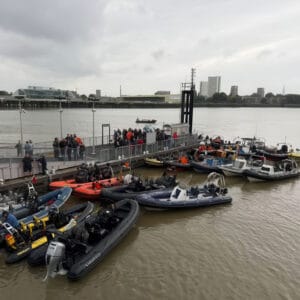
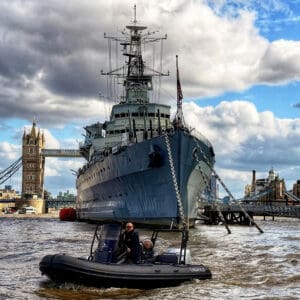
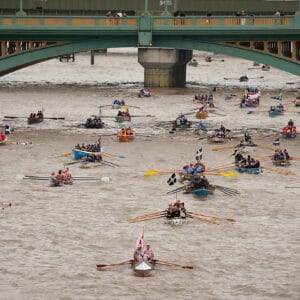
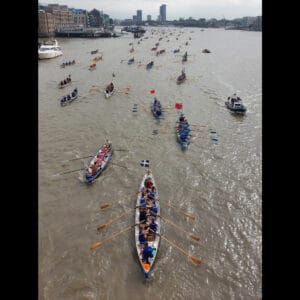
The team are split into three groups, Static, Mobile and Task:
The Task group are used to bounce around the fleet, supporting where ever an additional resource is needed.
The Mobile group is allocated a slot in the race line. They escort the rowers up the river. They try to ensure there is a safety boat in view at all times. The maximum response time is three minutes.
The Static Group are allocated bridges and hazards, acting as a guard boat and directing traffic accordingly.
For 2025 we were initially allocated a static role, sitting between London Bridge and Cannon Street Railway Bridge.
The rowers of the River Race must keep to the North Bank due to the rest of the river traffic.
It sounds easy when the flow of boats coming through isn’t that busy. However, once mid flow is reached, there are boats everywhere.
They try to push their way through, around, and, in some cases, over others!
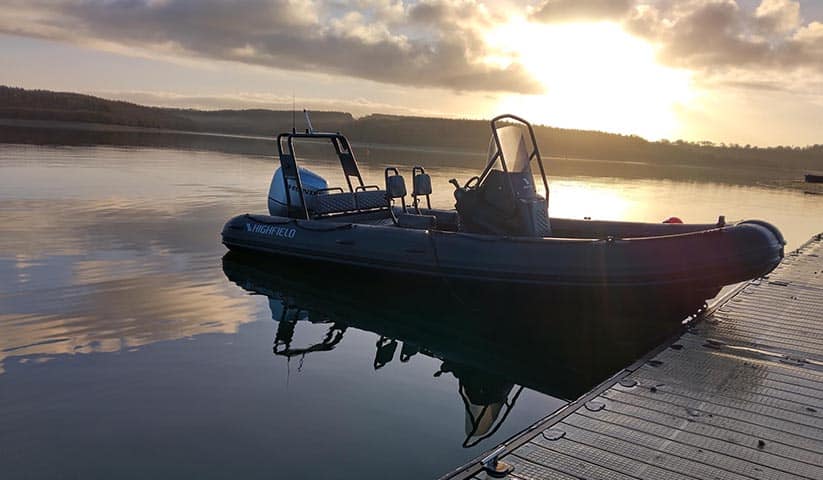
My Highfield Patrol 600
This Rigid Inflatable Boat (RIB) is a superb guard boat due to its impressive presence in the water, deck space and seating.
The 26 degree bow rise ensures users, low in the water in row boats, have a visible block in front of them.
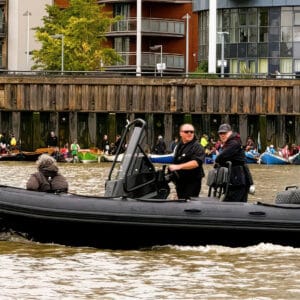
We were able to use the front console seat for the crew member. They were tasked with waving, shouting, and encouraging direction changes.
We used the rear bench seat for the photographer we also had on board.
It was going to be a long day afloat. We decided to launch the evening before. We also booked the RIB into Greenwich Yacht Club for the Friday and Saturday nights.
The venue isn’t far from the start. However, it is a deceptively long way from the finish or launch point.
This is due to the speed restrictions on areas of the Thames.
That said it’s a lovely cruise down the river with plenty to see and enjoy.
The venue has an all states pontoon. There is a slipway that can be used at all times except low tide.
It also features a superb bar that serves Sunday lunches among other things.
We were staying overnight. We were planning a Sunday river trip to the end of the estuary.
The storage on the Patrol 600 was tested to its extreme.
The front anchor locker contained the usual anchor, chain, and warp. It also had additional tow lines for the event.
Longer lines were included to be used as springs. There were extra lines because who knows how mooring was going to be!
The front locker carried the usual small fenders, buckets, and a fire extinguisher.
It also contained a jiggle pump for fuel transfer, a large drogue, and the issued Highfield paddles.
The locker built into the console itself is pretty big. For this trip, we managed to store an additional 50l of fuel.
We used 30 and 25 l containers. We also stored the console and seat covers and three large foam fenders.
The rear locker was also packed full with two overnight bags, first aid kit, tool kit, and spare lifejackets.
It also contained emergency blankets and the photographer’s spare bag. They don’t travel light!
This year the mix of safety fleet boats covered most manufacturers. Highfield was well represented as was Ribcraft and Humber with a smattering of most other manufactures thrown in.
The story continues below the gallery (click to enlarge the photos).
The river can be pretty unforgiving. The Western areas can see some pretty rough waters.
The high speed ferries throw up a mean wash. After it hits the river walls and bounces back, it meets the next wash.
This interaction throws some impressive waves. These waves can catch out an unsuspecting helm, both of a safety boat and a racer!
Fastest was Caradon Gig club in 2 hours 22 minutes. This didn’t mean they won. They actually only came 4th as the event runs a handicap system.
This gave them a run time of 3:11. The Four Oars Rowing club took the overall win at 3:07, with an actual run time of 2:54!
Instead of driving to London, launching, racing, and recovering, a few of the boats stayed the extra night.
They headed off to enjoy the lower estuary on Sunday morning. The area is a great place to explore.
Once through the Thames barrier, calling London VTS and asking for permission is a simple task. There are a range of historic buildings and new builds to see.
You will also find ancient floodgates and newer style barriers. They are nestled in amongst salt marshes and commercial areas.
A couple of old forts are visible (Tilbury, Coalhouse, Cliffe, and the remains of Nore Sea Fort). Guns still point out to sea.
It’s worth remembering that this area is the first line of nature’s protection for 1.42 million people and £321 billion worth of infrastructure. Makes you wonder why it’s being built on!
We were planning to get out as far as the Maunsell Forts. They are around 40 nautical miles from Greenwich. Alas, the tide and carvery lunches wait for no man.
So we returned back up the river. We continued to explore the large container ports and ancient docks. We plan to visit the Forts another day.
All in all, we travelled 150 nautical miles over the long weekend. According to the onboard computer, we managed to use all 140 l on board.
The screens went to zero just as we reached the slipway for the journey home.
The Thames is a great place to go ribbing. There’s plenty to do and plenty to see.
Unfortunately, there are very few places to launch, stop, get out, drink tea, and enjoy a walk.
However, the views from the water are just superb.
Picture credits: Northern Exposure Rescue, Miles Hill, Anthony Hadaway and myself.
The video was published on the Adam Tate YouTube channel.
Meet more RIBs ONLY authors: Robin Kilroy (aka VISTATREKKER) and Roy Anderson (rib-adventure.no).
Proud to share that Highfield is a good Friend of RIBs ONLY.
Specs
| Model | Highfield Patrol 600 |
| Overall length | 6,17 m |
| Internal length | 4,49 m |
| Overall width | 2,58 m |
| Internal width | 1,32 m |
| Dead rise | 26° |
| Tube diameter | 54 cm |
| Number of air chambers | 6 |
| Maximum load* | 1.200 kg |
| Maximum engine weight | 230 kg |
| Maximum people | 15 |
| Boat only weight** | 762 kg |
| Fuel tank | 140 l |
| Maximum power | 150 hp |
| Engine shaft | XL Single |
| Design category | C*** |
**boat, console & standard seating only
*Maximum load includes crew & cargo – it does not include engine weight, fuel or water
***discover what this means