New RIB Boats, Launches, Manufacturers and Industry Updates
Stay up to date with the latest RIB news worldwide, covering new launches, manufacturers, technology, equipment and developments across the Rigid Inflatable Boat industry.
This page also contains stories where a a Rigid Inflatable boat was used.
This live news overview tracks relevant Rigid Inflatable Boat stories from international sources and brings them together in one place. New items are added automatically as they are discovered, with direct links to the original publishers.
It provides a continuously updated view of what is happening in the global RIB market.
The People and Institutions Credited With Creating the Modern RIB
The question of who invented the RIB doesn’t have a single, simple answer, but several names and institutions stand out clearly. So it’s not very clear who invented the RIB.
Innovation rarely happens in isolation, and the RIB’s development involved contributions from multiple people over several years.
This guide covers the individuals and institutions most widely credited with creating and popularising the modern RIB.
Facts about who invented the Rigid Inflatable Boat (RIB).
The UK Origins of the RIB Concept
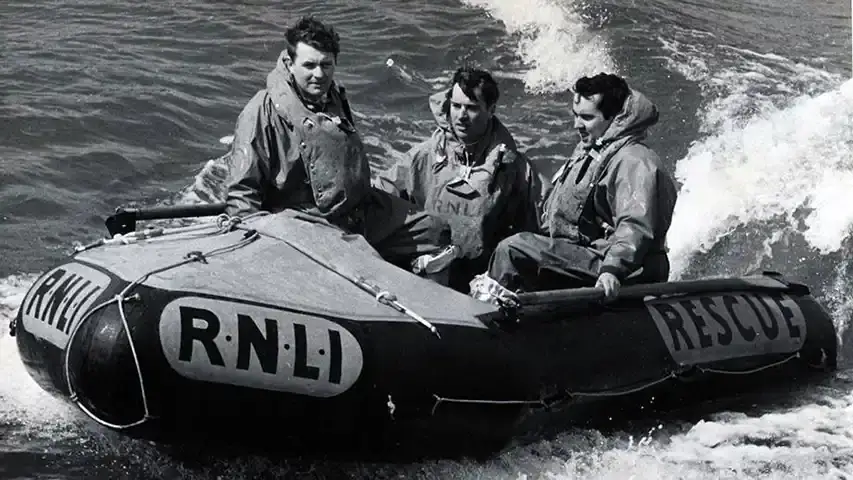
Most historical accounts trace the RIB’s origins to the United Kingdom during the 1960s, particularly around university and rescue circles.
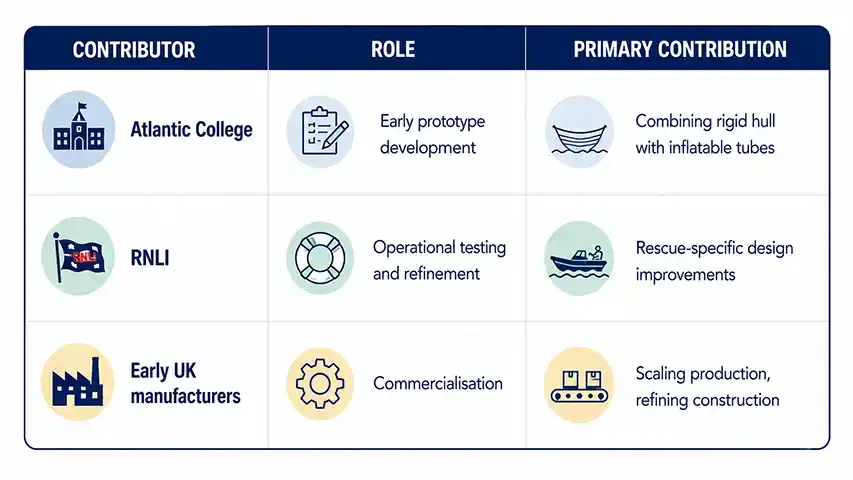
Atlantic College in Wales is frequently credited as a key site of early RIB development, driven by lifeboat crew needs.
Students and instructors at the college worked on combining a rigid hull with inflatable tubes to improve rescue boat performance.
Several individuals associated with Atlantic College and the UK lifeboat community are credited with pioneering early RIB designs.
Their work focused on practical rescue requirements: launching quickly through surf, remaining stable, and resisting swamping in rough seas.
This collaborative, problem-driven approach shaped the RIB’s fundamental design philosophy from its earliest development stages.
Documentation from this era is limited, and precise individual credit is sometimes debated among maritime historians.
The Role of the RNLI and Lifeboat Institutions
The Royal National Lifeboat Institution (RNLI) played a significant role in adopting and refining early RIB designs for operational rescue use. Their operational feedback helped refine hull shape, tube construction, and overall durability under genuinely demanding rescue conditions.
This institutional involvement helped transform an experimental concept into a proven, operationally reliable rescue boat design.
Is there a single person credited with inventing the RIB? No single individual is universally credited; the RIB emerged from collaborative development at Atlantic College and within UK rescue circles.
What role did Atlantic College play in RIB development? It’s widely recognised as a key site of early prototype development, driven by lifeboat crew operational needs.
Why is the RNLI significant in RIB history? Their operational testing and feedback helped refine early RIB designs into a proven, reliable rescue boat format.
When did commercial RIB manufacturing begin? Following successful rescue adoption, UK-based manufacturers began commercialising RIB designs through the 1970s and beyond.
Quick, Clear Answers to the Questions RIB Buyers and Owners Ask Most
Some questions come up again and again, whether from first-time buyers, curious newcomers, or experienced owners facing a new situation.
This FAQ collects the most common questions about RIBs in one place, with concise answers and links to deeper guides.
Use it as a quick-reference starting point, then follow the linked guides for more detailed explanations.
General Understanding
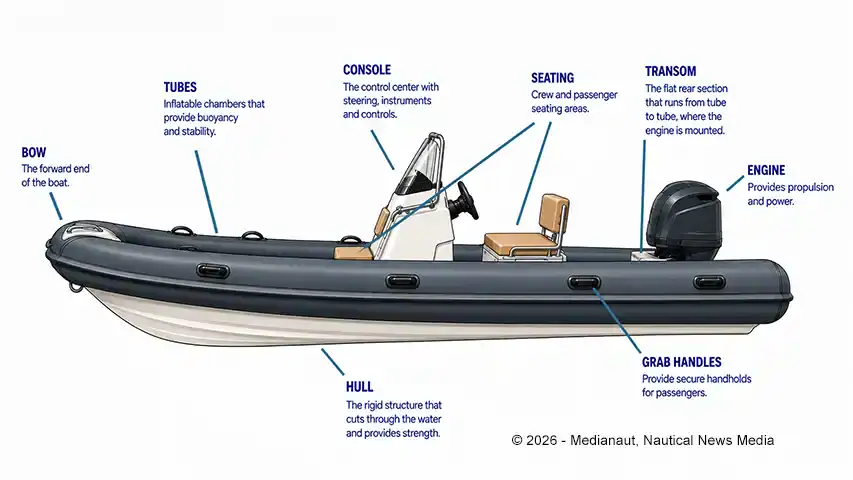
What is a Rigid Inflatable Boat (RIB)? A Rigid Inflatable Boat, almost always shortened to RIB, is a motorboat built around two very different structures. A solid hull sits beneath the waterline. Inflatable tubes wrap around the sides above it: What is a Rigid Inflatable Boat (RIB).
What does RIB stand for? RIB stands for Rigid Inflatable Boat, combining a solid hull with inflatable tubes around the sides: What Does RIB Stand For?
Why do RIBs have inflatable tubes? Tubes provide buoyancy, stability, and impact protection alongside the rigid hull, combining strengths of both boat types: Why Do RIBs Have Inflatable Tubes?
What’s the difference between a RIB and a regular inflatable boat? A RIB has a rigid hull for performance and handling; a standard inflatable lacks this rigid structure entirely: RIB vs Inflatable Boat: What is the Difference?
Is RIB the same as RHIB? RHIB (Rigid Hull Inflatable Boat) and RIB are generally interchangeable terms, though RHIB is more common in military and commercial contexts: RIB vs RHIB: Meaning and Differences
Safety Questions
Are RIBs safe? Yes, generally very safe, thanks to their stability and reserve buoyancy, when operated within their design category and properly maintained: Are Rigid Inflatable Boats Safe?
Can a RIB sink? It’s extremely difficult due to multi-chamber tube construction and hull buoyancy, though not technically impossible under extreme circumstances: Can a RIB Sink?
What safety equipment do I need on a RIB? This depends on your jurisdiction and intended use; our guide Essential Safety Equipment for a RIB covers the full breakdown.
What’s a kill cord and why does it matter? It’s a safety lanyard that cuts the engine if the helmsman is displaced, preventing dangerous runaway boat scenarios: Essential Safety Equipment for a RIB.
Buying Questions
How much does a RIB cost? Prices vary enormously by size, brand, and engine; our guide How Much Does a RIB Cost? breaks down the key factors.
What size RIB do I need? This depends on intended use, typical passenger numbers, and storage constraints; see our guide What Size RIB Do I Need?.
PVC or Hypalon: which is better? Neither is universally better; it depends on climate and budget. Our guide PVC vs Hypalon/CSM RIB Tubes explains the trade-offs.
Aluminium or fibreglass hull: which should I choose? Both have merits depending on priorities; see our guide Aluminium vs Fibreglass RIB for a full comparison.
How long do RIB tubes last? Typically 8–20 years depending on material and climate; see our guide PVC vs Hypalon/CSM RIB Tubes for specifics.
Ownership and Maintenance Questions
How much does it cost to own a RIB? Beyond purchase price, expect insurance, storage, fuel, and maintenance costs; see our guide RIB Ownership Costs.
Can I leave my RIB in the water? It depends on tube material, climate, and hull type; our guide Can You Leave a RIB in the Water? covers this in detail.
How often should I service my RIB? Engine servicing is typically annual or hours-based; our guide RIB Maintenance Schedule covers the full timeline.
How do I store my RIB for winter? Proper winterisation protects the engine, tubes, and hull; see our guide RIB Winter Storage Guide.
What happens if I don’t have an insurance? Without insurance, you are personally responsible for covering the costs of accidents, injuries, property damage, theft, or the total loss of your watercraft. Read all about it in our guide: RIB Insurance Guide.
Performance and Handling Questions
How fast can a RIB go? This varies enormously by size, hull, and engine; our guide How Fast Can a RIB Go? covers realistic expectations.
How do I drive a RIB safely in rough water? Technique, trim, and speed management matter significantly; see our guide How to Drive a RIB in Rough Water.
Single or twin outboards: which do I need? This depends on your typical use and risk tolerance; see our guide Single vs Twin Outboards on a RIB.
Where to Go From Here
This FAQ covers the questions asked most often, but every linked guide offers considerably more depth on its specific topic.
Our pillar guide What Is a Rigid Inflatable Boat? remains the best comprehensive starting point for understanding RIBs from the ground up.
If your specific question isn’t answered here, browse our full evergreen guide library covering buying, ownership, safety, and technique.
Frequently Asked Questions
Is this FAQ updated regularly? Yes, it’s periodically reviewed and expanded as new common questions emerge across the RIBsONLY community.
Can I suggest a question to add to this FAQ? Yes, feedback helps keep this resource genuinely useful and comprehensive for future readers: Get in Touch.
Where should complete beginners start? Begin with our pillar guide What Is a Rigid Inflatable Boat? before exploring specific topics in more depth.
Does this FAQ cover professional and commercial RIB use too? Some questions touch on this, but our guide Professional and Rescue RIBs Explained covers commercial applications more thoroughly.
A Comprehensive Reference for RIB Terminology, From Hull to Helm
RIB terminology can be confusing for newcomers, mixing general boating language with terms specific to inflatable and rigid-hull construction.
This glossary collects the essential terms you’ll encounter across manufacturer specifications, reviews, and buying guides.
Use it as a quick reference whenever unfamiliar terminology appears elsewhere on RIBsONLY or in manufacturer documentation.
Hull and Construction Terms
Deadrise — The angle of the hull bottom relative to horizontal, measured in degrees, affecting ride and stability. See our guide RIB Hull Shapes Explained.
Deep-V hull — A hull with a steep deadrise angle, typically 20 degrees or more, favouring rough-water performance. See our guide Deep-V Hull: Advantages and Trade-offs.
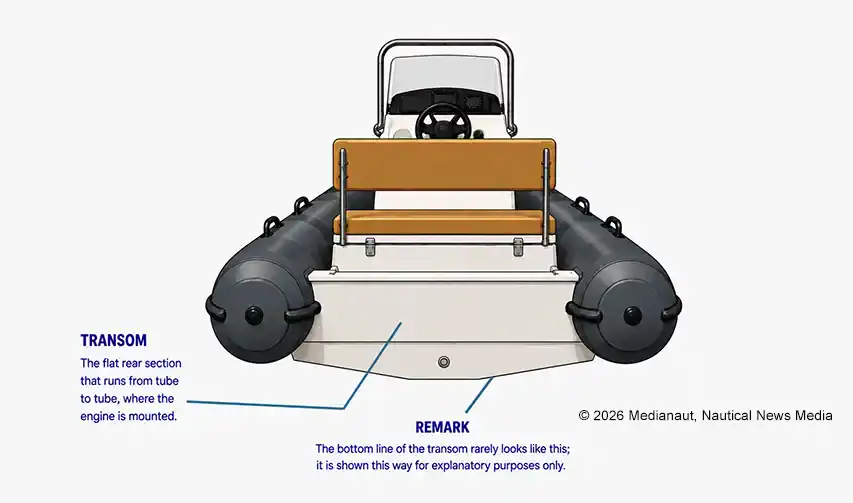
Transom — The flat, vertical structure at the stern where the engine is typically mounted. See our guide How to Inspect a RIB Transom.
SOLAS — International maritime safety treaty affecting certain commercial and rescue vessel requirements. See our guide SOLAS RIB Requirements Explained.
Jockey seat — A straddle-style seat offering better support at speed than flat bench seating.
Bimini — A folding fabric top providing sun and weather protection.
Sun pad — A cushioned area, often aft, convertible between seating and sunbathing use.
Using This Glossary Effectively
Bookmark this page as a quick reference whenever unfamiliar terminology appears in reviews, specifications, or buying guides. Terms here link directly to more detailed guides covering each concept in far greater depth.
Our pillar guide What Is a Rigid Inflatable Boat? remains the best starting point for understanding how these terms fit together.
Frequently Asked Questions
Is this glossary specific to RIBs, or does it cover general boating terms? It focuses primarily on RIB-specific terminology, though some general boating terms are included for context.
Will more terms be added over time? Yes, this glossary is updated periodically as new terminology and technology become relevant to the RIB category.
Can I suggest a term to add? Yes, feedback and suggestions help keep this reference comprehensive and useful for the RIBsONLY community.
Where should I start if I’m completely new to RIBs? Begin with our pillar guide What Is a Rigid Inflatable Boat? before diving into specific terminology.
How the Rib Evolved From a Simple Concept Into a Global Boating Standard
The Rigid Inflatable Boat (RIB) is a relatively modern invention, yet it has reshaped entire sectors of the marine industry. Its story combines academic experimentation, maritime necessity, and decades of incremental engineering refinement.
This guide traces the RIB’s development from early prototypes to the diverse, globally established boat category it is today.
The Problem the RIB Was Designed to Solve
Before the RIB, boat designers faced a persistent trade-off between the stability of inflatable boats and the performance of rigid hulls.
Fully inflatable boats offered excellent buoyancy and stability but lacked the speed, durability, and directional control of hard-hulled boats.
Rigid hulled boats offered performance and durability but lacked the forgiving stability and buoyancy of inflatables in rough conditions.
The RIB concept aimed to combine the strengths of both approaches into a single, purpose-built design.
History Starts with Early Development in the 1960s
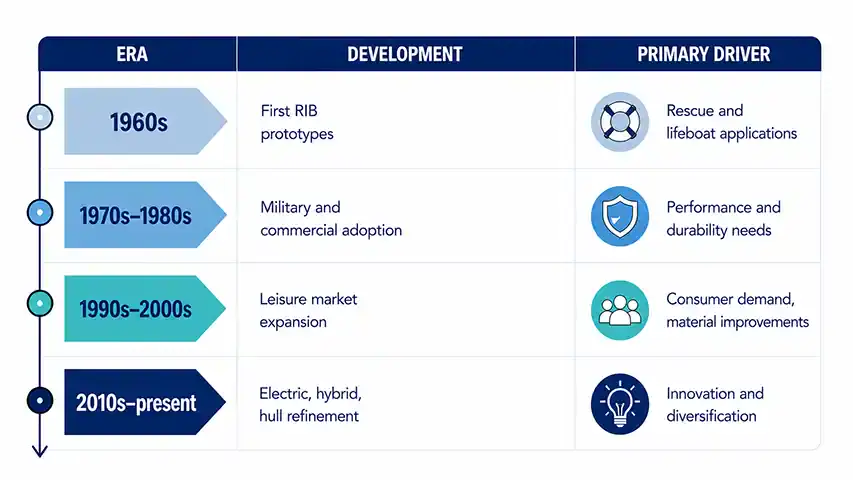
The first recognised RIB designs emerged in the United Kingdom during the 1960s, developed for lifeboat and rescue applications.
Early prototypes combined a rigid fibreglass hull with inflatable tubes fitted around the sides for added buoyancy and stability.
This combination proved particularly effective for launching through surf and operating in challenging near-shore rescue conditions.
Our guide Who Invented the RIB? covers the specific individuals and institutions credited with these early breakthroughs.
Adoption by Rescue and Military Organisations
Lifeboat institutions were early adopters, recognising the RIB’s advantages for launching quickly through difficult surf conditions. Military organisations soon followed, valuing the RIB’s combination of speed, stability, and resistance to swamping in rough seas.
These early professional applications drove significant investment in refining hull design, tube construction, and overall durability.
Through the 1970s and 1980s, RIB technology gradually expanded beyond rescue and military applications into commercial and leisure markets. Manufacturers began producing RIBs specifically for diving support, pilot transfer, and eventually recreational boating.
Improvements in tube material, particularly the development of more durable fabrics, made RIBs increasingly practical for everyday leisure use.
Our guide PVC vs Hypalon/CSM RIB Tubes covers the material developments that supported this broader commercial expansion.
Hull Design Evolution
Early RIB hulls were relatively simple, but decades of refinement introduced variable deadrise and more sophisticated hull geometry.
Our guide RIB Hull Shapes Explained covers how modern hull design reflects this long evolutionary process.
Performance-oriented deep-V designs, in particular, trace their lineage directly back to these decades of iterative racing and rescue development.
The Growth of the Leisure RIB Market
By the 1990s and 2000s, RIBs had become an established leisure boating category, no longer limited to specialist applications.
Manufacturers began offering RIBs in a wide range of sizes, styles, and price points aimed squarely at recreational buyers.
This period saw significant diversification: family-oriented layouts, performance-focused designs, and compact tenders all emerged as distinct segments.
The history of the RIB got a real boost.
Our guide Family RIB Buying Guide reflects one branch of this diversification into dedicated leisure use cases.
Modern Innovation and Continued Evolution
Today’s RIB industry continues to innovate, exploring electric propulsion, hybrid systems, and increasingly sophisticated hull and tube technology.
When was the first RIB developed? Recognised RIB prototypes emerged in the United Kingdom during the 1960s, developed initially for rescue applications.
Why were RIBs first developed for rescue use? Their combination of stability, buoyancy, and rough-water performance suited launching through surf and difficult sea conditions well.
When did RIBs become popular for leisure boating? Leisure market expansion accelerated through the 1990s and 2000s, as material and design improvements broadened their appeal.
Has the core RIB design changed much since the 1960s? The core concept remains similar, though hull shape, tube materials, and propulsion technology have advanced considerably.
To provide the best experiences, we use technologies like cookies to store and/or access device information. Consenting to these technologies will allow us to process data such as browsing behavior or unique IDs on this site. Not consenting or withdrawing consent, may adversely affect certain features and functions.
Functional
Always active
The technical storage or access is strictly necessary for the legitimate purpose of enabling the use of a specific service explicitly requested by the subscriber or user, or for the sole purpose of carrying out the transmission of a communication over an electronic communications network.
Preferences
The technical storage or access is necessary for the legitimate purpose of storing preferences that are not requested by the subscriber or user.
Statistics
The technical storage or access that is used exclusively for statistical purposes.The technical storage or access that is used exclusively for anonymous statistical purposes. Without a subpoena, voluntary compliance on the part of your Internet Service Provider, or additional records from a third party, information stored or retrieved for this purpose alone cannot usually be used to identify you.
Marketing
The technical storage or access is required to create user profiles to send advertising, or to track the user on a website or across several websites for similar marketing purposes.