How the Rib Evolved From a Simple Concept Into a Global Boating Standard
The Rigid Inflatable Boat (RIB) is a relatively modern invention, yet it has reshaped entire sectors of the marine industry. Its story combines academic experimentation, maritime necessity, and decades of incremental engineering refinement.
This guide traces the RIB’s development from early prototypes to the diverse, globally established boat category it is today.
The Problem the RIB Was Designed to Solve
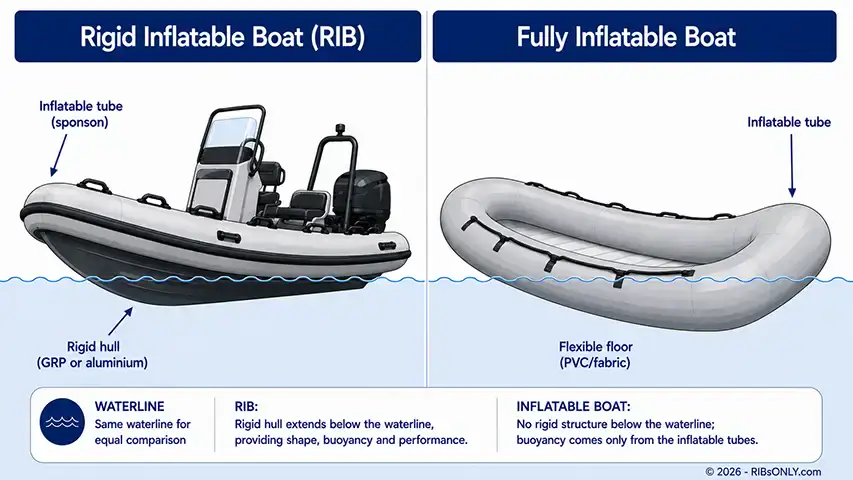
Before the RIB, boat designers faced a persistent trade-off between the stability of inflatable boats and the performance of rigid hulls.
Fully inflatable boats offered excellent buoyancy and stability but lacked the speed, durability, and directional control of hard-hulled boats.
Rigid hulled boats offered performance and durability but lacked the forgiving stability and buoyancy of inflatables in rough conditions.
The RIB concept aimed to combine the strengths of both approaches into a single, purpose-built design.
History Starts with Early Development in the 1960s
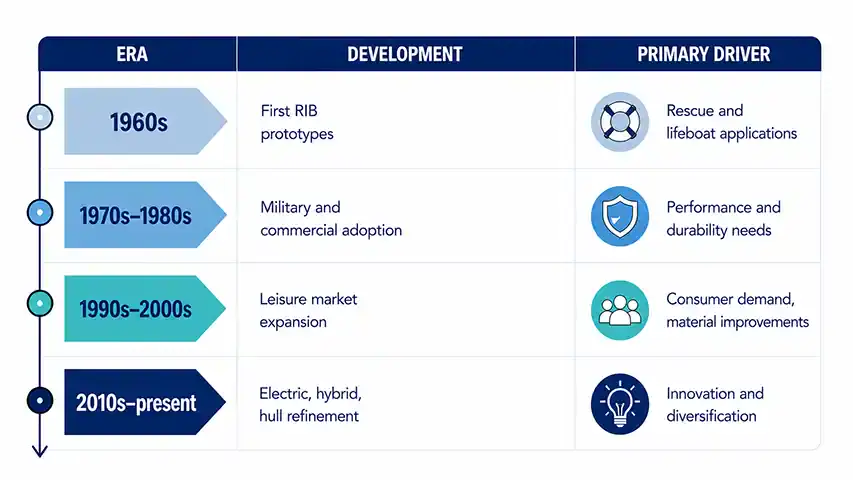
The first recognised RIB designs emerged in the United Kingdom during the 1960s, developed for lifeboat and rescue applications.
Early prototypes combined a rigid fibreglass hull with inflatable tubes fitted around the sides for added buoyancy and stability.
This combination proved particularly effective for launching through surf and operating in challenging near-shore rescue conditions.
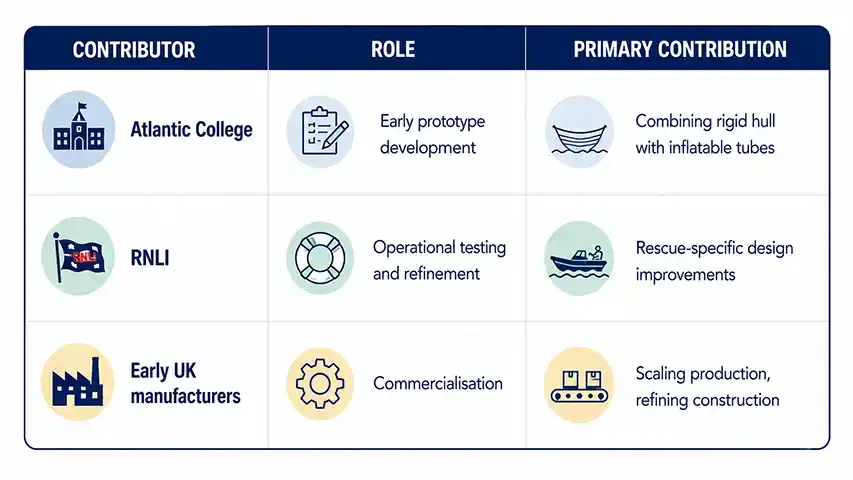
Our guide Who Invented the RIB? covers the specific individuals and institutions credited with these early breakthroughs.
Adoption by Rescue and Military Organisations
Lifeboat institutions were early adopters, recognising the RIB’s advantages for launching quickly through difficult surf conditions. Military organisations soon followed, valuing the RIB’s combination of speed, stability, and resistance to swamping in rough seas.
These early professional applications drove significant investment in refining hull design, tube construction, and overall durability.
Our guide Professional and Rescue RIBs Explained explains how these origins still shape professional RIB design today.
Expansion into Commercial and Leisure Markets
Through the 1970s and 1980s, RIB technology gradually expanded beyond rescue and military applications into commercial and leisure markets. Manufacturers began producing RIBs specifically for diving support, pilot transfer, and eventually recreational boating.
Improvements in tube material, particularly the development of more durable fabrics, made RIBs increasingly practical for everyday leisure use.
Our guide PVC vs Hypalon/CSM RIB Tubes covers the material developments that supported this broader commercial expansion.
Hull Design Evolution
Early RIB hulls were relatively simple, but decades of refinement introduced variable deadrise and more sophisticated hull geometry.
Our guide RIB Hull Shapes Explained covers how modern hull design reflects this long evolutionary process.
Performance-oriented deep-V designs, in particular, trace their lineage directly back to these decades of iterative racing and rescue development.
The Growth of the Leisure RIB Market
By the 1990s and 2000s, RIBs had become an established leisure boating category, no longer limited to specialist applications.
Manufacturers began offering RIBs in a wide range of sizes, styles, and price points aimed squarely at recreational buyers.
This period saw significant diversification: family-oriented layouts, performance-focused designs, and compact tenders all emerged as distinct segments.
The history of the RIB got a real boost.
Our guide Family RIB Buying Guide reflects one branch of this diversification into dedicated leisure use cases.
Modern Innovation and Continued Evolution
Today’s RIB industry continues to innovate, exploring electric propulsion, hybrid systems, and increasingly sophisticated hull and tube technology.
Our guide Electric RIBs: Technology and Limitations covers one of the more significant recent developments in the category’s ongoing evolution.
The core concept, however, remains remarkably unchanged: a rigid hull combined with inflatable tubes for stability and performance.
Why the RIB’s History Still Matters Today
Understanding the RIB’s rescue and military origins helps explain why durability and rough-water performance remain central design priorities.
Many design conventions used across the industry today trace directly back to decades-old rescue and racing requirements.
This history also explains why certain manufacturers with military or rescue heritage carry particular credibility in the marketplace.
The RIB’s Legacy in Modern Boating
The RIB’s journey from a rescue-focused prototype to a globally established boating category reflects decades of practical, incremental innovation.
Its continued evolution suggests the core concept still has room to grow, particularly around propulsion and materials.
Our pillar guide What Is a Rigid Inflatable Boat? covers the fundamentals this history eventually produced.
Frequently Asked Questions
When was the first RIB developed?
Recognised RIB prototypes emerged in the United Kingdom during the 1960s, developed initially for rescue applications.
Why were RIBs first developed for rescue use?
Their combination of stability, buoyancy, and rough-water performance suited launching through surf and difficult sea conditions well.
When did RIBs become popular for leisure boating?
Leisure market expansion accelerated through the 1990s and 2000s, as material and design improvements broadened their appeal.
Has the core RIB design changed much since the 1960s?
The core concept remains similar, though hull shape, tube materials, and propulsion technology have advanced considerably.
Related reading: What Is a Rigid Inflatable Boat? · Who Invented the RIB? · Professional and Rescue RIBs Explained · PVC vs Hypalon/CSM RIB Tubes · RIB Hull Shapes Explained