A Comprehensive Reference for RIB Terminology, From Hull to Helm
RIB terminology can be confusing for newcomers, mixing general boating language with terms specific to inflatable and rigid-hull construction.
This glossary collects the essential terms you’ll encounter across manufacturer specifications, reviews, and buying guides.
Use it as a quick reference whenever unfamiliar terminology appears elsewhere on RIBsONLY or in manufacturer documentation.
Hull and Construction Terms
Deadrise — The angle of the hull bottom relative to horizontal, measured in degrees, affecting ride and stability. See our guide RIB Hull Shapes Explained.
Deep-V hull — A hull with a steep deadrise angle, typically 20 degrees or more, favouring rough-water performance. See our guide Deep-V Hull: Advantages and Trade-offs.
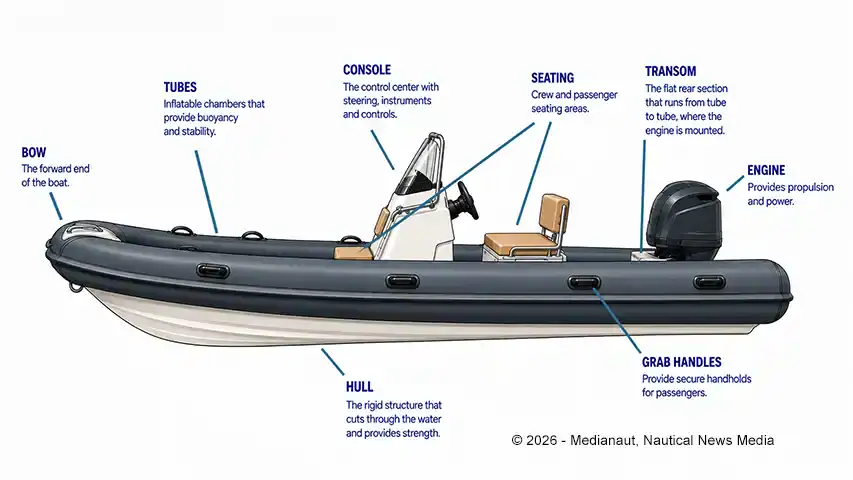
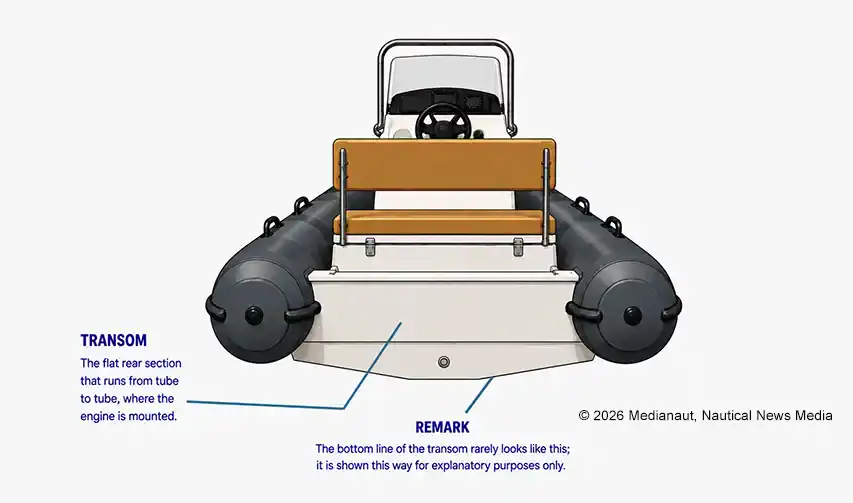
Transom — The flat, vertical structure at the stern where the engine is typically mounted. See our guide How to Inspect a RIB Transom.
Chine — The line where the hull’s side meets its bottom, affecting stability and spray deflection.
Keel — The central structural line running along the hull’s bottom, providing directional stability.
GRP — Glass Reinforced Plastic, commonly known as fibreglass, a common hull material. See our guide Aluminium vs Fibreglass RIB.
Cathedral hull — A multi-sponson hull design offering stability, less common on modern performance RIBs.
Tube and Material Terms
Tubes — The inflatable collar surrounding the hull, providing buoyancy and stability. See our pillar guide What Is a Rigid Inflatable Boat?.
Hypalon/CSM — Chlorosulfonated polyethylene, a durable synthetic rubber used in tube fabric. See our guide PVC vs Hypalon/CSM RIB Tubes.
PVC — Polyvinyl chloride, a common tube fabric offering lower cost but shorter lifespan than Hypalon.
PU — Polyurethane, a tube fabric offering good abrasion resistance and strength, but less commonly used for RIB tubes than Hypalon or PVC.
Chamber — An individual inflatable section of the tube system, with multi-chamber designs offering redundancy.
D-ring — A metal or plastic fitting attached to the tubes, used for rigging lines or securing equipment.
Engine and Propulsion Terms
Outboard — An engine mounted externally on the transom, the most common RIB propulsion method. See our guide How to Choose an Outboard for a RIB.
Inboard — An engine installed inside the hull, typically driving a propeller or waterjet through a separate propulsion system.
Waterjet — A propulsion system using pumped water rather than a propeller. See our guide Waterjet vs Propeller RIB.
Trim — Adjusting the engine angle to affect the boat’s attitude in the water.
Deadman/kill cord — A safety lanyard connecting the helmsman to the engine cut-off switch.
Planing — The state where a boat rides on top of the water rather than displacing through it.
Hybrid propulsion — A system combining electric and combustion power sources. See our guide Hybrid RIBs Explained.
Safety and Regulatory Terms
CE category — A regulatory classification (A, B, C, D) indicating intended operating conditions. See our guide CE Categories for RIBs Explained and What Exactly Do the CE Certifications Stand For.
SOLAS — International maritime safety treaty affecting certain commercial and rescue vessel requirements. See our guide SOLAS RIB Requirements Explained.
EPIRB — Emergency Position Indicating Radio Beacon, a distress signalling device. See our guide Essential Safety Equipment for a RIB.
DSC — Digital Selective Calling, a VHF radio feature enabling one-touch distress alerts.
Broaching — A dangerous sideways turn caused by a following sea pushing the stern unexpectedly.
Buying and Ownership Terms
Deadweight — The total weight capacity a boat can safely carry, including passengers and equipment.
Agreed value policy — An insurance policy paying a pre-set sum on total loss. See our guide RIB Insurance Guide.
Survey — A professional inspection assessing a boat’s condition before purchase. See our guide Buying a Used RIB: Complete Inspection Guide.
Sea trial — An on-water test of a boat’s performance before purchase. See our guide RIB Sea Trial Checklist.
Deadrise transition — The gradual change in hull angle from bow to stern in variable-deadrise hull designs.
Console and Layout Terms
Console — The structure housing the helm, controls, and instruments. See our guide RIB Console Types and Ergonomics.
Jockey seat — A straddle-style seat offering better support at speed than flat bench seating.
Bimini — A folding fabric top providing sun and weather protection.
Sun pad — A cushioned area, often aft, convertible between seating and sunbathing use.
Using This Glossary Effectively
Bookmark this page as a quick reference whenever unfamiliar terminology appears in reviews, specifications, or buying guides. Terms here link directly to more detailed guides covering each concept in far greater depth.
Our pillar guide What Is a Rigid Inflatable Boat? remains the best starting point for understanding how these terms fit together.
Frequently Asked Questions
Is this glossary specific to RIBs, or does it cover general boating terms?
It focuses primarily on RIB-specific terminology, though some general boating terms are included for context.
Will more terms be added over time?
Yes, this glossary is updated periodically as new terminology and technology become relevant to the RIB category.
Can I suggest a term to add?
Yes, feedback and suggestions help keep this reference comprehensive and useful for the RIBsONLY community.
Where should I start if I’m completely new to RIBs?
Begin with our pillar guide What Is a Rigid Inflatable Boat? before diving into specific terminology.
Related reading: What Is a Rigid Inflatable Boat? · RIB Hull Shapes Explained · PVC vs Hypalon/CSM RIB Tubes · RIB Buying Guide: How to Choose the Right Boat · RIB FAQ: The Most Asked Questions