
What a Sharp Deadrise Angle Really Means for Ride, Speed, and Cost
The deep-V hull is widely regarded as the benchmark for rough-water performance among planing powerboats. But “deep-V” isn’t a single specification; it covers a range of angles with real trade-offs attached.
This guide explains what qualifies as deep-V, why it performs the way it does, and where it falls short.
What Qualifies as a Deep-V Hull
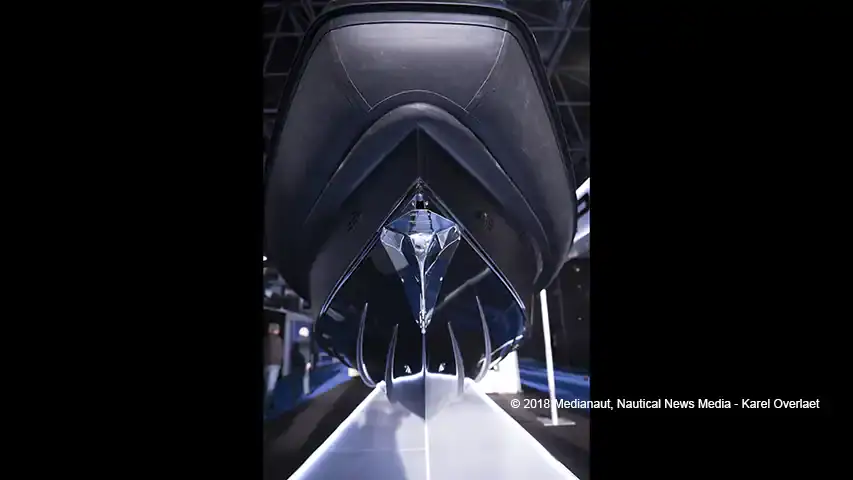
A deep-V hull typically carries a transom deadrise of 20 degrees or more, sometimes reaching 24 degrees. This is meaningfully sharper than the 12 – 18 degree range typical of shallow-V or moderate-V hull designs.
The deep-V concept was popularised in powerboat racing before becoming standard on many offshore-capable leisure boats. Most deep-V RIBs still reduce deadrise somewhat toward the bow and stern for handling balance.
Why Deep-V Hulls Handle Rough Water Well
A sharp deadrise angle cuts into wave faces rather than slamming flat against them at speed. This significantly reduces the shock loading transmitted to the hull, occupants, and onboard equipment in chop.
The result is a smoother, more controlled ride at speed through conditions that would punish a flatter hull. This is why deep-V designs dominate offshore racing, rescue, and serious passage-making RIB applications.
The Trade-offs of a Deep-V Hull
Deep-V hulls generally have less initial stability at rest, since less hull surface contacts the water when stationary. This can make boarding, fishing, or standing at rest feel less stable than on a flatter-bottomed boat.
Deep-V hulls typically need more power to reach and hold plane at a given speed and load. This translates to higher fuel consumption compared with a shallow-V hull of similar size and engine.
Construction costs are often slightly higher too, reflecting the more complex hull geometry involved.
Deep-V and Fuel Consumption
More wetted surface and steeper deadrise mean more hull resistance to overcome at any given speed. Expect a deep-V RIB to burn noticeably more fuel than a shallow-V equivalent at cruising speed.
This gap narrows somewhat at higher speeds, where a well-designed deep-V hull can plane efficiently.
Our guide RIB Fuel Consumption Explained covers how hull shape interacts with engine choice and cruising habits.
Deep-V and Low-Speed Stability
At rest or at very low speed, a deep-V hull rolls and rocks more than a flatter design. This matters most for activities like fishing, diving, or extended anchoring rather than underway performance.
Wider tubes and a properly designed deadrise transition can meaningfully offset this stability trade-off in practice.
Test any deep-V RIB at rest, not just underway, if low-speed stability matters for your intended use.

Who Should Choose a Deep-V RIB?
Choose a deep-V hull if you regularly boat offshore, in open water, or in areas prone to chop.
Choose a shallower design if you mostly boat in sheltered water and prioritise stability and fuel efficiency instead.
Many buyers overestimate how often they’ll actually encounter genuinely rough conditions, worth an honest assessment before deciding.
Our guide RIB Hull Shapes Explained places deep-V hulls in context alongside the other major hull types.
Frequently Asked Questions
Is a deep-V hull always the best choice?
No. It excels in rough water but costs more to run and feels less stable at rest.
What deadrise angle counts as deep-V?
Generally 20 degrees or more at the transom, with some racing-derived designs reaching 24 degrees or higher.
Do deep-V RIBs cost more to buy?
Often slightly more, reflecting more complex hull construction, though this varies significantly by manufacturer and build quality.
Can a deep-V hull be too much boat for calm-water use?
Yes. If you rarely leave sheltered water, the fuel and stability trade-offs may outweigh the rough-water benefit.
Related reading: What Is a Rigid Inflatable Boat? · RIB Hull Shapes Explained · Best RIB for Rough Water: What Really Matters? · RIB Fuel Consumption Explained · Aluminium vs Fibreglass RIB