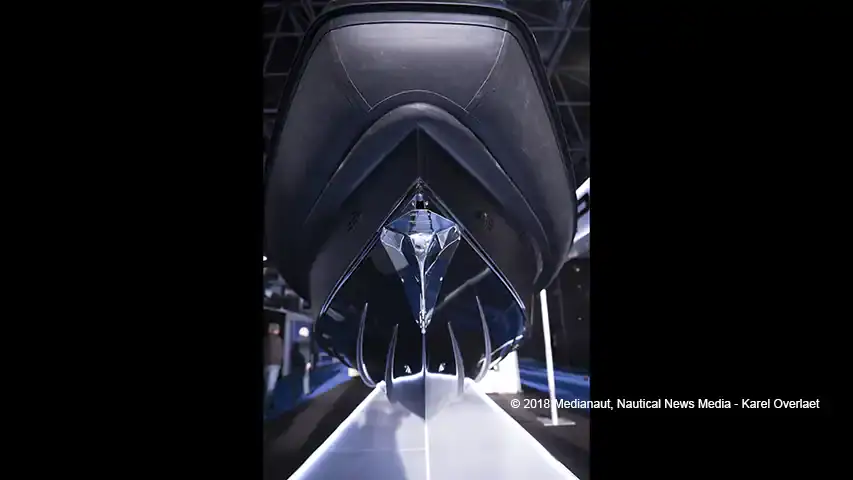
The Zulu 37C is a Swedish high-performance powerboat designed for speed, precision and offshore handling.
Built by Zulu Marine, this 12.05-metre boat combines a lightweight hull with powerful Mercury Racing outboards.
Its semi wave piercing hull form designed for low impact makes for an exceptional comfortable ride in rough conditions.
Its narrow 2.70-metre beam and low-profile design make it stand out from conventional offshore powerboats.
The hull uses vacuum-infused carbon fibre or glass fibre construction to reduce weight while maintaining strength.
If you’re interested, youcan choose twin or triple Mercury Racing 400R or 500R engines.
Depending on the configuration, Zulu Marine reports top speeds ranging from 73 to an impressive 95 knots.
The Zulu 37C on the Baltic Sea offers an interesting look at a Scandinavian approach to high-speed boating.
Rather than focusing on spacious accommodation or family cruising, this Swedish powerboat puts performance, responsive handling and speed at the centre of its design.
Speed converter
–knots
–km/h
–mph
–m/s
1 knot = 1 nautical mile per hour = 1.852 km/h. Indicative values, not for navigation.
By RIBsONLY.com – Home of the Rigid Inflatable Boat
The Editor’s View
The Swedish-built Zulu 37C, designed by the renowned naval architect Petter Martens (LinkedIn profile), takes to the seas with a clear purpose: speed and precise handling.
This Scandinavian powerboat isn’t designed around generous living spaces or relaxed family trips. Instead, it prioritises performance, sharp responses and the driving experience. I hope one day to get my hands on it.
What a Sharp Deadrise Angle Really Means for Ride, Speed, and Cost
The deep-V hull is widely regarded as the benchmark for rough-water performance among planing powerboats. But “deep-V” isn’t a single specification; it covers a range of angles with real trade-offs attached.
This guide explains what qualifies as deep-V, why it performs the way it does, and where it falls short.
A deep-V hull typically carries a transom deadrise of 20 degrees or more, sometimes reaching 24 degrees. This is meaningfully sharper than the 12 – 18 degree range typical of shallow-V or moderate-V hull designs.
The deep-V concept was popularised in powerboat racing before becoming standard on many offshore-capable leisure boats. Most deep-V RIBs still reduce deadrise somewhat toward the bow and stern for handling balance.
Why Deep-V Hulls Handle Rough Water Well
A sharp deadrise angle cuts into wave faces rather than slamming flat against them at speed. This significantly reduces the shock loading transmitted to the hull, occupants, and onboard equipment in chop.
The result is a smoother, more controlled ride at speed through conditions that would punish a flatter hull. This is why deep-V designs dominate offshore racing, rescue, and serious passage-making RIB applications.
The Trade-offs of a Deep-V Hull
Deep-V hulls generally have less initial stability at rest, since less hull surface contacts the water when stationary. This can make boarding, fishing, or standing at rest feel less stable than on a flatter-bottomed boat.
Deep-V hulls typically need more power to reach and hold plane at a given speed and load. This translates to higher fuel consumption compared with a shallow-V hull of similar size and engine.
Construction costs are often slightly higher too, reflecting the more complex hull geometry involved.
Deep-V and Fuel Consumption
More wetted surface and steeper deadrise mean more hull resistance to overcome at any given speed. Expect a deep-V RIB to burn noticeably more fuel than a shallow-V equivalent at cruising speed.
This gap narrows somewhat at higher speeds, where a well-designed deep-V hull can plane efficiently.
At rest or at very low speed, a deep-V hull rolls and rocks more than a flatter design. This matters most for activities like fishing, diving, or extended anchoring rather than underway performance.
Wider tubes and a properly designed deadrise transition can meaningfully offset this stability trade-off in practice.
Test any deep-V RIB at rest, not just underway, if low-speed stability matters for your intended use.
Choose a deep-V hull if you regularly boat offshore, in open water, or in areas prone to chop.
Choose a shallower design if you mostly boat in sheltered water and prioritise stability and fuel efficiency instead.
Many buyers overestimate how often they’ll actually encounter genuinely rough conditions, worth an honest assessment before deciding.
Our guide RIB Hull Shapes Explained places deep-V hulls in context alongside the other major hull types.
Frequently Asked Questions
Is a deep-V hull always the best choice? No. It excels in rough water but costs more to run and feels less stable at rest.
What deadrise angle counts as deep-V? Generally 20 degrees or more at the transom, with some racing-derived designs reaching 24 degrees or higher.
Do deep-V RIBs cost more to buy? Often slightly more, reflecting more complex hull construction, though this varies significantly by manufacturer and build quality.
Can a deep-V hull be too much boat for calm-water use? Yes. If you rarely leave sheltered water, the fuel and stability trade-offs may outweigh the rough-water benefit.
“Our experience from building race and military vessels ensures that you are well prepared to challenge the sea and your driving skills to achieve your goals. We believe that the pilot’s fitness should be the limiting factor, not how the vessel is built.”
Team Zulu has an impressive background in composite manufacturing and are at the forefront in building high-performance boats for individuals, racing teams and police/military.
For such usage Ullman seats were chosen. Check out these videos for more Ullman Seats.
Their boats are designed in cooperation with Adam Younger and Petter Martens some of the best designers in the industry and members of RIBs ONLY – and built in Vaxholm, Sweden.
The Zulu 3310 is a versatile RIB designed to offer a fast and stable ride in difficult sea states.
It is strong with offshore requirements in mind and the appropriate material for that purpose, built by the Swedish Zulu Marine AB. Read the impressive specs below!
I’ve posted the announcement earlier here on RIBsONLY.com.
“We’ve been building sea-worthy vessels to challenge your driving skills and provide you with a thrill since the first boats were created.
The experience we’ve gained from constructing vessels for challenging conditions, like races and military missions, is sure to benefit you as you plan your next voyage.
We never want safety concerns or restrictions to get in the way of great driving experiences.”
I encountered this incredible quote in our Facebook group in a post about the Swedish RIB-built by Zulu Marine AB. This quote was shared on January 20, 2022:
The designer patted my tube and said: “There’s no such thing as bad weather, just bad hulls. Go out there!”
And that designer is none other than the amazing Petter Martens, member of RIBs ONLY! Petter made the conversion to a RIB based on the enormously capable Adam Younger‘s hull design and running surfaces. Adam is also member of RIBs ONLY!
The collaboration between these two very successful designers reached its peak in this impressive ZULU RIB.
Manage Consent
To provide the best experiences, we use technologies like cookies to store and/or access device information. Consenting to these technologies will allow us to process data such as browsing behavior or unique IDs on this site. Not consenting or withdrawing consent, may adversely affect certain features and functions.
Functional
Always active
The technical storage or access is strictly necessary for the legitimate purpose of enabling the use of a specific service explicitly requested by the subscriber or user, or for the sole purpose of carrying out the transmission of a communication over an electronic communications network.
Preferences
The technical storage or access is necessary for the legitimate purpose of storing preferences that are not requested by the subscriber or user.
Statistics
The technical storage or access that is used exclusively for statistical purposes.The technical storage or access that is used exclusively for anonymous statistical purposes. Without a subpoena, voluntary compliance on the part of your Internet Service Provider, or additional records from a third party, information stored or retrieved for this purpose alone cannot usually be used to identify you.
Marketing
The technical storage or access is required to create user profiles to send advertising, or to track the user on a website or across several websites for similar marketing purposes.