Electric RIBs: Technology and Limitations

Are electric powered RIBs the future? @ RIBs ONLY - Home of the Rigid Inflatable Boat
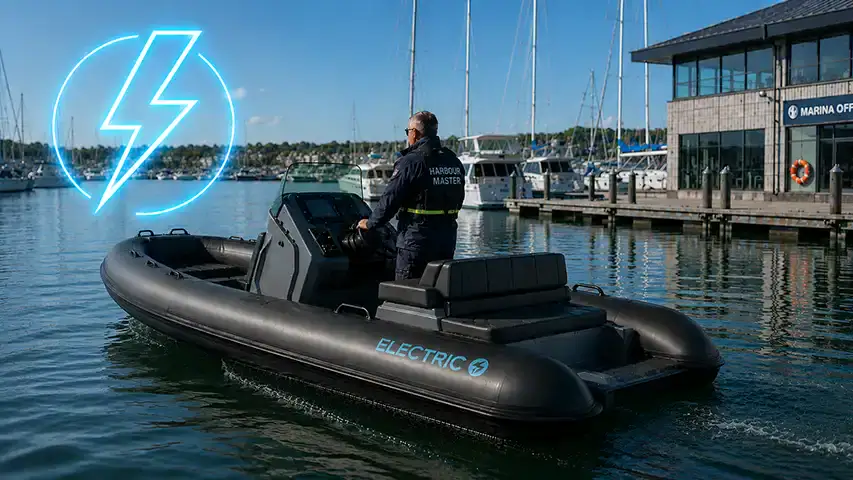
AI generated image of an electric RIB – © 2026 Medianaut, Nautical News Media

How Electric Propulsion is Changing and Currently Limiting RIB Design

Electric propulsion has moved from niche experiment to genuine product category across the boating industry.

RIBs are no exception, with several manufacturers now offering electric or electric-assisted models for leisure and light commercial use.

This guide explains how electric RIB technology actually works, what it does well, and where it currently falls short.

What Makes a RIB “Electric”

An electric RIB replaces the combustion outboard or inboard with an electric motor powered by an onboard battery pack. Some designs use a dedicated electric outboard, visually similar to a conventional outboard but without fuel or exhaust systems.

Others integrate the motor and battery more deeply into the hull, prioritising weight distribution and hydrodynamics over modularity.

Hybrid systems, covered separately in our guide Hybrid RIBs Explained, combine electric and combustion power rather than replacing one with the other.

How Electric Outboard Motors Work

Electric outboards use a battery pack to power an electric motor connected directly or via a gearbox to the propeller. They offer instant torque, smooth and quiet operation, and none of the vibration typical of combustion outboards.

There’s no idling, no warm-up period, and no exhaust fumes, which meaningfully changes the on-water experience. Maintenance is generally simpler too, since electric motors have far fewer moving parts than combustion equivalents.

Range and Battery Limitations

Battery energy density remains the single biggest constraint on electric RIB performance and practicality today.

Most electric RIBs offer a realistic range of 20 to 50 nautical miles at moderate cruising speed.

Range drops significantly at higher speeds, since power draw increases sharply once the boat exceeds efficient cruising speed. This makes electric RIBs currently better suited to short trips, harbour use, and calm inland water than long passages.

Our guide RIB Fuel Consumption Explained explains how combustion engines compare on range and efficiency for context.

Weight and Balance Considerations

Battery packs are heavy, and that weight is typically concentrated low and aft, near the transom. This can meaningfully affect trim, handling, and stability compared with a lighter combustion outboard of similar power.

Manufacturers designing electric RIBs from the ground up can better manage this weight distribution than simple outboard conversions.

Retrofitting an existing hull with electric propulsion often produces worse handling than a boat designed specifically around it.

Performance Compared to Combustion Engines

Top speed for most electric RIBs currently trails comparable combustion-powered boats, particularly at the larger end of the size range. Acceleration is often excellent thanks to instant electric torque, even where top speed remains modest.

For displacement or low-speed cruising, electric propulsion performs very competitively against combustion alternatives.

For high-speed offshore use, combustion engines still hold a clear performance advantage as of today’s technology.

Charging Infrastructure Challenges

Marina charging infrastructure remains limited and inconsistent across regions, unlike the widespread availability of fuel docks.

Charging times vary considerably, from under an hour for fast charging to several hours for standard charging setups.

This makes trip planning more important for electric RIB owners than it typically is for combustion boat owners.

Owners without home or marina charging access may find electric ownership significantly less practical in daily use.

Where Electric RIBs Make Sense Today

Sheltered harbours, marine reserves with combustion restrictions, and short-range leisure use suit current electric RIB technology well. Quiet operation makes electric RIBs particularly appealing for wildlife watching, diving support, and noise-sensitive environments.

Commercial applications like harbour patrol or short-range tender work are also emerging use cases for electric propulsion. Long-range cruising, offshore passages, and high-speed leisure use remain better served by combustion or hybrid systems for now.
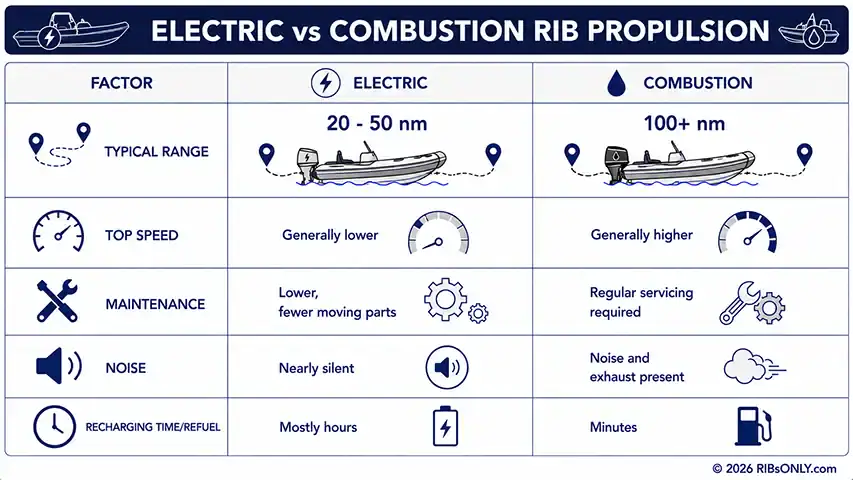
Diagram showing electric v combustion rib propulsion @ RIBs ONLY - Home of the Rigid Inflatable Boat
Diagram showing general data about electric vs combustion rib propulsion – © 2026 Medianaut, Nautical News Media

Previously we have published an opinion article (2023) on electric propulsion for Rigid Inflatable Boats (RIBs): Why an Electric Outboard Is Not the Better Choice Now.

Is an Electric RIB Right for You?

Choose electric if your use case involves short trips, sheltered water, and access to reliable charging infrastructure.

Choose combustion or hybrid if you need long range, high speed, or operate where charging access is limited.

Electric RIB technology is improving quickly, and today’s limitations will likely narrow considerably over the coming years.

Our RIB Buying Guide: How to Choose the Right Boat covers propulsion choice alongside every other major buying factor.


Frequently Asked Questions

How far can an electric RIB travel on one charge?
Most currently offer 20 to 50 nautical miles at moderate cruising speed, with range dropping at higher speeds.

Are electric RIBs as fast as combustion RIBs?
Generally not yet, particularly for larger boats, though acceleration from a standstill is often very competitive.

Is electric RIB maintenance really lower?
Yes. Electric motors have far fewer moving parts than combustion outboards, reducing routine servicing needs considerably.

Can I convert my existing RIB to electric power?
Technically often possible, but weight distribution and range limitations usually favour purpose-built electric hulls over conversions.

Where can I watch videos of electric-powered RIBs?
Explore our collection of videos and articles covering everything you need to know about electric-powered Rigid Inflatable Boats (RIBs), from real-world performance and range to technology, charging, and onboard experience.


Related reading: What Is a Rigid Inflatable Boat? · Hybrid RIBs Explained · RIB Fuel Consumption Explained · How to Choose an Outboard for a RIB · RIB Buying Guide: How to Choose the Right Boat · Why an Electric Outboard Is Not the Better Choice Now Electric-powered Rigid Inflatable Boats
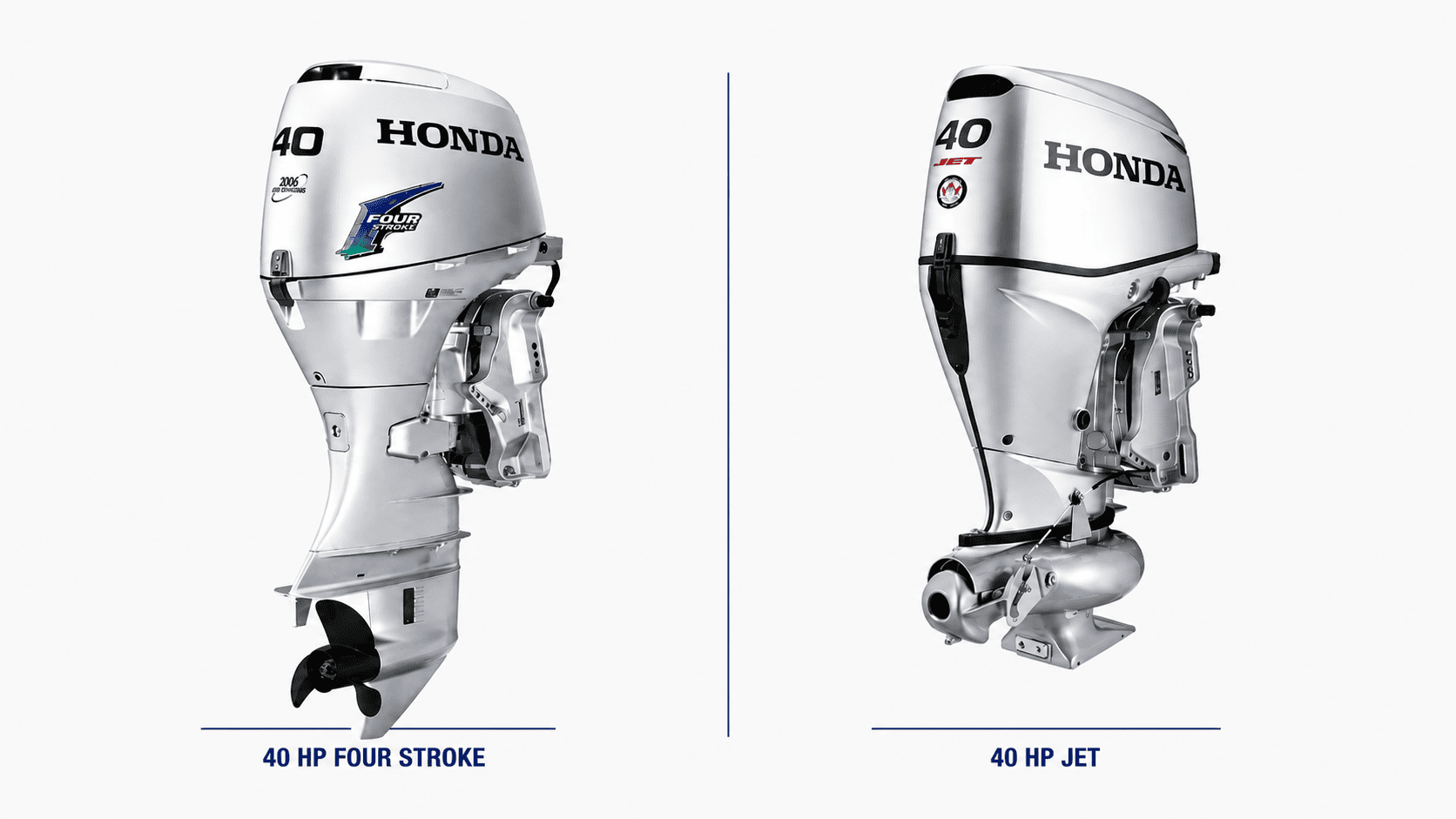

Waterjet vs Propeller RIB Propulsion

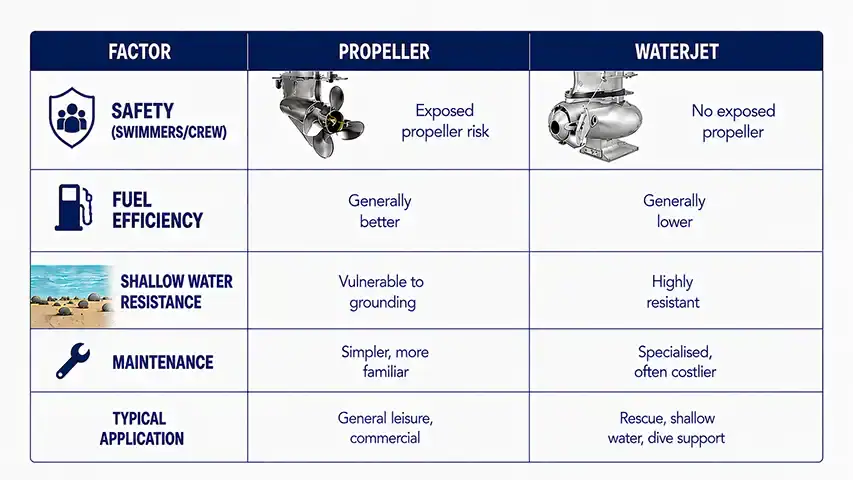
A Honda 40 hp in waterjet and propeller version @ RIBs ONLY - Home of the Rigid Inflatable Boat
© Honda Marine

Comparing Propulsion Types for Performance, Safety, and Maintenance

Propulsion type shapes a RIB’s performance, safety profile, and maintenance needs more than many buyers initially realise. The choice between waterjet and propeller drive involves genuine trade-offs, not a simple “better or worse” answer.

This guide compares both systems across the factors that matter most for typical RIB ownership and use.

How Propeller Drive Works

Propeller drive uses a rotating propeller, typically mounted on an outboard or sterndrive, to generate forward thrust. This is the standard propulsion method on the vast majority of leisure and commercial RIBs worldwide.

Propellers are well understood, widely serviceable, and generally more fuel-efficient than waterjets at cruising speed. The propeller itself and the lower unit remain exposed below the hull, vulnerable to grounding or debris strikes.

How Waterjet Drive Works

Waterjet drive pulls water in through an intake beneath the hull and expels it under pressure through a steerable nozzle. There’s no exposed propeller, since the entire mechanism sits within the hull rather than protruding below it.

Steering and reverse are achieved by redirecting the water jet rather than by turning a rudder or lower unit. Waterjets are common on rescue RIBs, shallow-water craft, and boats operating in debris-prone or rocky environments.

Safety Differences Between the Two Systems

Waterjets eliminate the exposed propeller entirely, significantly reducing injury risk to swimmers or crew in the water. This makes waterjets the preferred choice for rescue operations, dive support, and any application involving people in the water.

Propeller drive carries genuine injury risk if someone falls overboard or approaches the boat while the propeller is turning.

Our guide Essential Safety Equipment for a RIB covers broader safety considerations that apply regardless of propulsion type.

Performance Comparison

Propeller drive generally offers better fuel efficiency and acceleration from a standing start than comparable waterjet systems.

Waterjets typically need higher engine power to achieve similar speeds, since jet propulsion is inherently less efficient.

At high speed, waterjets can perform very competitively, particularly in shallow or debris-prone water where propellers are vulnerable.

Handling characteristics differ too; waterjets often feel different at low speed due to reduced low-speed thrust and steering response.

Shallow Water and Grounding Resistance

Waterjets draw significantly less water than propeller drives, since nothing protrudes below the hull.

This makes waterjets far more resistant to damage from grounding, sandbars, or debris strikes in shallow water.

Propeller-driven RIBs risk propeller and lower unit damage in the same conditions that a waterjet would handle safely.

For operation in rivers, shallow estuaries, or rocky coastlines, this durability advantage often outweighs the efficiency trade-off.

Maintenance Differences

Propeller drive is simpler mechanically and generally cheaper and easier to service, given widespread technician familiarity.

Waterjets require specialised knowledge for servicing, and impeller wear or intake blockages need specific diagnostic attention.

Parts availability for propeller systems is typically better, particularly for common outboard brands and models. Waterjet servicing costs are often higher, reflecting the more specialised nature of the mechanism.

Which Propulsion Type Should You Choose?

Aspects of a waterjet vs propellor rib propulsion @ RIBs ONLY - Home of the Rigid Inflatable Boat
Comparison rib propulsion systems – © 2026 Medianaut, Nautical News Media

Choose propeller drive for general leisure and commercial use where efficiency and simple maintenance matter most.

Choose waterjet drive if you operate in shallow water, around swimmers, or in debris-prone environments regularly.

Our guide Professional and Rescue RIBs Explained explains why waterjets remain common in rescue and shallow-water applications.

Our RIB Buying Guide: How to Choose the Right Boat covers propulsion choice alongside every other major purchase factor.


Frequently Asked Questions

Is a waterjet safer than a propeller?
Yes, significantly, since there’s no exposed propeller to injure swimmers or crew in the water.

Are waterjets less fuel-efficient than propellers?
Generally yes, since jet propulsion typically requires more power to achieve comparable speeds to a propeller.

Can waterjet RIBs operate in shallow water safely?
Yes, this is one of their main advantages, since nothing protrudes below the hull to strike bottom.

Is waterjet maintenance more expensive?
Often yes, reflecting the specialised knowledge and parts required compared with widely serviced propeller systems.


Related reading: What Is a Rigid Inflatable Boat? · Essential Safety Equipment for a RIB · Professional and Rescue RIBs Explained · Single vs Twin Outboards on a RIB · RIB Buying Guide: How to Choose the Right Boat


Single vs Twin Outboards on a RIB

A Greek built Technohull with twin outboards by Brugge Marine Center (BMC) @ RIBs ONLY - Home of the Rigid Inflatable Boat
A Greek built Technohull with twin outboards by Brugge Marine Center – © BMC – entrant photo contest 2023

Weighing Redundancy, Performance, and Cost for Engine Configuration

Choosing between a single outboard and twin outboards is one of the more consequential decisions in RIB specification. The choice affects redundancy, performance, fuel consumption, purchase price, and long-term maintenance cost simultaneously.

This guide compares both configurations across the factors that matter most when specifying or buying a RIB.

What Twin Outboards Actually Offer

Twin outboard configurations split total power across two separate engines rather than concentrating it in one.

The most significant advantage is redundancy: if one engine fails, the other can typically get you back safely.

This matters considerably for offshore use, remote locations, or any situation where a tow or rescue would be difficult.

Twin engines also allow differential thrust for tighter low-speed manoeuvring, useful when docking or handling in confined spaces.

What Single Outboards Offer

A single outboard configuration is simpler, lighter, and generally cheaper to purchase and maintain over time. Fewer components mean fewer things that can fail, and servicing involves only one engine rather than two.

Weight savings from a single engine can improve performance and efficiency compared with a twin setup of equal total power.

For coastal and inland use where help is readily available, the redundancy benefit of twins matters less.

Performance Differences

Twin outboards, when properly matched to the hull, can offer excellent acceleration and top speed for larger RIBs. Single outboards on smaller to mid-size RIBs often perform very competitively, without the added weight of a second engine.

At larger sizes, above roughly 8 metres, available single-engine power sometimes can’t match what twins provide.

Our guide How to Choose an Outboard for a RIB explains how to match engine power to hull size and intended use.

Fuel Consumption Comparison

Twin outboards generally consume more fuel in total than a single outboard producing equivalent combined horsepower. This is partly due to added weight and partly due to the inherent inefficiency of running two smaller engines.

Our guide RIB Fuel Consumption Explained covers how engine configuration affects overall running costs.

Some twin outboards setups allow running on one engine at cruising speed, improving efficiency when full power isn’t needed.

Redundancy and Safety Considerations

For offshore passages, remote cruising, or professional use, twin engine redundancy is often considered essential rather than optional. A single engine failure with only one outboard fitted leaves you entirely without propulsion until help arrives.

Our guide Professional and Rescue RIBs Explained explains why twin engines are near-standard in that segment.

For sheltered coastal and inland use, this redundancy benefit is real but less critical to overall safety.

Cost Considerations: Purchase and Maintenance

Twin outboards cost more upfront, since you’re purchasing and installing two engines instead of one. Ongoing maintenance costs roughly double too, covering servicing, parts, and eventual replacement for two separate engines.

Our guide How Much Does a RIB Cost? breaks down how engine configuration affects total ownership cost.

Weigh this added cost against how much you genuinely value the redundancy for your typical use pattern.

Weight and Transom Considerations

Twin outboards add significant weight at the stern, which can affect trim, handling, and hull performance if not properly accounted for. Not every hull is designed or rated for twin-engine installation; check manufacturer specifications before considering a conversion.

Retrofitting a single-engine hull with twins is rarely straightforward and often not recommended without manufacturer guidance.

Comparison single vs twin outboards on a RIB @ RIBs ONLY - Home of the Rigid Inflatable Boat
Comparison diagram of single vs twin outboards installed on a RIB – © 2026 Medianaut, Nautical News Media

Which Configuration Should You Choose?

Choose twin outboards if you regularly boat offshore, professionally, or in remote areas where redundancy matters most.

Choose a single outboard if you boat mainly in sheltered coastal or inland water with help readily available.

Our RIB Buying Guide: How to Choose the Right Boat covers engine configuration alongside every other major buying decision.


Frequently Asked Questions

Is twin outboard redundancy really necessary for leisure boating?
It depends on where you boat. Offshore or remote use benefits significantly; sheltered coastal use less so. Some countries also legally require a second, usually smaller, outboard as a backup alongside your main engine.

Do twin outboards always cost double to maintain?
Roughly, yes, since servicing, parts, and eventual replacement apply separately to each engine.

Can any RIB hull be fitted with twin outboards?
No. Hulls must be designed or rated for twin-engine installation; check manufacturer specifications before considering it.

Are twin outboards faster than a single outboard of equal total power?
Not necessarily. Added weight from a second engine can offset the power advantage in some configurations.


Related reading: What Is a Rigid Inflatable Boat? · How to Choose an Outboard for a RIB · RIB Fuel Consumption Explained · Professional and Rescue RIBs Explained · How Much Does a RIB Cost?


Best RIB for Rough Water: What Really Matters?

Best RIB for Rough Water: What Really Matters @ RIBs ONLY - Home of the Rigid Inflatable Boat
A Northstar RIB in rough waters – © 2026 – Northstar

What ‘Rough Water Capability’ Actually Means

“Rough water capability” gets thrown around loosely in boat marketing, often reduced to little more than “bigger is better.”

The reality is more specific, and more useful once you understand what actually determines how a RIB behaves when conditions turn.

This guide breaks down the real factors, deadrise angle, tube diameter, weight distribution and hull length.

That way you can evaluate any RIB’s genuine rough water capability rather than relying on marketing language alone.

Deadrise Angle: The Most Important Hull Factor

Deadrise angle describes how sharply a hull’s bottom rises from the keel to the sides, measured in degrees.

This single specification affects rough-water behaviour more than almost any other hull characteristic.

Higher deadrise (typically 20 – 24 degrees at the transom) cuts through waves more smoothly, reducing pounding and improving comfort in a chop.

The trade-off is slightly reduced stability at rest and marginally higher fuel consumption at a given speed.

Lower deadrise (typically 12 – 18 degrees) offers more stability at rest and better fuel efficiency, but transmits more pounding impact in genuine rough conditions.

Many serious offshore RIBs use a variable deadrise design, sharper toward the bow for wave-cutting, flatter toward the stern for stability and efficient planing.

This represents the practical compromise most rough water-focused manufacturers settle on.

Hull Length: Why Longer Generally Handles Better

A longer waterline crosses a greater portion of a wave’s wavelength simultaneously, which reduces the boat’s tendency to pitch violently as it moves through consecutive waves.

This is genuine physics, not just a size-selling argument.

It’s also why our sizing guide, What Size RIB Do I Need?, recommends longer boats specifically for buyers planning serious offshore use.

That said, length alone doesn’t guarantee good rough water behaviour.

A long hull with poor deadrise or weight distribution can still handle worse than a shorter, better-designed alternative.

Tube Diameter and Rough-Water Stability

Larger diameter tubes provide greater reserve buoyancy and a higher freeboard.

Both are valuable in genuinely rough conditions where waves regularly wash over the deck of a lower-freeboard boat.

Offshore-focused RIBs typically feature noticeably larger tube diameters relative to their length compared with calm-water leisure models.

This isn’t purely cosmetic; it directly affects how much water the boat can take on before performance and safety are compromised.

Our guide Why Do RIBs Have Inflatable Tubes? explains the underlying buoyancy physics this design choice relies on.

Weight Distribution and Trim

How weight is distributed aboard a RIB significantly affects rough-water handling, sometimes more than the hull’s inherent design.

Excess weight concentrated at the stern, whether from heavy twin outboards or poorly placed equipment, can cause the bow to ride high.

It’s reducing wave-cutting effectiveness and increasing the risk of the hull slamming down hard between waves.

Properly distributed weight, including thoughtful fuel tank placement and balanced passenger seating, helps the hull maintain its designed running trim even as conditions worsen.

Freeboard: Often Overlooked, Genuinely Important

Freeboard, the height of the hull and tubes above the waterline, determines how much wave height a boat can encounter before water regularly comes aboard.

Rough water focused RIBs typically feature higher freeboard than calm-water leisure models of similar length.

This single specification, easy to overlook on a spec sheet, has a direct and significant effect on how a boat feels and performs once conditions deteriorate.

Self-Bailing Cockpit Design

A self-bailing cockpit, where the deck sits above the waterline and drains automatically through dedicated outlets, matters enormously in genuine rough water. In those conditions some water coming aboard becomes almost inevitable.

Boats without effective self-bailing design can accumulate water on deck faster than it drains, adding dangerous weight exactly when stability matters most.

We cover this design feature’s broader safety role in Can a RIB Sink?

Engine Configuration and Rough Water Confidence

Twin outboards provide genuine redundancy that matters significantly more in rough, remote or offshore conditions than in calm coastal day boating.

Losing propulsion entirely in challenging conditions represents a far more serious situation than the same failure closer to shore in calm water.

Our complete guide, How to Choose an Outboard for a RIB, covers this trade-off between single and twin configurations in full detail.

Rafnar RHIB in rough waters @ RIBs ONLY - Home of the Rigid Inflatable Boat
A Rafnar in agitated seas – © 2026 – Tom Bettle

Putting the Factors Together: A Practical Checklist

When evaluating any specific RIB’s genuine rough water capability, check:

  1. Deadrise angle, ideally variable, sharper forward and flatter aft.
  2. Hull length, appropriate to your realistic sea conditions, not just your budget.
  3. Tube diameter, proportionally larger for genuine offshore use.
  4. Freeboard height, adequate for the wave conditions you’ll actually encounter.
  5. Self-bailing cockpit design, confirmed rather than assumed.
  6. Weight distribution, including realistic loaded trim, not just an empty-boat spec sheet.

No single factor guarantees good rough-water performance alone.

The best rough-water RIBs get most or all of these factors right simultaneously, which is precisely why genuine offshore-capable models command a price premium over superficially similar leisure boats.

Hull Material’s Role in Rough Water

Hull material also factors into rough-water performance, primarily through weight, flex and impact resistance under repeated wave slamming.

Our detailed comparison, Aluminium vs Fibreglass RIB, covers how each material behaves specifically under this kind of sustained stress.


Frequently Asked Questions

Is a bigger RIB always better in rough water?
Generally length helps, but deadrise angle, freeboard and weight distribution all matter just as much. A well-designed smaller RIB can outperform a poorly designed larger one.

What deadrise angle should I look for in a rough-water RIB?
Look for variable deadrise designs, typically 20+ degrees at the bow tapering to a flatter stern, though exact figures vary by manufacturer and intended use.

Does tube diameter really make a measurable difference?
Yes. Larger tube diameter increases reserve buoyancy and freeboard, both directly relevant to how a boat handles waves washing over the deck.

Are twin outboards necessary for rough-water use?
Not strictly necessary, but the redundancy they provide becomes considerably more valuable the further offshore or more remote your typical routes become.


Related reading: What Is a Rigid Inflatable Boat? · How Does a RIB Work? · What Size RIB Do I Need? · Are Rigid Inflatable Boats Safe? · Aluminium vs Fibreglass RIB


Aluminium vs Fibreglass RIB

Aluminium vs Fibreglass RIB @ RIBs ONLY - Home of the Rigid Inflatable Boat
Left: After the fibreglass is laid up, the hull is vacuum-sealed for resin infusion.
Right: The aluminium hull is assembled by welding the individual sections together.
© Gemini Marine – © Highfield Boats

Learn All About Both Materials

Hull material shapes a RIB’s ride, weight, durability and even its resale market, often more than buyers expect before comparing the two side by side.

Aluminium and fibreglass (also known as GRP) each have genuine strengths, and neither is objectively superior across every use case.

This guide compares both materials honestly, covering the trade-offs that matter once you’re standing on the dock deciding between two real boats.

Construction: How Each Hull is Built

GRP (fibreglass) hulls are built by laying layers of glass fibre and resin into a mould, sometimes with a foam or balsa core for added stiffness and buoyancy. This process allows complex, smoothly curved hull shapes and consistent quality across production runs.

Aluminium hulls are typically welded from marine-grade aluminium plate and extrusions, a process closer to traditional metal boatbuilding. This construction method favours simpler, often more angular hull shapes, though modern techniques increasingly allow more refined forms.

Ride Quality and Noise

This is one of the most noticeable differences owners report after switching between the two materials.

Fibreglass hulls (GRP) flex slightly under load, which helps absorb some vibration and impact energy. Combined with the resin matrix’s natural damping properties, this generally produces a quieter, smoother-feeling ride, particularly at speed in a chop.

Aluminium hulls are stiffer and transmit more vibration and slap noise through the structure, especially in choppy conditions. Many owners describe aluminium RIBs as noticeably louder underway, though hull design and construction quality significantly affect how pronounced this difference feels in practice.

Weight and Performance

Aluminium can offer a genuine weight advantage in certain configurations, particularly for larger hulls, since it achieves structural strength with thinner material than fibreglass (GRP) requires for equivalent rigidity.

This weight advantage can translate into better power-to-weight ratios, marginally improved fuel efficiency, or the ability to run a smaller engine for equivalent performance.

The practical difference varies considerably by specific hull design and size, and isn’t universal across every model comparison.

Durability and Impact Resistance

Aluminium’s standout advantage is impact resistance.

It dents rather than cracks under significant impact, and dents can often be repaired without the structural concerns that accompany GRP damage (fibreglass).

This resilience explains aluminium’s popularity in commercial, rescue and working environments where hull impacts are routine.

Fibreglass (GRP) performs excellently under normal use but is more vulnerable to cracking or delamination under significant impact, particularly if a core material is compromised by water intrusion following damage.

Well-built GRP hulls are robust, but repairs after serious impact are typically more involved and costly than aluminium dent repair.

Corrosion and Long-term Maintenance

GRP (fibreglass) doesn’t corrode in the way metal does, though gelcoat can fade, chalk or develop osmosis blisters over many years without proper care.

Aluminium requires attention to galvanic corrosion, particularly around fittings, fasteners and areas where dissimilar metals meet. Saltwater use demands proper anode maintenance and attentive care around any electrical connections. Well-maintained aluminium hulls resist corrosion effectively, but neglect carries real consequences over time.

Repair Complexity

Minor aluminium dents are often straightforward for a competent welder to address, and welding repairs, while requiring specific skills, are widely available in most boating regions.

GRP (fibreglass) repairs require gelcoat matching, resin work and, for structural damage, careful attention to core material condition.

Cosmetic GRP repairs are generally accessible; structural repairs benefit strongly from professional expertise.

Resale Value and Market Preference

Resale patterns vary considerably by region and market segment.

In many leisure markets, GRP remains the more commonly traded material, benefiting from broader buyer familiarity and typically stronger aesthetic resale appeal.

Aluminium holds strong resale value in commercial, rescue and working-boat markets, where its durability credentials directly translate into buyer confidence.

Checking local market trends for your specific region and intended resale timeline is worthwhile before treating either material as the automatically “safer” resale choice.

Cost Comparison

Pricing varies significantly by manufacturer, size and specification, making broad generalisations risky.

That said, aluminium construction, particularly for smaller hulls, can carry a cost premium related to labour-intensive welding processes, while GRP benefits from more standardised mould-based production at scale for popular models.

Larger aluminium hulls sometimes narrow or reverse this gap, given the material efficiency advantages at bigger sizes.

Always compare specific, equivalent models rather than assuming one material is universally cheaper.

Which Should You Choose?

Choose fibreglass (GRP) if ride comfort, noise levels and broad leisure-market resale familiarity matter most to your priorities.

Choose aluminium if impact resistance, repairability after damage, and proven performance in demanding or commercial-adjacent use matter more than ride refinement.

Many rescue services, commercial operators and serious offshore users choose aluminium specifically for its durability under repeated hard use.

Many leisure buyers choose GRP (fibreglass) specifically for the smoother, quieter experience it typically delivers.

Our complete RIB Buying Guide places this decision alongside sizing, tube material and engine choice for a full picture of what matters most to you.


Frequently Asked Questions

Is aluminium always heavier than fibreglass (GRP)?
Not necessarily. Aluminium can achieve strength with thinner material, sometimes producing lighter hulls than GRP at equivalent sizes, though this varies by specific design.

Which material is better for saltwater use?
Both perform well in saltwater with proper maintenance. Aluminium requires attentive corrosion management; GRP requires attentive gelcoat and core care.

Do aluminium RIBs really sound louder underway?
Generally yes, due to the material’s stiffness transmitting more vibration, though hull design and construction quality significantly affect how noticeable this is.

Is one material objectively safer than the other?
No. Both materials, properly built and maintained, deliver excellent safety records across leisure, commercial and rescue applications worldwide.


Related reading: What Is a Rigid Inflatable Boat? · How Does a RIB Work? · RIB Buying Guide · Best RIB for Rough Water


×