How International Safety Standards Apply to Commercial and Rescue RIBs
SOLAS (Safety of Life at Sea) is one of the most important international maritime safety frameworks, and it directly shapes certain RIB requirements.
While most leisure RIB owners never encounter SOLAS directly, commercial and rescue operators must understand it thoroughly.
This guide explains what SOLAS is, when it applies to RIBs, and what requirements it typically imposes.
What SOLAS Actually Is
SOLAS is an international maritime treaty establishing minimum safety standards for the construction, equipment, and operation of ships.
It’s overseen by the International Maritime Organization (IMO website) and adopted into national law by signatory countries worldwide.
While SOLAS primarily targets larger commercial vessels, certain provisions extend to lifeboats, rescue boats, and associated equipment.
When SOLAS Applies to RIBs
SOLAS requirements typically apply to RIBs used as ship’s lifeboats, rescue boats, or tenders aboard SOLAS-regulated commercial vessels.
Leisure RIBs used for private recreational boating generally fall outside SOLAS’s direct regulatory scope.
Our guide Professional and Rescue RIBs Explained explains how professional applications often intersect with SOLAS-type regulatory frameworks.
Commercial passenger vessels, cargo ships, and certain offshore installations are common contexts where SOLAS-compliant RIBs are required.
Through this link you can watch SOLAS RIBs in action.
Construction Requirements Under SOLAS
SOLAS-compliant rescue boats must meet specific construction standards covering buoyancy, stability, and structural integrity under load.
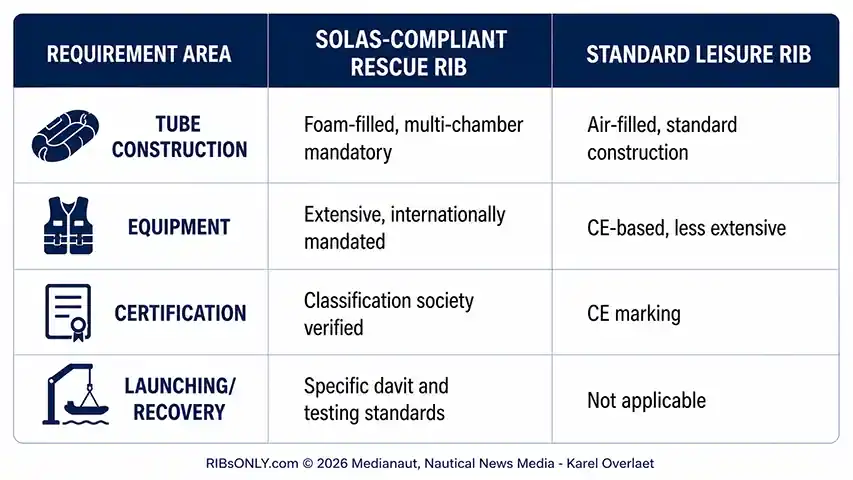
Multi-chamber, foam-filled tube construction is typically required, ensuring the boat remains functional even with damage to one chamber.
Our guide PVC vs Hypalon/CSM RIB Tubes explains material considerations relevant to this kind of robust, redundant construction.
Equipment Requirements Under SOLAS
SOLAS specifies detailed equipment requirements for rescue boats, covering communication, signalling, and survival equipment carried aboard.
This typically exceeds what’s required or expected on a standard leisure RIB by a significant margin.
Our guide Essential Safety Equipment for a RIB covers leisure-focused equipment requirements, useful context for understanding how much more extensive SOLAS requirements are.
Launching and Recovery Requirements
SOLAS includes specific requirements for how rescue boats must be capable of being launched and recovered, even in adverse conditions.
This affects davit design, boat weight limits, and the overall integration between the RIB and its parent vessel.
These requirements go well beyond what any typical leisure RIB owner would ever need to consider.
Certification and Testing Under SOLAS
SOLAS-compliant rescue boats undergo rigorous testing and certification, verified by classification societies recognised under the treaty framework.
This certification process is considerably more extensive than standard CE marking applied to leisure recreational craft.
Our guide CE Categories for RIBs Explained covers the certification framework relevant to leisure boats, useful for contrast with SOLAS’s stricter commercial standards.
Why Leisure Buyers Should Still Understand SOLAS
Understanding SOLAS helps leisure buyers appreciate the construction standards behind professional-grade RIBs derived from commercial designs.
Some manufacturers market leisure models built on SOLAS-influenced construction principles, carrying over meaningful durability advantages.
Our guide Best RIB Brands: How to Evaluate a Manufacturer explains how manufacturing heritage, including commercial and rescue experience, factors into brand evaluation.
SOLAS and Ongoing Compliance
SOLAS compliance isn’t a one-time certification; commercial operators must maintain ongoing inspection and equipment standards throughout the boat’s service life.
This ongoing compliance burden is one reason commercial RIB operation involves significantly more regulatory oversight than leisure ownership.
Understanding Where You Stand
If you own or operate a leisure RIB privately, SOLAS requirements almost certainly don’t apply to you directly.
If you’re involved in commercial vessel operations, professional rescue services, or ship’s tender provision, SOLAS compliance becomes a genuine requirement.
Our pillar guide What Is a Rigid Inflatable Boat? provides broader context on how RIBs are regulated across different use cases.
Frequently Asked Questions
Do leisure RIB owners need to worry about SOLAS?
Generally no. SOLAS primarily applies to commercial vessels and their associated rescue boats and tenders.
What makes a RIB SOLAS-compliant?
Specific construction, equipment, and certification standards covering buoyancy, redundancy, and launch/recovery capability under adverse conditions.
Is SOLAS the same as CE certification?
No. CE certification applies to recreational craft under EU law; SOLAS is a broader international commercial maritime safety framework.
Can a SOLAS-compliant RIB be used for leisure purposes?
Technically yes, though the added construction standards typically come with a significant cost premium over standard leisure boats.
Related reading: What Is a Rigid Inflatable Boat? · Professional and Rescue RIBs Explained · CE Categories for RIBs Explained · PVC vs Hypalon/CSM RIB Tubes · Best RIB Brands: How to Evaluate a Manufacturer