What CE Design Categories Mean and Why They Matter for Buyers
CE categories appear on nearly every RIB sold within the European market, yet many buyers don’t fully understand what they mean.
These categories aren’t marketing claims; they’re regulatory classifications based on tested design criteria for specific operating conditions.
This guide explains what each CE category actually represents and how it should inform your buying decision.
What CE Marking Actually Certifies
CE marking on a recreational craft confirms compliance with the EU Recreational Craft Directive‘s safety and construction requirements.
This covers structural integrity, stability, buoyancy, and a range of other safety-related design criteria tested during certification.
It is not a performance rating or a guarantee of suitability for every condition; it’s a baseline regulatory standard.
The Four CE Design Categories
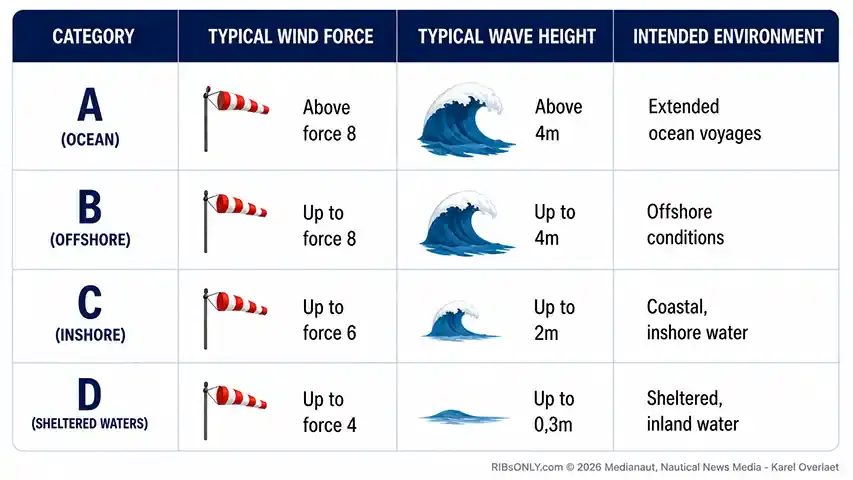
RIBs and other recreational craft are classified into four categories: A, B, C, and D, based on intended operating conditions.
Category A (Ocean) covers boats designed for extended voyages where wind conditions may exceed force 8 and significant wave heights exceed 4 metres.
Category B (Offshore) covers boats designed for offshore conditions up to force 8 winds and significant wave heights up to 4 metres.
Category C (Inshore) covers boats designed for coastal and inshore waters, typically up to force 6 winds and 2 metre wave heights.
Category D (Sheltered Waters) covers boats designed for sheltered, inland, or coastal waters with winds up to force 4 and wave heights up to 0.3 metres.
Why Category Matters When Buying
A boat’s CE category should directly match, or exceed, the conditions you actually intend to use it in.
Using a Category C boat in conditions that genuinely require Category B certification introduces real, avoidable risk.
Our guide Are Rigid Inflatable Boats Safe? explains how design and construction relate to safe operation within a given category.
Buying above your typical needs isn’t wrong, but it often adds cost, weight, and complexity without proportional benefit.
Category and Hull Design
Higher categories generally require more robust construction, better buoyancy reserves, and often correlate with deeper-V hull designs.
Our guide RIB Hull Shapes Explained explains how hull design relates to the kind of conditions a boat is built to handle.
This isn’t an absolute rule; some Category C boats are well-built and capable, while some Category B boats cut corners elsewhere.
Category Is Not a Complete Safety Guarantee
CE category reflects design intent and tested criteria, not ongoing maintenance, equipment, or skipper competence.
A well-maintained Category C boat, handled skilfully within its limits, can be safer in practice than a neglected Category B boat.
Our guide Essential Safety Equipment for a RIB explains how equipment and category work together to support genuine safety.
Checking a Boat’s Category
The CE category should appear on the builder’s plate, typically located near the helm or on the transom.
Always verify this documentation directly rather than relying solely on a seller’s or broker’s verbal description.
For used boats, confirm the category matches the original manufacturer specification, since modifications can sometimes affect actual compliance.
Category and Regulatory Requirements
Some regions or activities may require a minimum CE category for specific commercial or chartering purposes.
Check local regulations if you plan any commercial use, since requirements can differ meaningfully from private leisure use.
Our guide Professional and Rescue RIBs Explained touches on how commercial applications often involve additional regulatory requirements beyond standard CE categories.
How This Fits Into Your Buying Decision
Match your intended use honestly to the appropriate category rather than defaulting to the highest available option.
Consider how often you’d genuinely encounter conditions at the upper end of a given category’s tested range.
Our RIB Buying Guide: How to Choose the Right Boat covers CE category alongside every other major specification decision.
Choosing the Right Category for Your Needs
Be realistic about your typical boating conditions rather than planning around rare, extreme scenarios.
A boat matched appropriately to your actual use is generally a better investment than an oversized safety margin rarely used.
Our pillar guide What Is a Rigid Inflatable Boat? covers how CE categories fit into the broader picture of RIB design and certification.
Frequently Asked Questions
Is a higher CE category always safer?
Not automatically. Higher categories mean more robust design for tougher conditions, but maintenance and skill matter just as much.
Where can I find a boat’s CE category?
Check the builder’s plate near the helm or transom, and confirm it against original manufacturer documentation.
Can a boat’s CE category change after modification?
Significant modifications can potentially affect a boat’s actual compliance with its original certified category.
Do I need a Category B boat for coastal use?
Not necessarily. Category C is designed specifically for coastal and inshore water within its tested conditions.
Related reading: What Is a Rigid Inflatable Boat? · Are Rigid Inflatable Boats Safe? · RIB Hull Shapes Explained · Essential Safety Equipment for a RIB · RIB Buying Guide: How to Choose the Right Boat