RIB Tube Cleaning: How to Clean and Protect Your Tubes

August Race offers a full package of products to maintain your RIB @ RIBs ONLY - Home of the Rigid Inflatable Boat
August Race offers a full package of products to maintain your RIB – © 2026 Medianaut, Nautical News Media

Cleanig Products and Micro Fiber Cloths

Tube cleaning is the cheapest, easiest maintenance a RIB owner can do, and the most often skipped. Done consistently, it meaningfully extends how long tubes stay flexible, UV-resistant and structurally sound.

This guide covers the correct tube cleaning routine, the products that help, and the ones to avoid entirely.

Why Regular Tube Cleaning Matters

Salt, algae, bird droppings and general grime aren’t just cosmetic problems. Left on tube material, they accelerate UV damage and can degrade the surface coating that protects both PVC and Hypalon/CSM tubes. Read our guide on this topic: PVC vs Hypalon/CSM RIB Tubes

Regular tube cleaning also gives you a natural opportunity to spot early wear, small punctures or seam issues before they become bigger problems, covered in Common RIB Tube Problems and Repairs.

What You’ll Need

  • A soft-bristle brush or sponge, never anything abrasive.
  • A dedicated marine tube cleaner, matched to your tube material.
  • Fresh water for rinsing.
  • A UV-protectant product suitable for PVC or Hypalon/CSM, as appropriate.
  • Soft microfibre cloths for drying and buffing.

Step-by-Step Tube Cleaning Process

1. Rinse first. Hose down the tubes with fresh water to remove loose salt, sand and debris before applying any cleaner.

2. Apply the cleaner. Use a dedicated marine tube cleaner, applied with a soft brush or sponge, working in manageable sections rather than the whole boat at once.

3. Address stubborn marks separately. Bird droppings, tar or fuel stains often need a slightly longer dwell time or a second application, rather than harder scrubbing.

4. Rinse thoroughly. Remove all cleaner residue with fresh water, as leftover product can attract dirt faster if not fully rinsed.

5. Dry completely. Use microfibre cloths to dry tubes fully before applying any UV protectant, since most protectants work best on a clean, dry surface.

6. Apply UV protectant. Follow product instructions for even application, focusing on the most sun-exposed surfaces.

What to Avoid

Certain products and habits genuinely damage tubes rather than clean them:

  • Household detergents. Many strip protective coatings or leave residue that attracts grime faster.
  • Abrasive sponges or brushes. These create micro-scratches that trap dirt and accelerate wear.
  • Petroleum-based solvents. Can degrade both PVC and Hypalon/CSM material over repeated use.
  • Pressure washers on high setting. Excessive pressure can damage seams and surface coatings.

How Often to Clean

A light rinse after each use removes salt and surface debris before it has time to settle. A full tube cleaning, with dedicated cleaner and UV protectant, every 4 – 6 weeks during the season keeps tubes in genuinely good condition.

Boats in intense sun or saltwater benefit from more frequent attention than those in milder, freshwater conditions.

How Tube Cleaning Connects to Tube Lifespan

Consistent tube cleaning is one of the few maintenance habits directly linked to extending tube lifespan, alongside proper storage and prompt repair of minor damage. It’s a small, regular investment of time that pays off significantly over years of ownership.

Sometimes It Seems All Hope is Lost

Retubing might be the better solution. Read our guide to know more: How Long Do RIB Tubes Last? Tube Lifespan Explained.

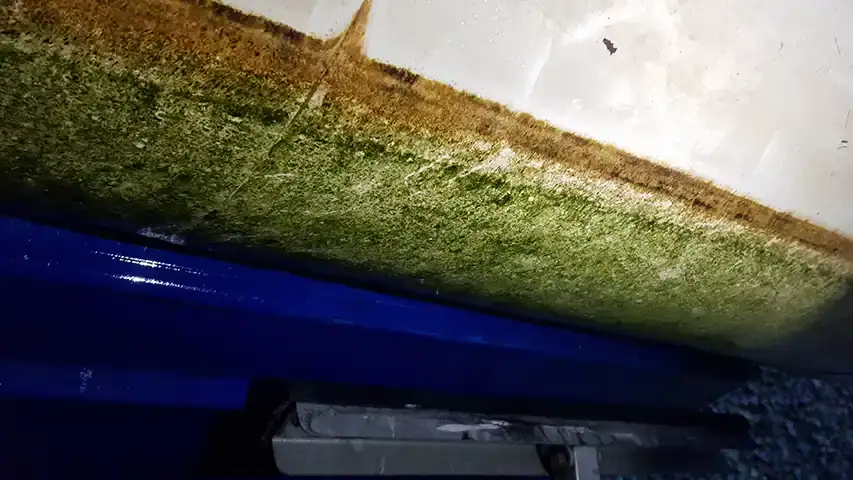
Sometimes it seems that tubes ae too far gone to clean them @ RIBs ONLY - Home of the Rigid Inflatable Boat
A heavy duty coast guard 1998 Zodiac Hurricane 590 with a twin 2005 Yamaha 50HP EFI on 11 25X14-G propellers – © Hocin Fourourr

Frequently Asked Questions

Can I use the same cleaner on PVC and Hypalon/CSM tubes?
Some products suit both, but always check the label. Material-specific cleaners generally perform better than universal ones.

Is UV protectant really necessary, or just cleaner optional?
UV protectant meaningfully slows degradation from sun exposure, making it one of the highest-value products for tube longevity.

How do I remove stubborn black streaks or scuff marks?
Dedicated marine tube cleaners handle most scuffs with patience. Persistent marks may need a specialist product recommended for your specific tube material.


Related reading: What Is a Rigid Inflatable Boat? · How Long Do RIB Tubes Last? · Common RIB Tube Problems and Repairs · PVC vs Hypalon/CSM RIB Tubes

Can You Leave a RIB in the Water?

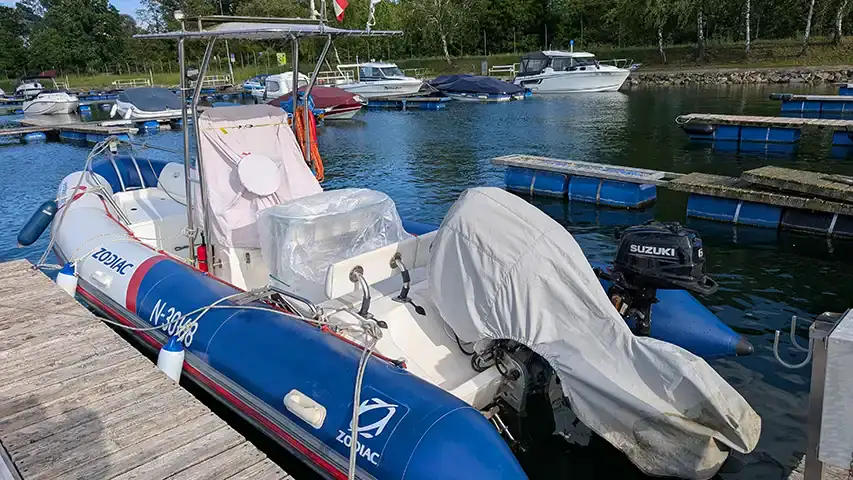
Protect your RIB when mooring @ RIBs ONLY - Home of the Rigid Inflatable Boat
For overnight protection, covering vulnerable areas is usually enough. For longer storage, use a full RIB cover
© Karl Petermichl – Zodiac

Think Twice

Leaving a RIB in the water is convenient, but it isn’t free of consequences. What happens depends heavily on how long, where, and how the boat is set up.

This guide explains what genuinely changes when you keep a RIB in the water for extended periods, so you can make an informed choice rather than a purely convenient one.

What Happens When a RIB Sits in the Water

A RIB in the water continuously experiences several ongoing effects, some cosmetic, some genuinely consequential.

Osmosis and gelcoat issues can develop on GRP hulls left permanently wet, particularly in warmer water over many months.

Marine growth accumulates on the hull below the waterline, adding drag and reducing performance until removed.

Galvanic corrosion becomes a real concern for aluminium hulls and metal fittings, especially in marinas with mixed-metal boats nearby.

Long contact with water pushes marine growth on the tubes  at the waterline @ RIBs ONLY - Home of the Rigid Inflatable Boat
Tube exposure to constant moisture and marine growth at the waterline can accelerate localised wear on the lower tube surface
© Karl Petermichl

Short-Term vs Long-Term Mooring

A few days or even weeks in the water rarely causes serious problems, provided the boat is properly set up with antifouling and a working bilge pump.

Months of continuous mooring change the calculation considerably. This is where marine growth, osmosis risk and corrosion genuinely accumulate, and where the convenience trade-off deserves real scrutiny.

Antifouling: The Baseline Requirement

Any RIB planning to stay for more than a few days needs proper antifouling paint on the hull below the waterline. Without it, marine growth accumulates rapidly, and removal becomes a bigger job the longer it’s left.

Antifouling requirements and suitable products vary depending on hull material and local water conditions, so checking manufacturer guidance for your specific hull is worthwhile before choosing a product.

RIB hull with anti-fouling to stop marine growth @ RIBs ONLY - Home of the Rigid Inflatable Boat
RIB hull with antifouling paint for extended mooring in the water – © Karl Petermichl

Bilge Pump Reliability Becomes Critical

A moored RIB depends entirely on a working bilge pump to manage rainwater, spray and any minor seepage. A failed pump on a boat left unattended for days can lead to serious problems.

Check the bilge pump regularly if you’re leaving the boat moored, and consider a battery monitor or float-switch backup for genuine peace of mind during longer absences.

Tube Considerations for Boats Left Moored

Tubes generally tolerate continuous water contact reasonably well, provided the material is in good condition to begin with. Persistent dampness at the waterline can, over time, encourage localised mould or grime buildup that’s worth cleaning regularly.

Our guide How to Clean and Protect RIB Tubes covers the right approach.

When Trailer Storage Makes More Sense

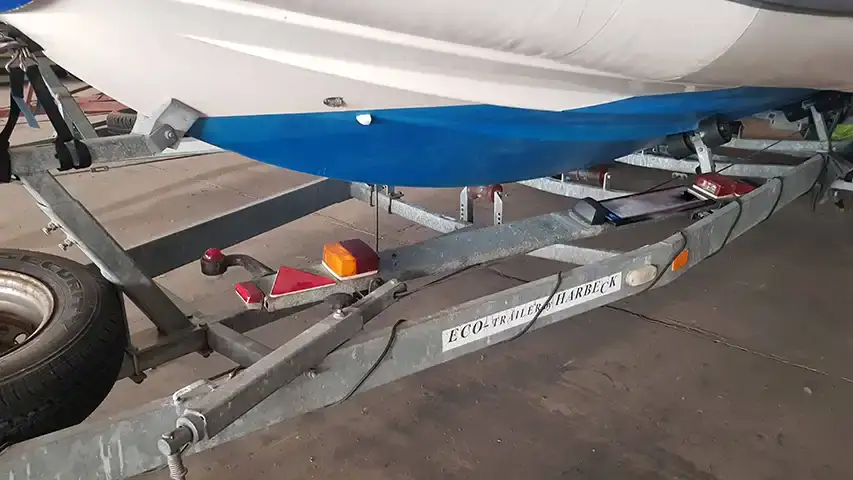
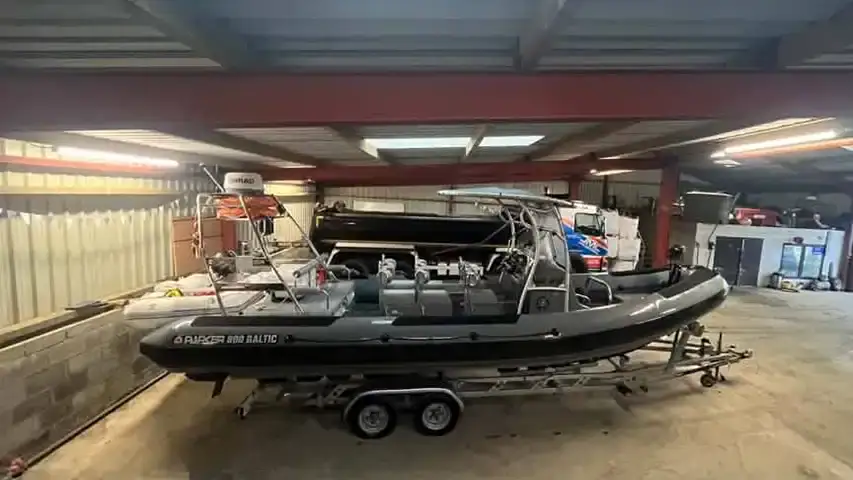
A RIB stored dry on a trailer @ RIBs ONLY - Home of the Rigid Inflatable Boat
A RIB stored dry on a trailer – © John Martin

If your RIB won’t be used for extended stretches, trailer or dry storage generally protects the hull, tubes and fittings better than continuous mooring. Our RIB Winter Storage Guide covers the off-season version of this decision in full.

For boats used frequently through a season, the convenience of leaving a RIB in the water often outweighs the added maintenance, provided antifouling and bilge checks are kept up consistently.


Frequently Asked Questions

Is it safe to leave a RIB in the water overnight occasionally?
Yes, generally, provided the bilge pump works and weather conditions are reasonable.

Does leaving a RIB in the water void any warranty?
Check your specific manufacturer’s terms, as some warranties specify maximum recommended mooring periods without haul-out.

How often should a moored RIB’s hull be checked for growth?
Roughly every 4–6 weeks during warm months, more often in areas with fast-growing marine fouling.


Related reading: What Is a Rigid Inflatable Boat? · RIB Winter Storage Guide · How to Clean and Protect RIB Tubes · PVC vs Hypalon/CSM RIB Tubes

Professional and Rescue RIBs Explained

A rescue RIB heading out @ RIBs ONLY - Home of the Rigid Inflatable Boat
A rescue RIB heading out – © 2025 Will Evans Snap Photography – RIB Photo Contest Entry

How Commercial and Rescue Ribs Differ From Leisure Boats

Professional and rescue RIBs share the same basic concept as leisure boats but are built to a very different standard. Reliability, durability, and performance in extreme conditions take priority over comfort, styling, or cost efficiency.

This guide explains how these boats differ in construction, certification, and application from typical leisure RIBs.

What Defines a Professional or Rescue RIB

Professional RIBs are built for commercial, military, or rescue applications rather than leisure use. They typically meet stricter certification standards and undergo far more rigorous testing than consumer-grade equivalents.

Applications include search and rescue, coast guard, military, pilot transfer, port authority, and commercial diving support.

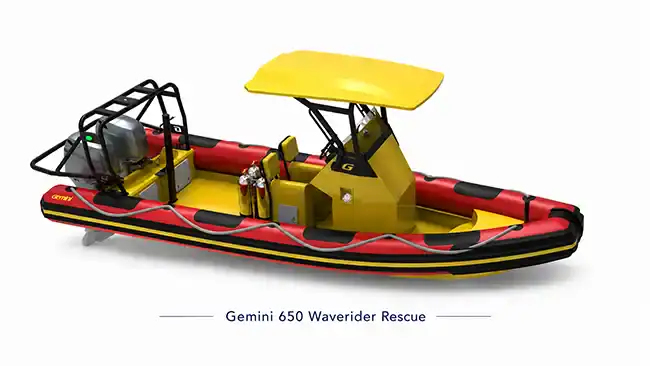
A proven favorite in both the leisure and professional markets @ RIBs ONLY - Home of the Rigid Inflatable Boat
A proven favourite in both the leisure and professional markets. Its commercial-grade construction is immediately apparent.
© Gemini Marine

Construction Differences

Professional RIB tubes are often foam-filled rather than air-filled, eliminating the risk of complete deflation from puncture. Multi-chamber tube construction is standard, ensuring the boat remains functional even if one chamber is damaged.

Hulls are typically more heavily reinforced, built to withstand years of hard commercial or operational use.

Our guide PVC vs Hypalon/CSM RIB Tubes explains why Hypalon/CSM dominates this segment, given its durability advantages.

Hull Design for Professional Use

Deep-V hulls are near-universal in this segment, since rough-water performance is often mission-critical rather than optional.

Our guide Best RIB for Rough Water: What Really Matters? explains why hull shape matters so much for these applications.

Reinforced fendering and impact-resistant materials protect the hull during frequent docking against larger vessels or piers.

Engine and Performance Requirements

Professional RIBs often run significantly more power relative to size than comparable leisure boats. Redundancy matters: twin engines are common, ensuring the boat can return safely if one engine fails.

Reliability under sustained hard use is prioritised over efficiency, given the operational demands these boats face.

Certification and Regulatory Standards

Rescue and commercial RIBs must meet stricter regulatory categories than typical leisure boats sold to private owners. Requirements vary by application and jurisdiction, covering stability, buoyancy, and equipment standards specific to commercial use.

Our guide How Does a RIB Work? explains the buoyancy and stability principles that these stricter standards build upon.

Materials and Longevity

Aluminium hulls are common in this segment, valued for their durability and resistance to impact damage.

Our guide Aluminium vs Fibreglass RIB compares these materials in more detail, relevant to both leisure and professional buyers.

Professional RIBs are typically designed and maintained for a longer operational lifespan than most leisure equivalents.

Cost and Lifecycle Differences

Professional RIBs cost significantly more than comparable-sized leisure boats, reflecting stricter build standards and certification requirements.

Maintenance schedules are typically more rigorous, with more frequent inspections mandated by operating authorities or insurers. Total lifecycle cost is often justified by the mission-critical nature of the application rather than by resale value.

difference in construction between professional and leisure ribs @ RIBs ONLY - Home of the Rigid Inflatable Boat
The true differences between pro and leisure RIBs – © 2026 Medianaut, Nautical News Media

Why This Matters for Leisure Buyers

Understanding professional RIB standards helps leisure buyers appreciate what separates a genuinely robust boat from a lighter-duty equivalent. Some manufacturers offer leisure models derived from professional designs, carrying over meaningful durability advantages.

Our RIB Buying Guide: How to Choose the Right Boat helps leisure buyers weigh these durability factors against cost.


Frequently Asked Questions

Why are professional RIB tubes foam-filled instead of air-filled?
Foam-filled tubes can’t fully deflate from puncture, ensuring the boat stays operational during rescue or commercial missions.

Can leisure buyers purchase professional-grade RIBs?
Yes, though at significantly higher cost. Some manufacturers offer civilian versions of their professional or rescue models.

Why do rescue RIBs almost always use deep-V hulls?
Rough-water performance is often mission-critical for rescue operations, making deep-V hulls the standard choice.

Are professional RIBs always aluminium-hulled?
Not always, but aluminium is common given its durability and resistance to impact damage in hard commercial use.


Related reading: What Is a Rigid Inflatable Boat? · Are Rigid Inflatable Boats Safe? · PVC vs Hypalon/CSM RIB Tubes · Best RIB for Rough Water: What Really Matters? · Aluminium vs Fibreglass RIB · RIB Photo Contest 2025


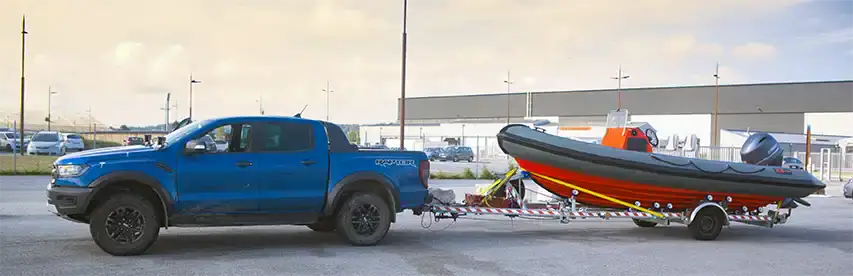
How to Trailer a RIB Safely

A RIB secured on its trailer to it the road @ RIBs ONLY - Home of the Rigid Inflatable Boat
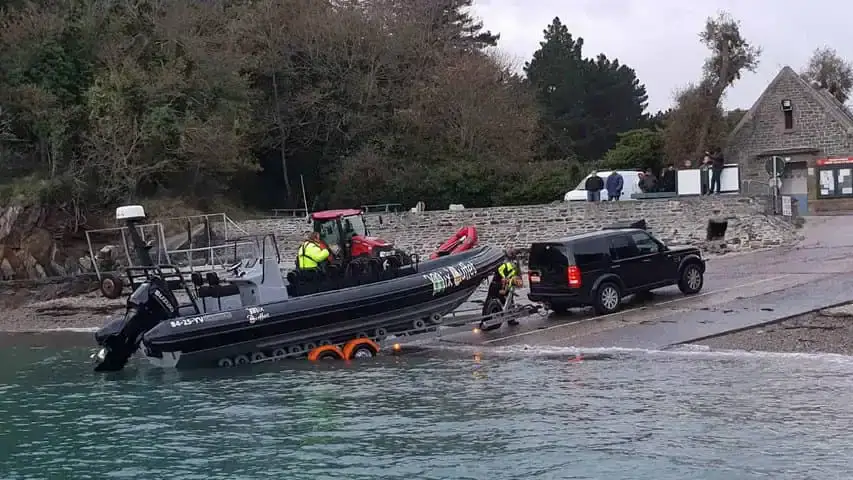
A Vanclaes RIB railer on the boot ramp recovering a RIB

Your Trailer Carries Your Investment

A RIB trailer is as safety-critical as the boat itself, yet it receives far less attention from most owners. Most trailering incidents trace back to setup and towing habits, not to the road or the trailer’s build quality.

This guide covers choosing the right RIB trailer, safe towing practice, and the launching and retrieval steps that prevent the most common mistakes.

Matching the RIB Trailer to the Boat

A correctly matched RIB trailer supports the hull properly across its full length, not just at a few contact points. Mismatched trailers, even if technically rated for the weight, can cause hull stress over time from incorrect support.

Check that roller or bunk positions suit your specific hull shape, particularly for deep-V hulls where incorrect support can create pressure points along the keel line.

Confirming Your Tow Vehicle is Suitable

Before towing anything, confirm your vehicle’s rated towing capacity against the combined weight of boat, trailer, fuel and equipment, not the boat’s weight alone.

Check local regulations regarding towing licence requirements, trailer braking systems and maximum combined weight, as these vary considerably by country and trailer class.

When a RIB's beam is too large, you have to deflate the tubes for safe transport @ RIBs ONLY - Home of the Rigid Inflatable Boat
Nothing wrong here. When a RIB’s beam is too large, you have to deflate the tubes for safe transport – © John Martin

Trailer Maintenance Checklist

A well-maintained RIB trailer prevents the vast majority of roadside problems.

  • Check tyre pressure and condition, including the spare, before every significant trip.
  • Grease wheel bearings on a regular schedule, more frequently for trailers regularly submerged during launching.
  • Test all lights, indicators and brake lights before departure.
  • Inspect the winch, strap or chain securing the boat for wear or damage.
  • Check safety chains and coupling mechanism for correct, secure attachment.

Loading the Boat Correctly

Secure the RIB to the trailer using transom tie-down straps @ RIBs ONLY - Home of the Rigid Inflatable Boat
Secure the RIB to the trailer using transom tie-down straps (yellow in this case) – © Nicolas Hick

Position the boat so weight distributes appropriately over the trailer axle, avoiding excessive tongue weight or, conversely, a rear-heavy setup that reduces steering control.

Secure the boat with both the winch strap at the bow and additional transom tie-down straps for road travel. The winch strap alone isn’t designed to hold the boat in place during transport.

Safe Towing Practice

Driving with a loaded RIB trailer requires adjusted habits compared with normal driving.

  • Allow significantly more distance for braking than usual.
  • Take corners and roundabouts more slowly than feels necessary.
  • Check mirrors regularly for trailer sway, and ease off the accelerator rather than braking sharply if sway develops.
  • Plan routes avoiding unnecessarily tight manoeuvring where possible.

Launching Without Damage

Before backing down the slipway, remove tie-down straps except the winch strap, and disconnect any trailer lights if your setup requires it to avoid electrical damage from submersion.

Back down slowly and evenly, watching for the trailer wheels reaching a safe depth without submerging the vehicle’s exhaust or electrical components.

Release the boat under control, using the winch to ease it off rather than releasing it to float free suddenly, particularly on trailers with steep ramp angles.

Retrieval Without Stress

Line up the trailer centrally in the water before attempting to drive the boat on, rather than trying to correct alignment once the boat is already approaching.

Use the winch to draw the boat fully onto the trailer and seated correctly against the bow stop before pulling the trailer out of the water, avoiding a boat that shifts or turns during the final pull-out.

A Quick Pre-Trip Trailer Checklist

  1. Confirm combined weight is within your tow vehicle’s rated capacity.
  2. Check tyres, bearings and lights on the trailer.
  3. Load the boat with correct weight distribution.
  4. Secure both winch strap and transom tie-downs for road travel.
  5. Drive with adjusted following distance and cornering speed.

For buyers evaluating a used boat that includes a trailer, our Buying a Used RIB: Complete Inspection Guide covers what to check on the trailer itself before purchase.


Frequently Asked Questions

How often should I service my RIB trailer’s wheel bearings?
Roughly once a season for regular use, more often if the trailer is frequently submerged in saltwater during launching.

Is it safe to tow with only the winch strap securing the boat?
No. Always add separate transom tie-down straps for road travel; the winch strap alone isn’t designed for that load during transport.

Do I need a specific licence to tow a RIB trailer?
This depends on combined weight and your local regulations, which vary considerably by country. Always check current requirements for your specific setup.


Related reading: What Is a Rigid Inflatable Boat? · What Size RIB Do I Need? · Buying a Used RIB: Complete Inspection Guide


Family RIB Buying Guide

The number of passengers on the RIB  will determine the size
2025 RIB photo contest by RIBsONLY.com – © Michael.Nechajev

What Matters Most When Choosing a Rib for Family Boating

Buying a RIB for family use involves a different set of priorities than buying for performance or fishing. Safety, stability, seating comfort, and ease of handling typically outweigh raw speed or aggressive hull design.

This guide covers the specific factors that matter most when choosing a RIB that will carry a family safely and comfortably.

Priorities for Family Boating

Family RIBs need to balance capacity, stability, and manageable handling for a range of skill levels aboard. Unlike performance-focused buyers, most families prioritise a smooth, predictable ride over outright speed or sharp handling.

Ease of use matters too, since more than one family member may need to operate the boat confidently.

Size and Seating Capacity

These RIBs typically range from 5 to 7 metres, offering enough capacity for six to ten people comfortably. Check the manufacturer’s rated maximum capacity, but also consider realistic comfortable capacity for longer outings.

Our guide What Size RIB Do I Need? covers sizing principles that apply directly to family-use decisions.

Bow seating with proper handholds and backrests matters more for families than it does for performance-focused buyers.

Choosing a family RIB to enjoy the time on the water @ RIBs ONLY - Home of the Rigid Inflatable Boat
This large family RIB has a great deck layout – © Highfield Boats

Stability and Safety Features

A wider beam and higher tube volume generally improve stability at rest, useful for swimming stops and boarding. Look for boarding ladders, swim platforms, and secure handholds throughout the boat, not just at the helm.

Our guide Essential Safety Equipment for a RIB covers the equipment every family RIB should carry as standard. And Are Rigid Inflatable Boats Safe? explains the inherent stability advantages RIBs offer over comparable hard-hull boats.

Comfort Features for Longer Days

Sun shade or a bimini top makes a significant difference on longer summer outings with children aboard. Cushioned, well-padded seating throughout improves comfort considerably compared with basic bench seating on entry-level models.

Adequate stowage for gear, coolers, and safety equipment keeps the boat organised and safer to move around.

Engine Power for Family Use

Family RIBs generally don’t need maximum available horsepower; moderate power with good low-speed manners is more valuable. Prioritise smooth throttle response and easy low-speed handling over top speed for family-oriented boating.

Twin engines add redundancy and confidence for families boating further from shore, though at higher cost.

Budget Considerations

Family RIBs sit in a wide price range depending on size, brand, and engine configuration. Our guide How Much Does a RIB Cost? breaks down the cost factors relevant to typical family-oriented purchases.

Factor in ongoing costs too: fuel, storage, insurance, and safety equipment add up over a season of use.

RIB length and number of persons tabel @ RIBs ONLY - Home of the Rigid Inflatable Boat

RIB length and number of persons tabel – © 2026 Medianaut, Nautical News Media

Choosing the Right Family RIB

Prioritise stability, safety features, and comfortable seating over raw performance for most family boating scenarios. Test the boat with your typical passenger load, not empty, since handling changes meaningfully with weight aboard.

Our RIB Buying Guide: How to Choose the Right Boat covers the full decision process alongside these family-specific priorities.


Frequently Asked Questions

What size RIB is best for a family of four?
A 5 to 5,5 metre RIB comfortably serves a family of four, with room for gear and safety equipment.

Do family RIBs need twin engines?
Not necessarily. A single well-matched engine is often sufficient; twins add redundancy at higher cost.

What safety features matter most for family use?
A secure boarding ladder, sturdy handholds, proper lifejackets for all ages, and a stable swim platform.

Is a bigger RIB always better for families?
Not always. Bigger boats cost more to run and store; match size to realistic typical passenger numbers. But that’s a personal choice.


Related reading: What Is a Rigid Inflatable Boat? · What Size RIB Do I Need? · Essential Safety Equipment for a RIB · Are Rigid Inflatable Boats Safe? · How Much Does a RIB Cost?


×