SOLAS RIB Requirements Explained

SOLAS-Compliant vs Standard Leisure RIB Requirements @ RIBs ONLY - Home of the Rigid Inflatable Boat

How International Safety Standards Apply to Commercial and Rescue RIBs

SOLAS (Safety of Life at Sea) is one of the most important international maritime safety frameworks, and it directly shapes certain RIB requirements.

While most leisure RIB owners never encounter SOLAS directly, commercial and rescue operators must understand it thoroughly.

This guide explains what SOLAS is, when it applies to RIBs, and what requirements it typically imposes.

What SOLAS Actually Is

SOLAS is an international maritime treaty establishing minimum safety standards for the construction, equipment, and operation of ships.

It’s overseen by the International Maritime Organization (IMO website) and adopted into national law by signatory countries worldwide.

While SOLAS primarily targets larger commercial vessels, certain provisions extend to lifeboats, rescue boats, and associated equipment.

When SOLAS Applies to RIBs

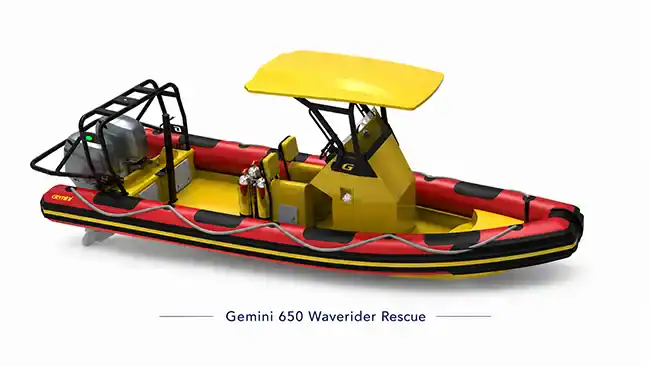
SOLAS requirements typically apply to RIBs used as ship’s lifeboats, rescue boats, or tenders aboard SOLAS-regulated commercial vessels.

Leisure RIBs used for private recreational boating generally fall outside SOLAS’s direct regulatory scope.

Our guide Professional and Rescue RIBs Explained explains how professional applications often intersect with SOLAS-type regulatory frameworks.

Commercial passenger vessels, cargo ships, and certain offshore installations are common contexts where SOLAS-compliant RIBs are required.

Through this link you can watch SOLAS RIBs in action.

Construction Requirements Under SOLAS

SOLAS-compliant rescue boats must meet specific construction standards covering buoyancy, stability, and structural integrity under load.

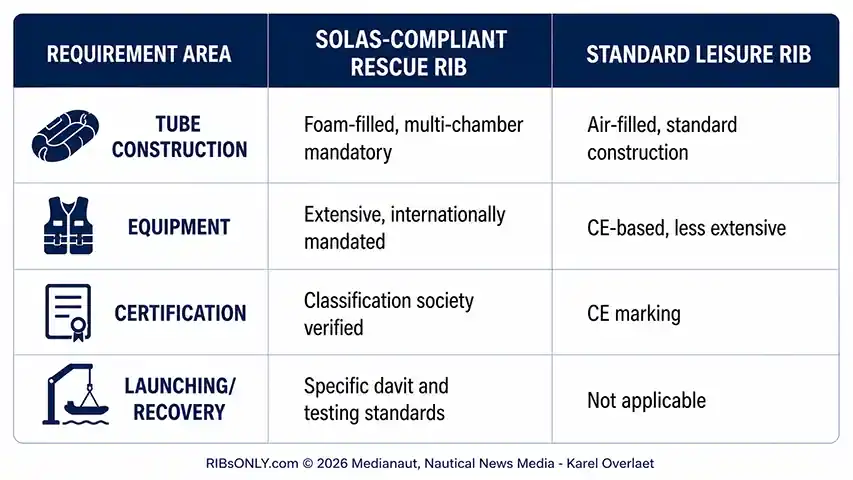
Multi-chamber, foam-filled tube construction is typically required, ensuring the boat remains functional even with damage to one chamber.

Our guide PVC vs Hypalon/CSM RIB Tubes explains material considerations relevant to this kind of robust, redundant construction.

Equipment Requirements Under SOLAS

SOLAS specifies detailed equipment requirements for rescue boats, covering communication, signalling, and survival equipment carried aboard.

This typically exceeds what’s required or expected on a standard leisure RIB by a significant margin.

Our guide Essential Safety Equipment for a RIB covers leisure-focused equipment requirements, useful context for understanding how much more extensive SOLAS requirements are.

Launching and Recovery Requirements

SOLAS includes specific requirements for how rescue boats must be capable of being launched and recovered, even in adverse conditions.

This affects davit design, boat weight limits, and the overall integration between the RIB and its parent vessel.

These requirements go well beyond what any typical leisure RIB owner would ever need to consider.

Certification and Testing Under SOLAS

SOLAS-compliant rescue boats undergo rigorous testing and certification, verified by classification societies recognised under the treaty framework.

This certification process is considerably more extensive than standard CE marking applied to leisure recreational craft.

Our guide CE Categories for RIBs Explained covers the certification framework relevant to leisure boats, useful for contrast with SOLAS’s stricter commercial standards.

Why Leisure Buyers Should Still Understand SOLAS

Understanding SOLAS helps leisure buyers appreciate the construction standards behind professional-grade RIBs derived from commercial designs.

Some manufacturers market leisure models built on SOLAS-influenced construction principles, carrying over meaningful durability advantages.

Our guide Best RIB Brands: How to Evaluate a Manufacturer explains how manufacturing heritage, including commercial and rescue experience, factors into brand evaluation.

SOLAS and Ongoing Compliance

SOLAS compliance isn’t a one-time certification; commercial operators must maintain ongoing inspection and equipment standards throughout the boat’s service life.

This ongoing compliance burden is one reason commercial RIB operation involves significantly more regulatory oversight than leisure ownership.

Understanding Where You Stand

If you own or operate a leisure RIB privately, SOLAS requirements almost certainly don’t apply to you directly.

If you’re involved in commercial vessel operations, professional rescue services, or ship’s tender provision, SOLAS compliance becomes a genuine requirement.

Our pillar guide What Is a Rigid Inflatable Boat? provides broader context on how RIBs are regulated across different use cases.


Frequently Asked Questions

Do leisure RIB owners need to worry about SOLAS?
Generally no. SOLAS primarily applies to commercial vessels and their associated rescue boats and tenders.

What makes a RIB SOLAS-compliant?
Specific construction, equipment, and certification standards covering buoyancy, redundancy, and launch/recovery capability under adverse conditions.

Is SOLAS the same as CE certification?
No. CE certification applies to recreational craft under EU law; SOLAS is a broader international commercial maritime safety framework.

Can a SOLAS-compliant RIB be used for leisure purposes?
Technically yes, though the added construction standards typically come with a significant cost premium over standard leisure boats.


Related reading: What Is a Rigid Inflatable Boat? · Professional and Rescue RIBs Explained · CE Categories for RIBs Explained · PVC vs Hypalon/CSM RIB Tubes · Best RIB Brands: How to Evaluate a Manufacturer

Electric RIBs: Technology and Limitations

Are electric powered RIBs the future? @ RIBs ONLY - Home of the Rigid Inflatable Boat
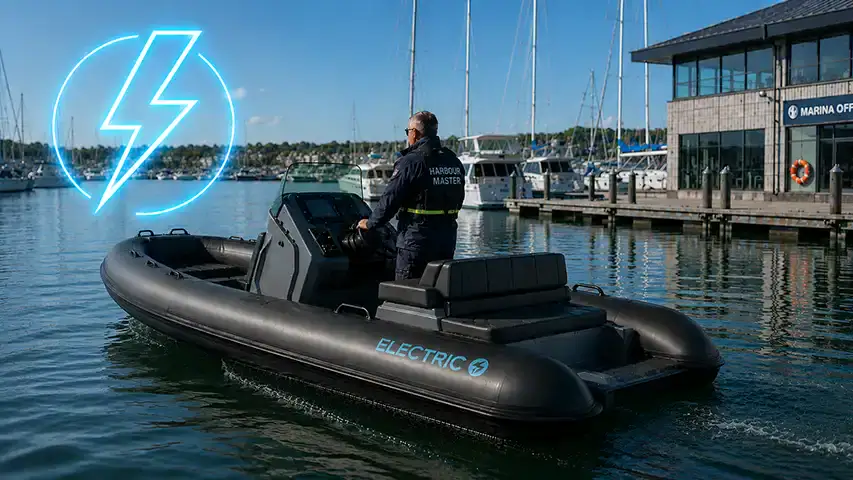
AI generated image of an electric RIB – © 2026 Medianaut, Nautical News Media

How Electric Propulsion is Changing and Currently Limiting RIB Design

Electric propulsion has moved from niche experiment to genuine product category across the boating industry.

RIBs are no exception, with several manufacturers now offering electric or electric-assisted models for leisure and light commercial use.

This guide explains how electric RIB technology actually works, what it does well, and where it currently falls short.

What Makes a RIB “Electric”

An electric RIB replaces the combustion outboard or inboard with an electric motor powered by an onboard battery pack. Some designs use a dedicated electric outboard, visually similar to a conventional outboard but without fuel or exhaust systems.

Others integrate the motor and battery more deeply into the hull, prioritising weight distribution and hydrodynamics over modularity.

Hybrid systems, covered separately in our guide Hybrid RIBs Explained, combine electric and combustion power rather than replacing one with the other.

How Electric Outboard Motors Work

Electric outboards use a battery pack to power an electric motor connected directly or via a gearbox to the propeller. They offer instant torque, smooth and quiet operation, and none of the vibration typical of combustion outboards.

There’s no idling, no warm-up period, and no exhaust fumes, which meaningfully changes the on-water experience. Maintenance is generally simpler too, since electric motors have far fewer moving parts than combustion equivalents.

Range and Battery Limitations

Battery energy density remains the single biggest constraint on electric RIB performance and practicality today.

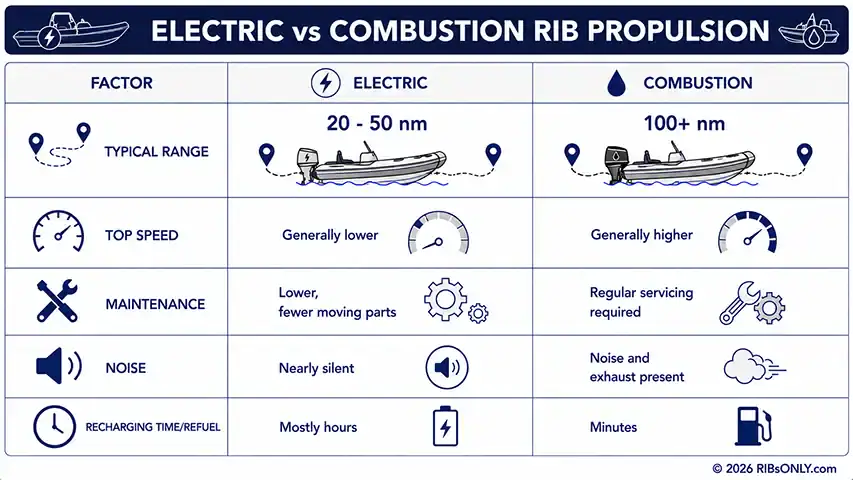
Most electric RIBs offer a realistic range of 20 to 50 nautical miles at moderate cruising speed.

Range drops significantly at higher speeds, since power draw increases sharply once the boat exceeds efficient cruising speed. This makes electric RIBs currently better suited to short trips, harbour use, and calm inland water than long passages.

Our guide RIB Fuel Consumption Explained explains how combustion engines compare on range and efficiency for context.

Weight and Balance Considerations

Battery packs are heavy, and that weight is typically concentrated low and aft, near the transom. This can meaningfully affect trim, handling, and stability compared with a lighter combustion outboard of similar power.

Manufacturers designing electric RIBs from the ground up can better manage this weight distribution than simple outboard conversions.

Retrofitting an existing hull with electric propulsion often produces worse handling than a boat designed specifically around it.

Performance Compared to Combustion Engines

Top speed for most electric RIBs currently trails comparable combustion-powered boats, particularly at the larger end of the size range. Acceleration is often excellent thanks to instant electric torque, even where top speed remains modest.

For displacement or low-speed cruising, electric propulsion performs very competitively against combustion alternatives.

For high-speed offshore use, combustion engines still hold a clear performance advantage as of today’s technology.

Charging Infrastructure Challenges

Marina charging infrastructure remains limited and inconsistent across regions, unlike the widespread availability of fuel docks.

Charging times vary considerably, from under an hour for fast charging to several hours for standard charging setups.

This makes trip planning more important for electric RIB owners than it typically is for combustion boat owners.

Owners without home or marina charging access may find electric ownership significantly less practical in daily use.

Where Electric RIBs Make Sense Today

Sheltered harbours, marine reserves with combustion restrictions, and short-range leisure use suit current electric RIB technology well. Quiet operation makes electric RIBs particularly appealing for wildlife watching, diving support, and noise-sensitive environments.

Commercial applications like harbour patrol or short-range tender work are also emerging use cases for electric propulsion. Long-range cruising, offshore passages, and high-speed leisure use remain better served by combustion or hybrid systems for now.

Diagram showing electric v combustion rib propulsion @ RIBs ONLY - Home of the Rigid Inflatable Boat
Diagram showing general data about electric vs combustion rib propulsion – © 2026 Medianaut, Nautical News Media

Previously we have published an opinion article (2023) on electric propulsion for Rigid Inflatable Boats (RIBs): Why an Electric Outboard Is Not the Better Choice Now.

Is an Electric RIB Right for You?

Choose electric if your use case involves short trips, sheltered water, and access to reliable charging infrastructure.

Choose combustion or hybrid if you need long range, high speed, or operate where charging access is limited.

Electric RIB technology is improving quickly, and today’s limitations will likely narrow considerably over the coming years.

Our RIB Buying Guide: How to Choose the Right Boat covers propulsion choice alongside every other major buying factor.


Frequently Asked Questions

How far can an electric RIB travel on one charge?
Most currently offer 20 to 50 nautical miles at moderate cruising speed, with range dropping at higher speeds.

Are electric RIBs as fast as combustion RIBs?
Generally not yet, particularly for larger boats, though acceleration from a standstill is often very competitive.

Is electric RIB maintenance really lower?
Yes. Electric motors have far fewer moving parts than combustion outboards, reducing routine servicing needs considerably.

Can I convert my existing RIB to electric power?
Technically often possible, but weight distribution and range limitations usually favour purpose-built electric hulls over conversions.

Where can I watch videos of electric-powered RIBs?
Explore our collection of videos and articles covering everything you need to know about electric-powered Rigid Inflatable Boats (RIBs), from real-world performance and range to technology, charging, and onboard experience.


Related reading: What Is a Rigid Inflatable Boat? · Hybrid RIBs Explained · RIB Fuel Consumption Explained · How to Choose an Outboard for a RIB · RIB Buying Guide: How to Choose the Right Boat · Why an Electric Outboard Is Not the Better Choice Now Electric-powered Rigid Inflatable Boats


Hybrid RIBs Explained

A custom hybrid solution on a Gemini by Novi Marine @ RIBs ONLY - Home of the Rigid Inflatable Boat
A hybrid Gemini RIB by Novi Marine – Yamaha in the middle flanked by Torqeedos – © 2026 Medianaut, Nautical News Media

How Combined Electric and Combustion Propulsion Works on a RIB

Hybrid propulsion offers a middle path between the range of combustion engines and the efficiency of electric motors.

For RIBs, this typically means combining a combustion outboard or inboard with an electric motor and battery system.

This guide explains how hybrid RIB systems work, their real-world benefits, and where the added complexity may not be worthwhile.

A custom hybrid solution throttles on a Gemini by Novi Marine @ RIBs ONLY - Home of the Rigid Inflatable Boat
The throttles for a hybrid Gemini RIB by Novi Marine – © 2026 Medianaut, Nautical News Media

What a Hybrid RIB Actually Is

A hybrid RIB pairs a conventional combustion engine with an electric motor, battery pack, and control system.

The two power sources can work independently or together, depending on the specific system design and operating mode.

This differs from a fully electric RIB, covered in our guide Electric RIBs: Technology and Limitations, which removes combustion power entirely.

Series vs Parallel Hybrid Systems

Series hybrid systems use the combustion engine solely to generate electricity, which then powers an electric propulsion motor.

Parallel hybrid systems allow either the combustion engine or electric motor to drive the propeller independently or together.

Parallel systems are more common on RIBs currently, offering flexibility between electric-only and combustion-assisted operation.

Series systems are less common but can offer smoother, more consistent power delivery in certain use cases.

Benefits of Hybrid Propulsion

Hybrid systems allow quiet, emission-free electric operation for short trips, harbour manoeuvring, or sensitive environments.

Combustion power remains available for longer range, higher speed, or situations where battery charge runs low.

This flexibility addresses the range anxiety that limits fully electric RIBs for many owners today.

Fuel efficiency can improve too, since electric assistance reduces combustion engine load during certain operating conditions.

Drawbacks and Added Complexity

Hybrid systems add weight, cost, and mechanical complexity compared with either pure combustion or pure electric propulsion.

More components mean more potential points of failure, and specialised servicing may be harder to source.

The added weight of carrying both a battery pack and a combustion engine can offset some efficiency gains.

For buyers who rarely need electric-only operation, a hybrid system may add cost without proportional benefit.

Performance Characteristics

Hybrid RIBs generally offer full combustion-engine range and speed, with electric-only capability as a supplementary mode.

Acceleration can benefit from combined power delivery, particularly in parallel systems that blend both sources.

Top speed is typically similar to a comparable combustion-only boat, since combustion remains the primary high-speed power source.

Typical Applications for Hybrid RIBs

Harbour authorities and commercial operators often favour hybrid systems, combining regulatory compliance with operational range flexibility.

Leisure owners who value occasional silent running, such as for wildlife watching, may also find hybrid systems appealing.

Our guide Professional and Rescue RIBs Explained covers how professional operators weigh propulsion choices against mission requirements.

Cost Considerations

Hybrid systems typically cost more than either pure combustion or pure electric equivalents, reflecting added component complexity.

Our guide How Much Does a RIB Cost? covers the broader cost factors that apply across propulsion types.

Weigh the premium against how often you’d realistically use the electric-only mode before committing to hybrid propulsion.

Contrasting series and parallel hybrid configurations by power flexibility, complexity, and typical use case @ RIBs ONLY - Home of the Rigid Inflatable Boat
Contrasting series and parallel hybrid configurations by power flexibility, complexity, and typical use case.
© 2026 Medianaut, Nautical News Media

Is a Hybrid RIB Worth Considering?

Choose hybrid if you want occasional electric-only capability without sacrificing combustion range and top speed.

Choose pure electric if your use case never requires long range or high speed regardless of circumstances.

Choose pure combustion if simplicity, lower cost, and proven reliability matter more than occasional silent running.

Our RIB Buying Guide: How to Choose the Right Boat helps weigh propulsion choice against your typical use case.


Frequently Asked Questions

Is a hybrid RIB more reliable than pure electric?
It offers more range flexibility, but added complexity means more components that could potentially require servicing.

How much extra does hybrid propulsion cost?
Typically more than pure combustion or pure electric systems, reflecting the added battery, motor, and control components.

Can hybrid RIBs run on electric power alone?
Yes, most parallel hybrid systems allow electric-only operation for short trips or sensitive environments.

Who benefits most from hybrid RIB technology?
Commercial operators and harbour authorities needing both range and occasional silent, emission-free operation benefit most.


Related reading: What Is a Rigid Inflatable Boat? · Electric RIBs: Technology and Limitations · Professional and Rescue RIBs Explained · How Much Does a RIB Cost? · RIB Buying Guide: How to Choose the Right Boat


Professional and Rescue RIBs Explained

A rescue RIB heading out @ RIBs ONLY - Home of the Rigid Inflatable Boat
A rescue RIB heading out – © 2025 Will Evans Snap Photography – RIB Photo Contest Entry

How Commercial and Rescue Ribs Differ From Leisure Boats

Professional and rescue RIBs share the same basic concept as leisure boats but are built to a very different standard. Reliability, durability, and performance in extreme conditions take priority over comfort, styling, or cost efficiency.

This guide explains how these boats differ in construction, certification, and application from typical leisure RIBs.

What Defines a Professional or Rescue RIB

Professional RIBs are built for commercial, military, or rescue applications rather than leisure use. They typically meet stricter certification standards and undergo far more rigorous testing than consumer-grade equivalents.

Applications include search and rescue, coast guard, military, pilot transfer, port authority, and commercial diving support.

A proven favorite in both the leisure and professional markets @ RIBs ONLY - Home of the Rigid Inflatable Boat
A proven favourite in both the leisure and professional markets. Its commercial-grade construction is immediately apparent.
© Gemini Marine

Construction Differences

Professional RIB tubes are often foam-filled rather than air-filled, eliminating the risk of complete deflation from puncture. Multi-chamber tube construction is standard, ensuring the boat remains functional even if one chamber is damaged.

Hulls are typically more heavily reinforced, built to withstand years of hard commercial or operational use.

Our guide PVC vs Hypalon/CSM RIB Tubes explains why Hypalon/CSM dominates this segment, given its durability advantages.

Hull Design for Professional Use

Deep-V hulls are near-universal in this segment, since rough-water performance is often mission-critical rather than optional.

Our guide Best RIB for Rough Water: What Really Matters? explains why hull shape matters so much for these applications.

Reinforced fendering and impact-resistant materials protect the hull during frequent docking against larger vessels or piers.

Engine and Performance Requirements

Professional RIBs often run significantly more power relative to size than comparable leisure boats. Redundancy matters: twin engines are common, ensuring the boat can return safely if one engine fails.

Reliability under sustained hard use is prioritised over efficiency, given the operational demands these boats face.

Certification and Regulatory Standards

Rescue and commercial RIBs must meet stricter regulatory categories than typical leisure boats sold to private owners. Requirements vary by application and jurisdiction, covering stability, buoyancy, and equipment standards specific to commercial use.

Our guide How Does a RIB Work? explains the buoyancy and stability principles that these stricter standards build upon.

Materials and Longevity

Aluminium hulls are common in this segment, valued for their durability and resistance to impact damage.

Our guide Aluminium vs Fibreglass RIB compares these materials in more detail, relevant to both leisure and professional buyers.

Professional RIBs are typically designed and maintained for a longer operational lifespan than most leisure equivalents.

Cost and Lifecycle Differences

Professional RIBs cost significantly more than comparable-sized leisure boats, reflecting stricter build standards and certification requirements.

Maintenance schedules are typically more rigorous, with more frequent inspections mandated by operating authorities or insurers. Total lifecycle cost is often justified by the mission-critical nature of the application rather than by resale value.

difference in construction between professional and leisure ribs @ RIBs ONLY - Home of the Rigid Inflatable Boat
The true differences between pro and leisure RIBs – © 2026 Medianaut, Nautical News Media

Why This Matters for Leisure Buyers

Understanding professional RIB standards helps leisure buyers appreciate what separates a genuinely robust boat from a lighter-duty equivalent. Some manufacturers offer leisure models derived from professional designs, carrying over meaningful durability advantages.

Our RIB Buying Guide: How to Choose the Right Boat helps leisure buyers weigh these durability factors against cost.


Frequently Asked Questions

Why are professional RIB tubes foam-filled instead of air-filled?
Foam-filled tubes can’t fully deflate from puncture, ensuring the boat stays operational during rescue or commercial missions.

Can leisure buyers purchase professional-grade RIBs?
Yes, though at significantly higher cost. Some manufacturers offer civilian versions of their professional or rescue models.

Why do rescue RIBs almost always use deep-V hulls?
Rough-water performance is often mission-critical for rescue operations, making deep-V hulls the standard choice.

Are professional RIBs always aluminium-hulled?
Not always, but aluminium is common given its durability and resistance to impact damage in hard commercial use.


Related reading: What Is a Rigid Inflatable Boat? · Are Rigid Inflatable Boats Safe? · PVC vs Hypalon/CSM RIB Tubes · Best RIB for Rough Water: What Really Matters? · Aluminium vs Fibreglass RIB · RIB Photo Contest 2025


×