A Practical Checklist for Assessing Outboard Condition Before You Buy
The outboard is often the single most expensive component to replace on a used RIB, making thorough testing essential. A well-maintained engine can run reliably for many years, while a neglected one can fail expensively soon after purchase.
This guide covers the practical checks you can perform yourself before deciding whether an outboard is worth buying.
Why Outboard Condition Matters So Much
Engine replacement or major repair can cost a substantial fraction of the entire boat’s value in some cases.
Unlike the hull, outboards have moving parts subject to wear, corrosion, and mechanical fatigue over time and use.
Our guide How to Choose an Outboard for a RIB covers selection criteria relevant when comparing a used engine against a new equivalent.
Checking Engine Hours and Service History
Ask for the engine’s total hours if available, along with a complete service history and receipts.
Regular servicing at manufacturer-recommended intervals is a strong positive indicator of how the engine has been treated. Gaps in service history, or no records at all, warrant more cautious inspection and potentially a lower offer.
Compare stated hours against visible wear; a low-hour engine with heavy visible wear may indicate inaccurate reporting.
Visual Inspection of the Powerhead
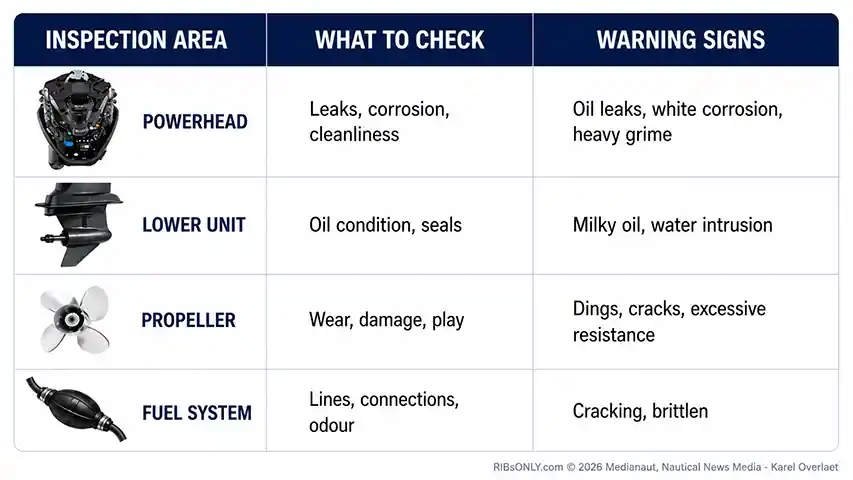
Check for oil leaks, corrosion, or discolouration around the powerhead, cowling, and mounting bracket.
White, chalky corrosion (particularly on aluminium components) suggests prolonged saltwater exposure without adequate flushing or maintenance.
Look inside the cowling for cleanliness; a well-maintained engine is typically reasonably free of built-up grime and debris.
Checking the Lower Unit and Propeller
Inspect the propeller for dings, cracks, or significant wear, all of which affect performance and indicate usage patterns.
Check lower unit oil for a milky appearance, which indicates water intrusion, a potentially serious and costly problem.
Spin the propeller by hand where safely possible, feeling for unusual resistance, grinding, or excessive play.
Starting and Running the Engine
Start the engine cold if possible; a healthy engine should start promptly without excessive cranking or hesitation. Listen for unusual knocking, ticking, or grinding sounds, particularly at idle and during acceleration.
Check that the engine reaches and holds a stable idle without stalling or surging unexpectedly. Monitor smoke colour, since excessive blue or white smoke can indicate internal wear or fuel system issues.
Testing Under Load: The Sea Trial
A stationary test tells you only so much; a proper sea trial reveals how the engine performs under actual load.
Our guide RIB Sea Trial Checklist covers the full range of checks worth performing during an on-water test.
Check acceleration response, ability to reach and hold planing speed, and any hesitation or power loss under load.
Checking Trim and Tilt Function
Test the power trim and tilt mechanism through its full range, checking for smooth, consistent movement without jerking.
Slow or unresponsive trim function can indicate hydraulic fluid issues or a failing trim motor, both repairable but worth noting.
Fuel System Considerations
Check fuel lines, primer bulb, and connections for cracking, brittleness, or fuel odour suggesting leaks. Ethanol-related fuel system degradation is common on engines that have sat with old fuel for extended periods.
A fuel system that’s been neglected may need cleaning or component replacement even on an otherwise sound engine.
Getting a Professional Compression Test
A compression test, performed by a qualified mechanic, provides objective data on internal engine health. Significant variance between cylinders can indicate internal wear that visual inspection alone won’t reveal.
For higher-value purchases, this small additional cost is a worthwhile investment before finalising the deal.
Making a Confident Decision
Combine visual inspection, a cold start test, and a proper sea trial for a well-rounded assessment of engine condition.
For significant purchases, a mechanic’s inspection and compression test add valuable objective confirmation before committing.
Our Buying a Used RIB: Complete Inspection Guide places outboard testing within the full pre-purchase process.
Frequently Asked Questions
How many hours is considered high for a used outboard?
This varies by engine and maintenance quality, but well-maintained engines can reliably exceed 1.000 hours.
Is milky lower unit oil always serious?
It indicates water intrusion, which can cause significant internal damage if left unaddressed, so treat it as a genuine concern.
Can I test an outboard without a sea trial?
A stationary check reveals some issues, but a sea trial under real load is essential for a complete assessment.
Is a compression test necessary for every used outboard purchase?
Not always essential for lower-value engines, but strongly recommended for significant purchases where certainty matters most.
Related reading: What Is a Rigid Inflatable Boat? · How to Choose an Outboard for a RIB · RIB Sea Trial Checklist · How to Inspect a RIB Transom · Buying a Used RIB: Complete Inspection Guide