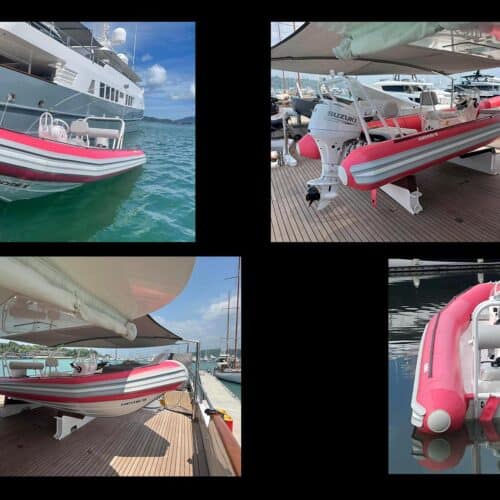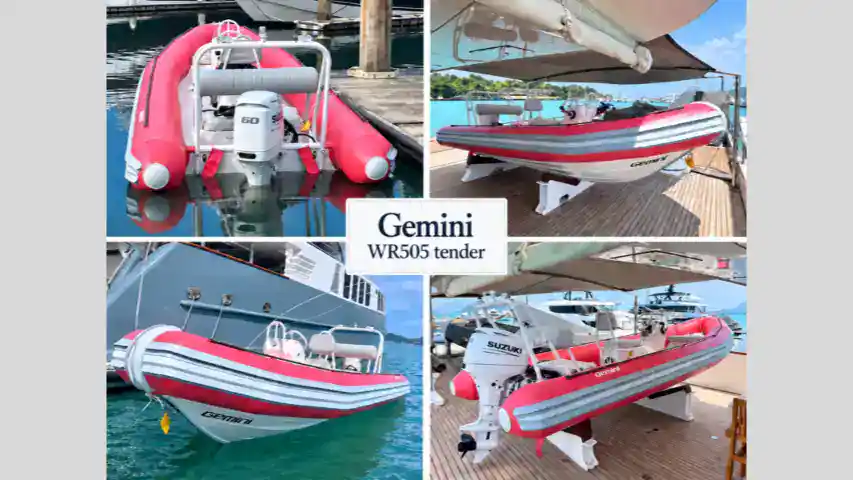
Who picked the colour? – © Gemini Marine
Choosing the Right Tender RIB to Serve a Larger Yacht
A tender RIB serves a different purpose than a standalone leisure boat, and that changes almost every buying decision.
Size, weight, storage method, and folding capability matter more here than they do for most other RIB purchases.
This guide covers what to prioritise when choosing a RIB specifically to serve as a yacht or cruiser tender.
What Makes a Good Tender RIB
A tender’s primary job is safe, practical transport between the mothership and shore, nothing more.
This means compactness, low weight, and easy handling typically matter more than outright performance or comfort.
Durability still matters, since tenders are used frequently and often handled roughly during loading and unloading.
Size and Weight Constraints
Tender size is dictated by the mothership’s davit, garage, or deck storage capacity, not by personal preference.
Check maximum length, beam, and weight limits for your specific storage system before considering any particular model.
Davit-launched tenders typically range from 2.5 to 4 metres, with weight limits often between 150 and 400 kilograms.
Garage-stored tenders may need to fold or deflate partially, depending on available garage dimensions.
Our guide What Size RIB Do I Need? covers sizing principles that apply here too, adapted for storage constraints.
Rigid vs Folding Tenders
Rigid tenders offer better performance and durability but take up fixed space regardless of storage method.
Folding or roll-up tenders trade some rigidity and performance for significantly reduced storage footprint when not in use.
For davit or garage storage with generous space, rigid tenders are generally the stronger long-term choice.
For tight storage or occasional use, a folding design may be the more practical compromise.
Tube Material for Tenders
Tenders spend more time exposed to sun, salt, and abrasion from loading than many leisure RIBs.
Hypalon/CSM is often favoured for tenders in sunny climates, given its superior UV resistance over long service life.
Our guide PVC vs Hypalon/CSM RIB Tubes explains this trade-off in full, including cost and climate considerations.
Engine and Performance for Tenders
Most tenders run smaller outboards, typically between 15 and 60 horsepower, prioritising weight and simplicity over speed.
Lighter four-stroke outboards are common, balancing reasonable performance against the weight limits of davit systems.
Our guide How to Choose an Outboard for a RIB covers outboard selection principles that apply to tenders as well.
Storage and Handling Features
Look for reinforced lifting points rated for your davit system’s specific hardware and weight capacity.
Non-marking fenders or rub strips protect both the tender and the mothership’s hull during loading.
Consider how easily the tender can be washed down and drained after saltwater use, given frequent handling.
Cost Considerations
Tender pricing varies enormously by size, material, and engine, typically ranging from a few thousand to tens of thousands.
Our guide How Much Does a RIB Cost? breaks down the factors driving price across all RIB categories, tenders included.
Factor in davit or garage compatibility costs, since retrofitting storage systems can add significantly to the total.
| Mothership length | Typical tender length | Storage method |
|---|---|---|
| Under 12 m | 2,5 – 3,2 m | Deck chocks or small davit |
| 12 – 18 m | 3,0 – 3,8 m | Davit or garage |
| 18 – 25 m | 3,5 – 4,5 m | Garage or davit |
| 25 m and above | 4,0 m and above | Garage or dedicated tender deck |
Tender RIB sizing by mothership length, purely indicative – © 2026 Medianaut, Nautical News Media
Which Tender Should You Choose?
Choose a rigid tender if your storage system has generous space and performance matters for guest use. Choose a folding tender if storage space is limited or the tender is used only occasionally.
Prioritise weight limits and davit compatibility above all else; a perfect tender that doesn’t fit is no tender at all.
To help you create a reference, watch these videos of many tender brands like Highfield, Northstar, Zodiac, Gemini, Interactor, AB Inflatables … to name a few.
Our RIB Buying Guide: How to Choose the Right Boat covers the broader decision framework alongside tender-specific factors.
Frequently Asked Questions
How heavy can a tender be for davit storage?
This depends entirely on your davit’s rated capacity, typically between 150 and 400 kilograms including engine and fuel.
Is Hypalon worth the extra cost for a tender?
Often yes, given frequent sun exposure and handling. The longer lifespan usually justifies the premium for tender use.
Can a folding tender perform as well as a rigid one?
Generally no. Folding tenders trade some rigidity and speed for significantly reduced storage footprint.
What engine size is typical for a yacht tender?
Most tenders use 15 to 60 horsepower outboards, balancing weight limits against reasonable performance.
Related reading: What Is a Rigid Inflatable Boat? · What Size RIB Do I Need? · PVC vs Hypalon/CSM RIB Tubes · How to Choose an Outboard for a RIB · How Much Does a RIB Cost? · videos of tender brands